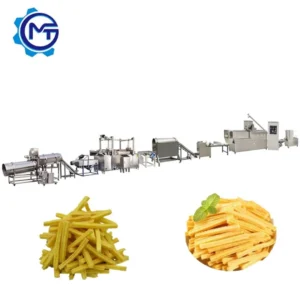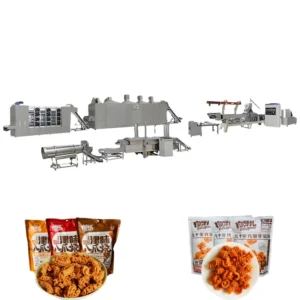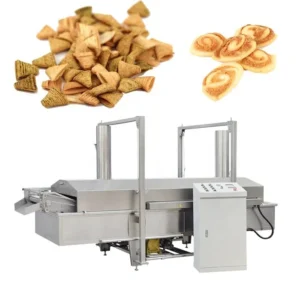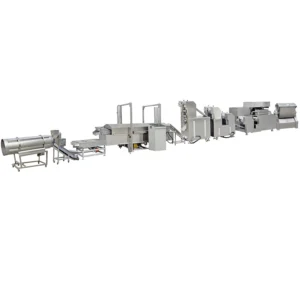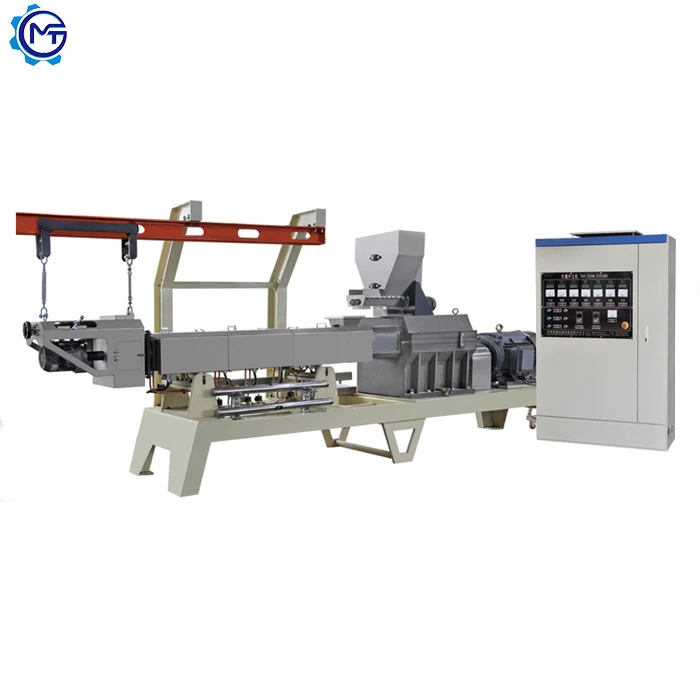
Station-by-station throughput alignment — every mixing, extrusion, frying, and flavoring unit is specified as a matched set so no single station chokes the line.
Technical Specifications
| Parameter | Value |
|---|---|
| Model | MT100/MT120 |
| Product Type | Puffed Snack Extrusion Line (Single Screw) |
| Extruder Type | Single screw extruder |
| Rated Power | 50–70 kW |
| Output Capacity | 120 kg/h (basis not stated in source — confirm raw material, moisture, and product shape) |
| Voltage & Frequency | Three-phase 380 V / 50 Hz; Single-phase 220 V / 50 Hz (configurable to local supply) |
| Energy Source Options | Electricity, gas, diesel, steam |
| Overall Dimensions (L × W × H) | 12 000–26 000 × 1 200 × 2 200 mm |
| Construction Material | Food-grade stainless steel 201 / 304 |
| Screw Configuration | High-pressure and low-pressure screw set |
| Line Stations | Mixing → Extrusion → Cutting → Drying → Frying → Flavoring → Packing |
| Standards | CE, ISO 9001 |
Application Suitability
| Application | Material or Output |
|---|---|
| Grid-pattern crust snacks | Wheat flour, corn starch, potato starch blends |
| Pani puri / golgappa shells | Wheat flour and starch-based dough |
| Vegan salad strips and rice cake strips | Starch-rich formulations for secondary puffing |
| Shaped puffed snacks (screw shell, tube, ring, cartoon) | Corn starch and potato starch with die change |
What "120 kg/h" Leaves Out About Line Capacity
A capacity number without raw material and product shape context is a guess, not a guarantee.
When a puffed snack extrusion line manufacturer quotes a single throughput figure, buyers often assume that rate holds across every product they plan to run. In practice, a dense corn-starch dough pushes through a single-screw barrel differently from a lighter wheat-flour mix, and a thick tube shape demands a different die pressure than a thin grid-pattern sheet. I have watched lines stall at the fryer because the extruder was rated on one shape while the buyer intended to run another, and the cutting station could not keep pace. Before any number is treated as a production target, the raw material recipe and the specific die opening must be locked in and tested. [NEED_CITE: extrusion throughput variation by raw material and die geometry]
Matching Every Station on the Catalogue
The MT100/MT120 line is presented as a full equipment sequence rather than a standalone extruder. Mixing, cutting, drying, frying, flavoring, and packing are each listed as part of the configuration, which means a puffed snack extrusion line manufacturer can be asked to confirm the duty cycle of every station against the same target output. When the dryer belt speed and the fryer basket capacity are both calculated from the extruder’s actual output on the buyer’s recipe, the line runs continuously instead of cycling between idle and backlog.
How Screw Pressure Range Expands the Material Window
The high-pressure and low-pressure screw set on the main extruder gives operators a wider operating envelope. Low-pressure configuration suits softer, high-moisture starch mixes that need gentle conveying, while high-pressure suits denser wheat-flour blends requiring greater shear to gelatinise fully. Switching between the two is a mechanical change on the screw shaft rather than a full barrel swap, so a producer running both grid-crust sheets and tubular shapes can adjust within a single shift without ordering a second extruder. [NEED_CITE: single screw pressure configuration and starch gelatinisation]
Reading the Spec Sheet Against Actual Production Needs
Rated power of 50–70 kW across the full line signals where the main energy draws sit. The extruder motor, dryer heating elements, and fryer heat source together account for the majority of that envelope, so a buyer choosing gas for the fryer and steam for the dryer can shift a meaningful portion of the electrical load to thermal fuel, reducing peak amperage demand on the workshop transformer. Stainless steel 201/304 construction across all stations means wash-down cleaning is feasible without corrosion concerns, which matters in a line that handles oil and seasoning powders daily. The dimension range of 12 000 to 26 000 mm in length reflects how adding or removing optional stations such as a secondary coating drum changes the floor plan, and buyers should measure their available straight-run space before confirming the layout.
The Bottleneck Cost of Unmatched Stations
When the fryer capacity is smaller than the extruder output, product piles up at the cutter and moisture absorption makes the pieces stick together before they enter the oil bath. I have seen this exact mismatch force a two-day shutdown while a larger fryer was sourced locally, and the seasoning drum downstream sat empty the entire time. The downtime cost and the wasted raw material during restarts exceed what a correctly sized fryer would have added to the initial equipment order. [NEED_CITE: production line bottleneck analysis in food processing]
Why Source the Full Line From One Equipment Catalogue
Each station is specified against the others, so the mixing batch size, extruder throughput, dryer belt speed, and flavoring drum volume are calculated from a single capacity model rather than assembled from separate vendor quotes. Screw and die configurations are recorded per product shape, so replacement parts match the original tooling. The in-house testing workshop runs the buyer’s actual raw material before shipment, generating a trial report that shows real output and texture. Voltage and frequency are confirmed per destination market before the control panel is wired. Ongoing maintenance support covers the entire sequence, not just the extruder.
Documentation & Verification
- Line layout showing station-by-station throughput calculation for your target snack shape
- Screw and die configuration record matched to your raw material blend
- Electrical schematic with confirmed voltage, frequency, and panel language
- Factory trial report on your starch or flour formulation before dispatch
- CE declaration of conformity for the complete line assembly
Installation, Commissioning & Support
- Floor space of 12–26 m length and 1.2 m width must be cleared with overhead clearance above 2.2 m
- Three-phase 380 V / 50 Hz dedicated circuit required; confirm local supply before panel wiring
- Line ships in sectional modules; on-site assembly aligns conveyor heights between each station
- First-run commissioning includes screw pressure adjustment and die alignment per product shape
- Operator training covers screw changeover, fryer temperature profiles, and seasoning drum calibration
- Wear parts list identifies high-pressure screws and die plates with reorder part numbers
- Stainless steel 201/304 surfaces require daily wash-down; bearing lubrication follows weekly schedule
What We Need From You to Size the Line
Share the primary raw material blend and moisture content you plan to extrude, the specific snack shapes you want from the die station, and your target daily output so the extruder, dryer, and fryer can be matched accordingly. Confirm your local voltage and frequency, the control panel language preference, and whether any existing upstream or downstream equipment needs to interface with the new line.
Frequently Asked Questions
Q: How is the 120 kg/h output capacity verified, and on which raw material and product shape?
A: That figure is quoted without a stated basis, so it must be confirmed against your specific raw material blend, moisture level, and die shape during a factory trial. We run your actual formulation in the testing workshop and record the measured throughput in the trial report before shipment, so the number you receive reflects your recipe, not a generic benchmark.
Q: What voltage and frequency configurations are available, and how is control panel language confirmed?
A: The line supports three-phase 380 V / 50 Hz and single-phase 220 V / 50 Hz as standard, with other configurations available on request. Control panel language and labeling are confirmed during the specification review stage before the panel is wired, ensuring operators can read all indicators in their working language at commissioning.
Q: Which line stations are included, and how is throughput matched between extruder, dryer, fryer, and flavoring drum?
A: The standard sequence covers mixing, extrusion, cutting, drying, frying, flavoring, and packing. Each station is sized from the same capacity calculation based on your target product shape and raw material, so belt speeds, basket volumes, and drum diameters align to prevent bottlenecks across the full sequence.
Q: What die configurations are available for different snack shapes, and how are they changed?
A: Available die shapes include screw shell, round tube, square tube, ring, and cartoon outlines. Changing the die involves removing the die plate at the extruder barrel end and fitting the replacement, a mechanical swap that does not require barrel disassembly. The screw configuration can be adjusted between high- and low-pressure settings to match the new shape.
Q: What energy sources apply to which stations, and how does that affect total electrical load?
A: Electricity powers the extruder motor and cutting station. The dryer and fryer can be configured for electricity, gas, diesel, or steam, allowing buyers to shift thermal load away from the electrical supply. This flexibility helps facilities with limited transformer capacity manage peak demand across the line.