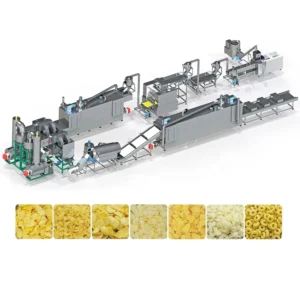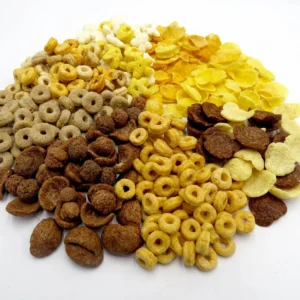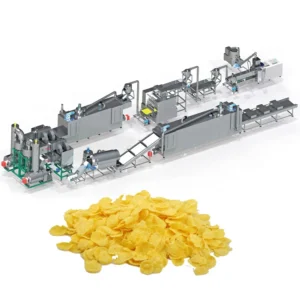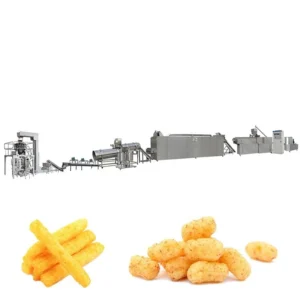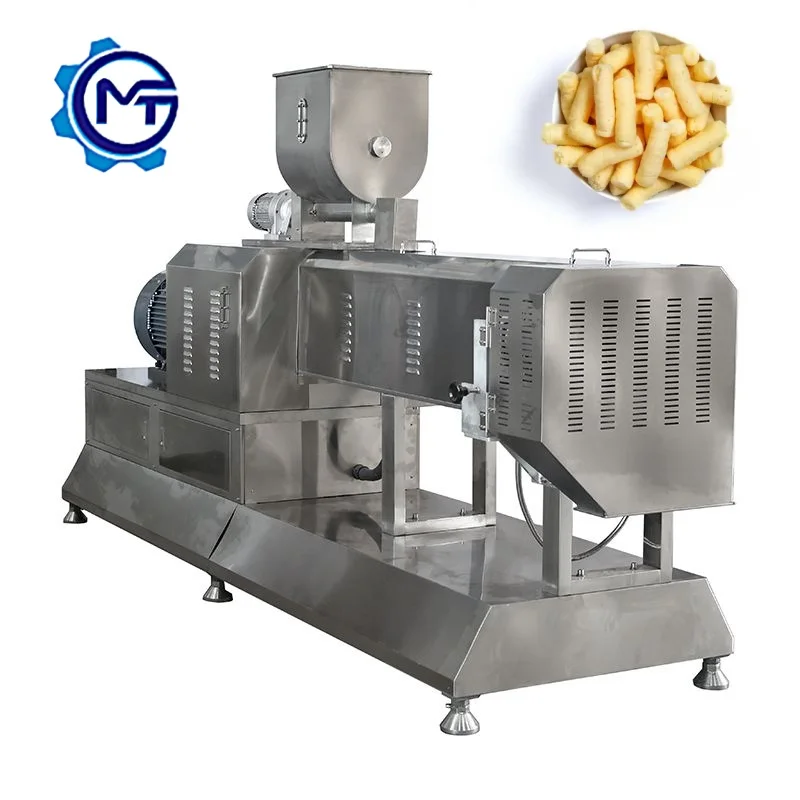
Station-by-station matching — Each mixer, extruder, dryer and flavoring drum is sized against the others so throughput holds steady from batch intake to final packing.
Technical Specifications
| Parameter | Value |
|---|---|
| Product Type | Twin Screw Puffed Snack Food Extrusion Line |
| Extruder Models | MT65 / MT70 / MT85 / MT100 |
| Screw Type | Twin-screw |
| Installed Power | 130 kW (MT65) / 180 kW (MT70) / 220 kW (MT85) / 240 kW (MT100) |
| Real Power Consumption | 95 kW (MT65) / 120 kW (MT70) / 130 kW (MT85) / 160 kW (MT100) |
| Output Capacity | 120-150 kg/hr (MT65) / 200-300 kg/hr (MT70) / 300-500 kg/hr (MT85) / 600-800 kg/hr (MT100) (basis to be confirmed on actual raw material and die) |
| Control System | Frequency speed controlling system (PLC / MCC available upon configuration) |
| Drying Heat Source | Electric / Steam / Gas |
| Lubrication | Automatic lubricating and cooling system |
| Key Features | Interchangeable die system, double drum flavoring line, core filling option, complete turnkey line from batching to packing |
Application Suitability
| Application | Material or Output |
|---|---|
| Corn puffs and cheese balls | Corn flour, rice flour, corn grits |
| Tubes, sticks and rings | Wheat flour, oat flour, barley flour |
| Fruit loops and stars | Mixed grain blends with adjustable moisture |
| Core-filled snacks | Grain outer shell with cream or chocolate filling |
| 2D and 3D pellet shapes | Starch-based formulations for secondary puffing |
Why Extruder-Only Quotes Create Downstream Bottlenecks
A puffed snack food extrusion line full equipment range only delivers its rated output when the dryer, cooler and flavoring drums are scaled to the same throughput.
I have watched buyers sign for an extruder based on a headline capacity figure, then discover the downstream dryer cannot keep up. Product piles up on the conveyor, moisture stays too high, and the flavoring drum gets overloaded. The line runs at a fraction of the extruder’s potential because the stations were never matched. Specifying a puffed snack food extrusion line full equipment range from one catalogue avoids this mismatch [NEED_CITE: throughput balancing principles in continuous food processing lines].
Every Station Sized to the Same Throughput Target
When you survey the puffed snack food extrusion line full equipment range, the first thing to confirm is that each station — batching mixer, twin-screw extruder, dryer, double drum flavoring unit, cooler and packing conveyor — is rated for the same hourly output. A 500 kg/hr extruder feeding a dryer built for 300 kg/hr will force you to run the extruder below its real capacity or face product backlog and inconsistent moisture levels.
Drying Heat Source Matched to Your Utility Reality
The drying station offers electric, steam and gas heat source options. The right choice depends on what is available and economical at your facility. Steam drying ties into an existing boiler and tends to give uniform heat distribution across the belt. Gas firing works where natural gas is piped and cost-effective. Electric heating suits smaller lines or sites without gas infrastructure. Confirming this before the order prevents expensive utility retrofits after the line arrives.
Screw and Die Logic Behind Shape and Texture
The twin-screw extruder uses a configurable screw profile and interchangeable die plates to control product geometry and expansion. Ball, tube, ring, star, wheel, flower and heart shapes all start from the same barrel — the die plate and cutter define the final form. Screw elements are selected based on your raw material formulation: higher fat content requires different shear and compression zones than lean corn grits. Getting this configuration right before the machine ships avoids re-cutting screws on your factory floor.
Power Consumption Versus Installed Motor Rating
Installed power and real consumption are two different numbers. The MT70 model carries 180 kW of installed motor capacity but typically draws around 120 kW during steady-state extrusion. The gap accounts for startup torque, intermittent load spikes and safety headroom. Basing your electrical panel design on real consumption rather than installed power keeps cable sizing and breaker selection closer to actual operating conditions [NEED_CITE: industrial motor sizing and continuous duty rating standards].
What Happens When the Flavoring Drum Is Undersized
An undersized flavoring drum means product tumbles through too quickly for even coating. Sugar or seasoning clumps on some pieces while others pass through bare. On a line producing cheese balls or sugar-coasted fruit loops, uneven coating shows up directly on the shelf. The double drum system with sugar melting and spraying nozzle is matched to extruder output so residence time in each drum is sufficient for full coverage.
Why the Whole Line Belongs Under One Specification
Ordering extruder, dryer and flavoring stations from separate vendors puts the burden of throughput matching on you. When every station in the puffed snack food extrusion line full equipment range comes from one supplier with a shared layout document, belt widths, conveyor speeds and transfer heights are designed together. This avoids the field modifications that eat into commissioning schedules.
Documentation & Verification
- Line layout and capacity calculation confirming matched throughput across all stations
- Machine specification sheet with voltage, frequency and control language for each unit
- Screw and die configuration record tied to your raw material and target shape
- Factory test record and trial run report on your actual raw material before shipment
- CE declaration of conformity and ISO certificate for the complete line
Installation, Commissioning & Support
- Foundation plan accounts for extruder weight and vibration isolation at full motor load
- Electrical panel sized for real consumption of the selected extruder model with dedicated circuits
- Drying station connected to confirmed heat source — electric, steam or gas — with utility hookups pre-planned
- Screw and die configuration validated during on-site commissioning with your raw material batch
- Operator training covers die changeover, screw element inspection and automatic lubrication system maintenance
- Wear parts list provided with lead times for screws, dies and spray nozzles
What to Prepare Before Requesting a Quote
To size the line correctly, share your primary raw material and its fat and moisture content, the product shapes you plan to run, and your target hourly output. Confirm the voltage, frequency and phase available at your facility, along with preferred control language. If you already have upstream batching or downstream packing equipment, provide their throughput ratings so the new stations integrate without creating a new bottleneck.
Frequently Asked Questions
Q: How do I choose between the MT65, MT70, MT85 and MT100 extruder models?
A: The choice depends on your target output and raw material. Each model covers a different capacity range, but the actual throughput depends on your formulation, moisture level and die configuration. Share your production target and material details so the extruder is selected on verified output, not just the model number.
Q: What supporting stations are included and how is throughput matched?
A: The line covers batching, extruding, drying, double drum flavoring, cooling and packing. Each station is sized so its capacity aligns with the extruder output. A shared layout document confirms belt speeds, transfer points and residence times, preventing one station from becoming a bottleneck that drags down the whole line.
Q: Can I add core filling or upgrade individual machines on an existing layout?
A: Yes. The core filling machine and cutting unit integrate into the extrusion station. Individual machines such as a higher-capacity dryer or a different flavoring drum can also be specified separately. Provide your current line throughput so the new equipment is matched to what you already run.
Q: How are capacity figures verified before the line ships?
A: Capacity is confirmed through a trial run using your actual raw material in the testing workshop. The trial run report documents real output, product shape, expansion and moisture content under the selected screw and die configuration, giving you verified numbers rather than generic estimates.
Q: What voltage and control options are available for each machine?
A: Voltage, frequency and control language are confirmed during the specification stage to match your facility’s electrical supply and operator requirements. This confirmation is documented before production begins, so the machines arrive ready to connect without field rewiring or control panel modifications.