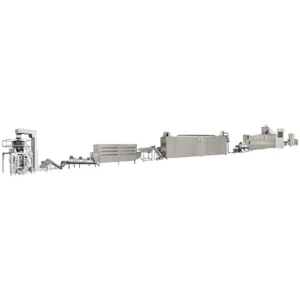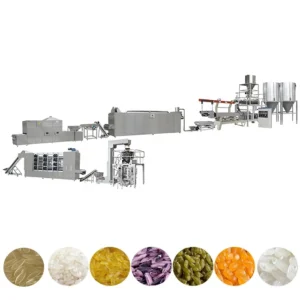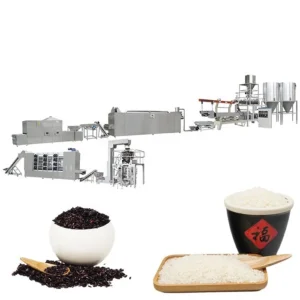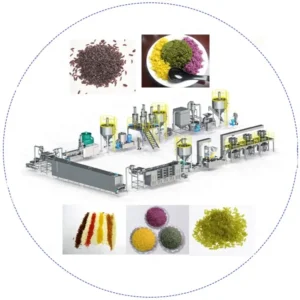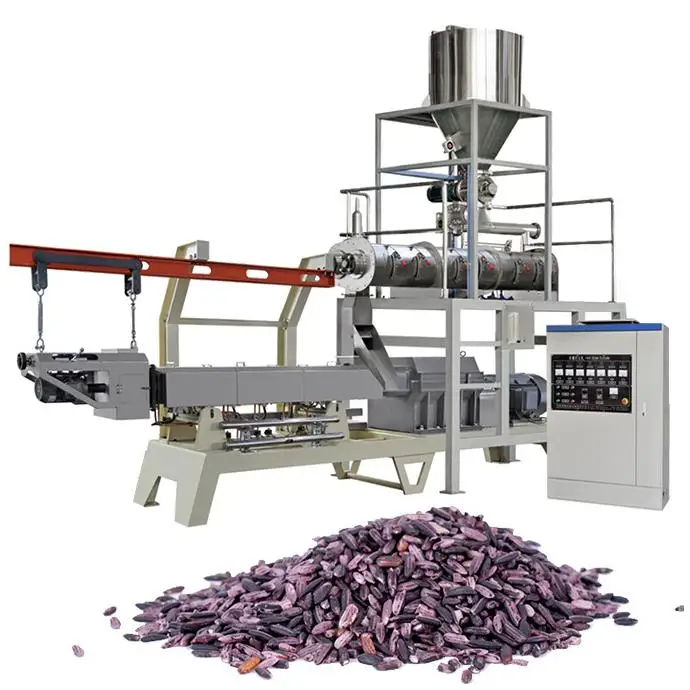
Matched Throughput Stations — Every station on this artificial rice processing equipment for sale, from batching through extrusion to packing, is sized to hold the same rated output so no single unit bottlenecks the line.
Technical Specifications
| Parameter | Value |
|---|---|
| Product Type | Nutritional Fortified Rice Extrusion Production Line |
| Models Available | MT65 / MT70 / MT85 / MT75 / MT95 |
| Screw Type | Twin-screw |
| Installed Power | 85 kW (MT65) / 120 kW (MT70) / 235 kW (MT85) / 180 kW (MT75) / 260 kW (MT95) |
| Power Consumption | 60 kW (MT65) / 85 kW (MT70) / 165 kW (MT85) / 135 kW (MT75) / 195 kW (MT95) |
| Output Capacity | 80–100 kg/h (MT65) / 100–120 kg/h (MT70) / 200–300 kg/h (MT85) / 300–500 kg/h (MT75) / 800–1000 kg/h (MT95) (basis not stated in source — confirm raw material formulation and moisture content) |
| Overall Dimensions (L×W×H) | 28×1.2×2.2 m (MT65) / 30×1.5×2.2 m (MT70) / 34×3.5×4.3 m (MT85) / 32×3.5×4.3 m (MT75) / 36×3.5×4.3 m (MT95) |
| Control System | Frequency speed control with high automation |
| Feeding System | Single or double screw feeding, selectable per material |
| Barrel & Screw Material | Wear-resistant screw with special treatment |
| Lubrication & Cooling | Automatic lubricating and cooling system |
| Drying Oven Heating Source | Electric or gas |
| Drying Method | Circulation drying, mesh belt speed controlled by frequency motor |
| Line Stations | Mixing → Extruding → Vibrating → Low Temperature Drying → Cooling → High Temperature Roasting → Cooling → Packing |
| Standards | CE certified, ISO certified |
Application Suitability
| Application | Material or Output |
|---|---|
| Nutritionally fortified rice kernels | Broken rice, rice bran, and cereal blends with added vitamins and minerals |
| Artificial rice manufacturing | Rice flour and starch base with micro-nutrient fortification |
| Purple sweet potato reconstituted rice | Purple sweet potato powder blended with rice and specialty grains |
| Infant and nutritional formula rice | Pre-cooked starch and grain blends for food aid programmes |
| Health food staple enhancement | Millet, buckwheat, oats, and bean formulations for functional food markets |
Why the Trial Run Matters More Than the Nameplate Capacity
A capacity figure on a spec sheet means nothing if the line was never tested on the formulation you actually plan to run.
Many buyers discover only after installation that a fortified rice extrusion production line quoted at a certain throughput cannot sustain that rate once their specific blend of broken rice, purple sweet potato, and micronutrient premix enters the barrel. The gelatinisation temperature shifts, the die pressure changes, and the output drops. That gap between nameplate promise and shop-floor reality is the single largest source of commissioning delays in starch-based extrusion projects [NEED_CITE: common causes of extrusion line commissioning delays].
Feeding Stability and Screw Configuration for Starch-Rich Blends
The selectable single or double screw feeding system allows operators to match the feeder to the flow characteristics of their raw material. Fine rice flour and sticky sweet potato powder behave very differently in a hopper; one may flood-feed while the other bridges. Choosing the correct feeder prevents surging that would otherwise disrupt the twin-screw extrusion process and produce inconsistent kernel density.
Drying Profile Control Across the Full Line
The circulation drying oven uses a frequency-controlled mesh belt to adjust residence time, while the heating source is configurable between electric and gas. For a fortified rice extrusion production line, low-temperature drying followed by high-temperature roasting sets the final moisture content and surface texture of each kernel. This two-stage approach prevents case-hardening on the outside while leaving the centre under-dried, a defect that causes cracking during storage [NEED_CITE: drying defects in extruded rice kernels].
What the Power and Dimension Figures Mean for Your Floor Plan
Installed power ranges from 85 kW on the MT65 to 260 kW on the MT95, with actual consumption running roughly 70–75 % of installed capacity due to the automatic lubricating and cooling system cycling intermittently. Line length stretches from 28 m to 36 m, and the larger models (MT85, MT75, MT95) require a ceiling clearance of at least 4.3 m. Before ordering, confirm that your workshop’s main bus bar can carry the peak draw and that overhead crane height allows maintenance access to the extruder barrel.
The Cost of Skipping the Configuration Step
When a line is assembled from generic station sizes rather than matched to a specific rice-starch formulation, the extruder may reach its target throughput while the dryer falls behind, forcing the operator to slow the entire line down. Wear parts such as screws and dies wear unevenly if the material abrasiveness was not factored into the configuration, leading to unplanned shutdowns within the first production campaign [NEED_CITE: wear patterns in twin-screw extrusion of mineral-fortified starch]. These issues compound into lost production days that no nameplate rating can predict.
Why Procurement Here Reduces Integration Risk
Complete lines from batching to packing are supplied under one responsibility, so throughput is matched across every station rather than assembled from separate vendors. Screw configuration and die design are specified to the buyer’s raw material and target product shape, not copied from a generic build. An in-house testing workshop runs the customer’s actual formulation before shipment, locking in process parameters. Twin-screw expertise spans pet food, aquatic feed, snacks, cereals, starch, and protein applications, meaning the engineering team has seen a wide range of starch gelatinisation behaviours. Pre-sales consultation covers line layout, utility planning, and on-site commissioning through to operator training.
Documentation & Verification
- Line layout drawing showing throughput calculation at every station
- Screw and die configuration record matched to your rice formulation
- Trial run report on your raw material produced before dispatch
- Electrical schematic with confirmed voltage and frequency for your market
- Factory test record documenting run-in under load
- CE declaration of conformity and ISO certificate on file
Installation, Commissioning & Support
- Foundation must carry the MT85’s 34 m footprint and 4.3 m headroom requirement
- Dedicated circuit sized to the model’s installed power, up to 260 kW for the MT95
- Frequency-controlled drives require stable supply; confirm local voltage and hertz before wiring
- First-run parameter setting includes barrel temperature profile and mesh belt speed tuning
- Operator training covers feeder selection, die changes, and automatic lubrication checks
- Wear parts list supplied with the line for screw and die replacement scheduling
Before You Send the Inquiry
Share your primary raw material blend, including the percentage of broken rice, starch, and any minor ingredients like purple sweet potato or mineral premix. Provide your target daily output in finished kilograms, your workshop length and ceiling height, and the local voltage and frequency standard. If you have existing upstream milling or downstream packing equipment, list those units so the line can be designed to integrate rather than duplicate.
Frequently Asked Questions
Q: How is the output capacity of each model verified?
A: Each model’s kg/h figure is a range that depends on raw material formulation, moisture content, and target kernel density. Before quotation, we request your specific blend and run it in the testing workshop to confirm the actual sustainable throughput, then record those parameters in the trial run report.
Q: What voltage and frequency options are available?
A: The control system and drive motors are configured to your local electrical standard before production begins. You will receive an electrical schematic for review and approval, covering voltage, frequency, and control language, so the line is ready for connection on arrival.
Q: How do I choose between the MT65, MT70, MT75, MT85, and MT95?
A: Selection depends on your target output and the physical constraints of your facility. We map your required throughput against the verified capacity of each model on your specific raw material, then cross-check that the line length and ceiling height fit your workshop before recommending a configuration.
Q: Can the line layout be customised to my factory footprint?
A: Yes. A detailed line layout and capacity calculation document is prepared during the proposal stage, showing every station’s position, utility connection points, and operator walkways. The layout is adjusted to your building dimensions before the order is finalised.
Q: What does after-sale support include once the line is running?
A: Support covers on-site installation supervision, commissioning, operator training on the frequency-controlled drives and automatic lubrication system, and a wear parts list for ongoing screw and die replacement. Remote troubleshooting is available for process parameter questions after the initial start-up period.