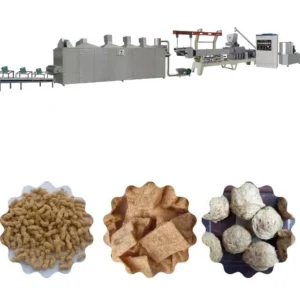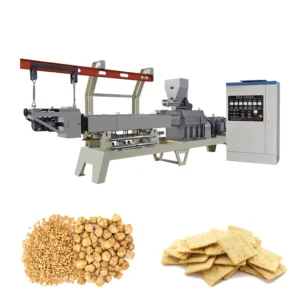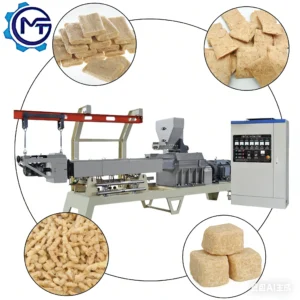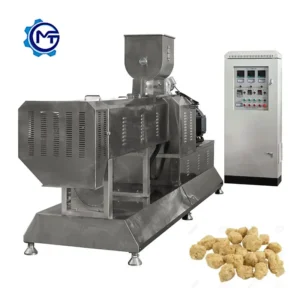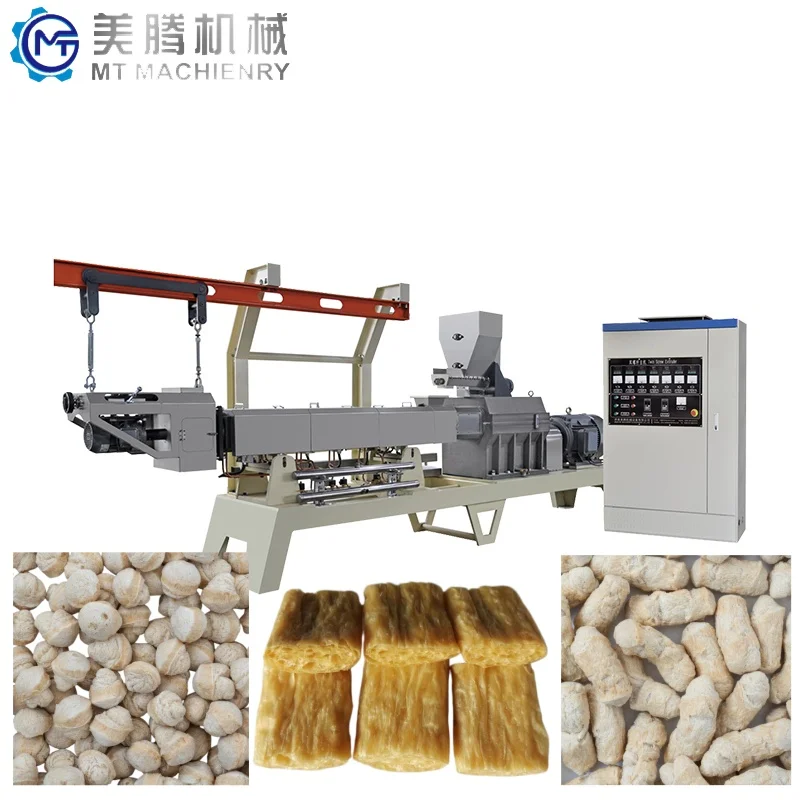
Matched Throughput Across Stations — We size the mixer, extruder, dryer, and cooler to your specific soybean meal formulation and target fiber structure, preventing the bottlenecks that occur when machines are quoted as standalone units rather than a coordinated system.
Technical Specifications
| Parameter | Value |
|---|---|
| Model | MT65 / MT70 / MT85 |
| Product Type | Textured Soy Protein Extrusion Line |
| Screw Configuration | Twin-screw (configuration matched to raw material) |
| Installed Power | MT65: 85kW; MT70: 120kW; MT85: 195kW |
| Actual Power Consumption | MT65: 65kW; MT70: 90kW; MT85: 165kW |
| Output Capacity | MT65: 150–200 kg/h; MT70: 200–300 kg/h; MT85: 600–800 kg/h (basis not stated in source — confirm raw material formulation / moisture) |
| Mixer Tank Volume | 150 kg |
| Mixer Rotary Speed | 385 rpm |
| Dryer Belt Effective Length | 3.5 m |
| Dryer Heating System | 3.9 kW × 24 (far infrared) |
| Cooling Machine Temperature Range | 0–260°C |
| Construction Material | Stainless steel (food-contact areas) |
| Control System | PLC and MCC (voltage configurable, language confirmed pre-build) |
| Certification | CE / ISO compliant manufacturing |
Application Suitability
| Application | Material or Output |
|---|---|
| Textured Soy Protein (TSP) / TVP production | Low-temperature soybean meal, standard defatted soybean meal |
| Plant-based meat and vegetarian meat ingredients | Peanut meal, soy protein isolate blends |
| Meat extender for ham, sausage, and canned food | High-fiber structured protein chunks and shreds |
| Quick-frozen food and fast food fillings | Rehydratable protein granules and fibrous strips |
Why "Nominal Capacity" Fails on Low-Temperature Soybean Meal
An extruder rated for 300 kg/h on standard meal will often deliver half that output on low-temperature soybean meal if the screw configuration is not adjusted for the different protein denaturation behaviour.
I have seen textured soy protein production line equipment manufacturer quotations that promise a specific hourly tonnage based on a generic test, only for the buyer to discover during commissioning that their actual raw material produces broken fibers and excessive fines. The extruder runs, but the downstream dryer sits idle waiting for material, or worse, the product fails the tensile strength test required by the end customer. Sourcing a textured soy protein production line equipment manufacturer requires confirming that the capacity figure is tied to your exact meal specification [NEED_CITE: protein solubility index and extrusion shear requirements].
Matching Shear and Temperature to Protein Solubility
The twin-screw extrusion process for plant-based meat relies on thermomechanical treatment to unfold and realign protein molecules into a fibrous network. Low-temperature soybean meal retains a higher protein solubility index than standard defatted meal, meaning it requires a different shear profile and barrel temperature gradient to achieve the same degree of texturization. A screw configuration designed for one will produce under-texturized, weak-fiber output from the other, which is why we require a raw material sample before finalizing the screw element arrangement and die geometry for any textured soy protein production line equipment manufacturer order.
Balancing Moisture, Residence Time, and Die Pressure
Achieving a consistent fiber structure demands precise control over moisture addition at the mixer, residence time within the barrel, and pressure at the die face. If the dryer capacity is undersized relative to the extruder output, moisture remains trapped in the protein matrix, leading to microbial spoilage during storage or a spongy texture upon rehydration. Conversely, an oversized dryer wastes energy and can over-brittle the product, creating excess dust during packing. We calculate the thermal load for each station based on the specific moisture content entering and leaving the extruder, ensuring the textured soy protein production line equipment manufacturer delivers a line where every component runs at its design point [NEED_CITE: thermal load calculation methodology for protein extrusion lines].
Reading the Spec Sheet: L/D Ratio, Motor Load, and Dryer Length
The screw length-to-diameter (L/D) ratio determines how long the material is subjected to shear and heat; a higher L/D allows for more gradual protein unfolding, which is critical for producing long-fiber structured meat analogues. The installed motor power versus actual power draw indicates the headroom available for processing high-viscosity protein doughs without stalling. The dryer belt effective length and heater bank configuration dictate the residence time under controlled temperature — a 3.5-meter belt with far infrared heating provides a different drying curve than a shorter belt with convective hot air. Understanding these relationships allows a buyer to compare quotations on engineering merit rather than just the final price figure.
The Hidden Cost of Unmatched Line Stations
When the mixer output exceeds the extruder intake capacity, material sits in the hopper, losing moisture and forming lumps that cause surging at the die. When the cooler cannot handle the dryer discharge rate, product temperature remains elevated during packing, leading to condensation inside the bag and reduced shelf life. These mismatches do not appear on a quotation that lists each machine’s nominal capacity in isolation. They surface weeks after installation as chronic downtime, inconsistent product quality, and operator frustration [NEED_CITE: causes of throughput bottlenecking in multi-stage food processing lines].
Why Source This Line Through Meiteng
- Complete line from batching to packing under one supplier, so throughput is calculated across every station rather than assembled from separate vendor quotes.
- Screw configuration and die design specified to the buyer’s actual raw material sample and target fiber structure, not copied from a generic build.
- In-house testing workshop allows trial runs on the customer’s soybean meal or peanut meal before shipment, validating output and texture.
- Twin-screw expertise spanning pet food, aquatic feed, snacks, cereals, and texturized protein applications, informing screw element selection.
- Pre-sales consultation through engineer design, on-site installation, commissioning, and ongoing maintenance support from the same technical team.
Documentation & Verification
- Line layout and capacity calculation confirming throughput matching across mixer, extruder, dryer, and cooler.
- Screw and die configuration record specified to buyer’s raw material sample and target product texture.
- Electrical schematic with voltage and frequency confirmation for the buyer’s target market grid standard.
- Trial run report on customer’s raw material performed in the in-house testing workshop before shipment.
- CE declaration of conformity and ISO certificate for the complete line, not individual components.
Installation, Commissioning & Support
- Overall dimensions (up to 24000×3500×4300 mm for MT85) require confirmed floor space and overhead clearance before foundation work.
- Installed power up to 195 kW necessitates dedicated circuit and transformer sizing confirmed via electrical schematic.
- Line ships in modular sections; on-site assembly includes mechanical alignment, belt tensioning, and electrical termination.
- First-run commissioning verifies PLC logic, MCC interlocks, and temperature profiles against the trial run report baseline.
- Operator training covers screw element replacement, die cleaning, dryer belt tracking, and daily sanitation procedures.
- Wear parts list identifies screws, dies, and dryer belts with lead times for first replacement order.
What We Need to Configure Your Line
To provide an accurate line layout and quotation, we require the specific type of raw material (low-temperature soybean meal, standard defatted meal, or peanut meal) along with a sample for testing. Please confirm your target daily output, available workshop floor area and ceiling height, and the local voltage and frequency standard. If you have existing upstream or downstream equipment that must integrate with the new line, provide the interface specifications. Let us know if a trial run on your raw material is required before the line ships.
Frequently Asked Questions
Q: How is output capacity verified and what raw material formulation is it based on?
A: Output capacity figures are determined during a trial run using the buyer’s actual raw material sample in our testing workshop. The final quotation specifies the confirmed capacity based on that specific formulation and moisture content, rather than a generic nominal rating.
Q: How are screw configuration and die design matched to my specific raw material?
A: We analyze the protein solubility index, particle size, and fiber content of your soybean meal or peanut meal sample. The screw element arrangement and die aperture geometry are then specified to achieve the target fiber structure and density for your end product.
Q: What voltage, frequency, and control language will the line support for my factory?
A: Voltage and frequency are confirmed during the quotation stage based on your local grid standard. The PLC and MCC control system is programmed with the operator language of your choice, and the electrical schematic reflects all confirmed specifications before production begins.
Q: Can I run a trial with my own raw material before the line ships?
A: Yes. We conduct trial runs in our in-house testing workshop using the buyer’s raw material sample. The trial run report documents output capacity, product texture, and machine settings, which are then replicated during on-site commissioning.
Q: How is throughput balanced between the extruder, dryer, and cooling stations?
A: We calculate the mass and thermal load at each station based on the confirmed extruder output and moisture content. The dryer belt length, heater capacity, and cooler airflow are sized to handle the extruder discharge rate without creating a bottleneck or energy waste.