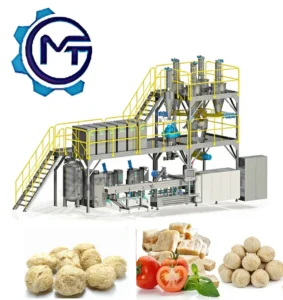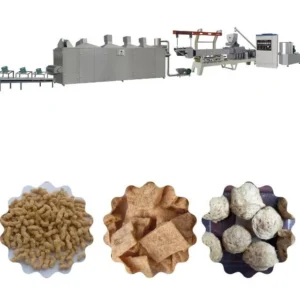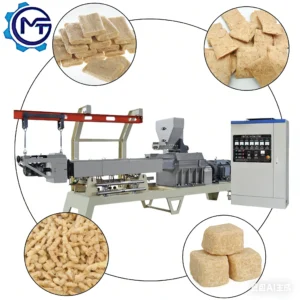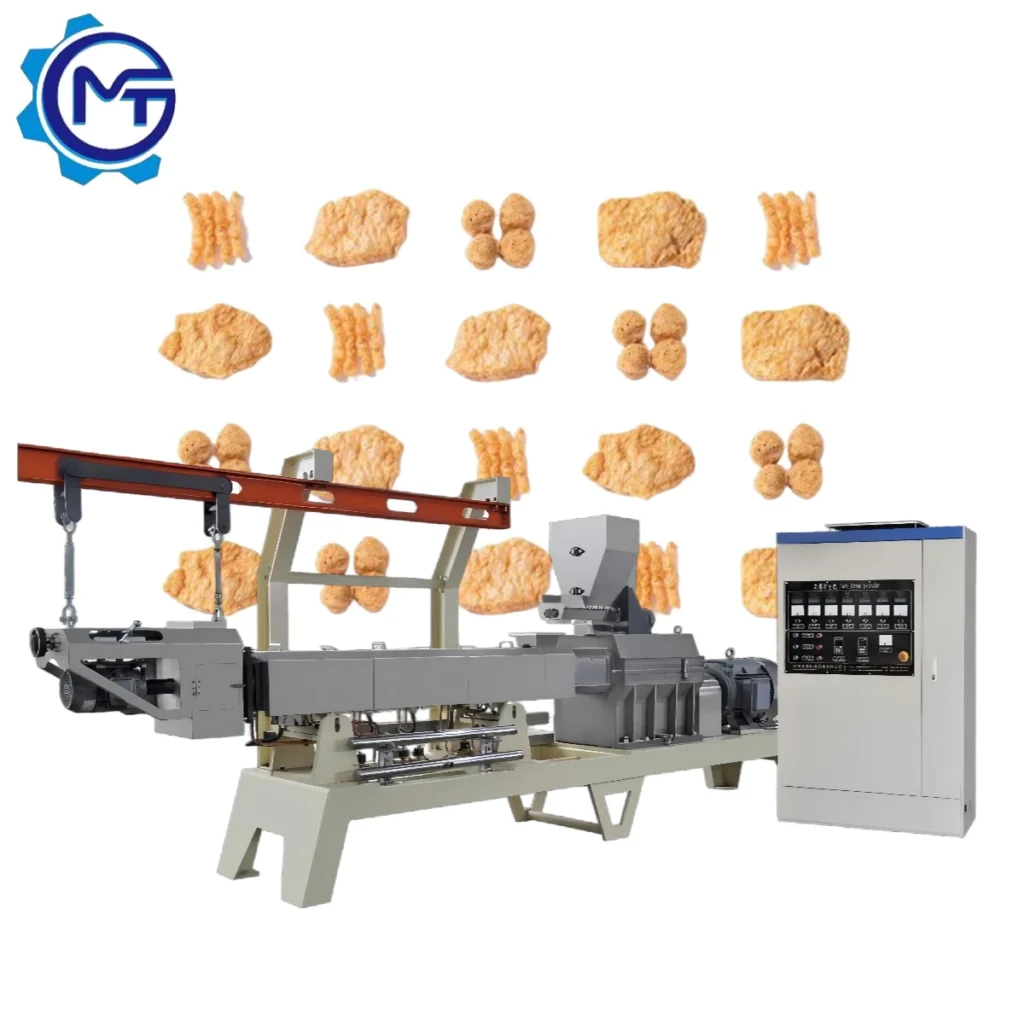
Integrated Station Capacity — every mixing, extrusion, and drying unit in the line is throughput-balanced so no single station bottlenecks your textured soy protein output.
Technical Specifications
| Parameter | Value |
|---|---|
| Product Type | Textured Soy Protein Production Line |
| Extrusion Type | Twin-screw (basis not stated in source — confirm screw diameter / L:D ratio / barrel zones) |
| Control System | PLC intelligent control |
| Output Capacity | Basis not stated in source — confirm kg/h based on specific raw material formulation and moisture content |
| Raw Material Compatibility | Soy protein and other plant protein sources (confirm full range with supplier) |
| Line Stations | Basis not stated in source — confirm mixing, extrusion, drying, cooling, cutting, packing stations included |
| Voltage & Frequency | Basis not stated in source — confirm target market electrical standard |
| Assembly State | Basis not stated in source — confirm skid-mounted or modular layout |
| Standards | CE and ISO availability to be verified with manufacturer |
Application Suitability
| Application | Material or Output |
|---|---|
| Vegetarian meat nugget manufacturing | Soy protein isolate or concentrate blended with starch and fiber |
| Plant-based patty and strip production | Textured soy protein rehydrated and formed into target shapes |
| Fortified food service protein portions | Blended soy and cereal protein formulations |
| Retail-ready plant-based meat alternatives | Multi-ingredient protein blends processed into consumer formats |
What "Rated Capacity" Leaves Out About Your Protein Line
A line rated on one protein blend will behave differently on yours.
When buyers evaluate a textured soy protein production line manufacturer, the first number they see is hourly output. But plant protein extrusion is sensitive to raw material variables that shift the real throughput noticeably. Protein content, particle size, fat residue, and moisture all change how the material moves through the barrel and expands at the die. I have watched a line that ran cleanly on standard defatted soy flour produce loose, sponge-like chunks when the buyer’s local soy concentrate had a different protein-to-starch ratio. The extruder ran, but the texture was wrong, and two weeks of commissioning vanished into parameter adjustment. [NEED_CITE: raw material variability in plant protein extrusion processing]
How Each Station in the Line Fits Together
The complete machine catalogue for a textured soy protein production line starts well before the extruder. A mixing and batching station meters protein powder, starch, and moisture into a consistent feed — without that upstream stability, no downstream twin-screw configuration can hold a steady fiber texture. The extruder itself develops the meat-like laminar structure through shear, heat, and die pressure. From there, a dryer removes surface and internal moisture to lock in the fibrous bite, and a cooler brings product temperature down before cutting or packing. Each station must be sized so the extruder never waits on the dryer or overfeeds the cooler.
Why the Full Equipment Range Matters More Than the Extruder Spec
Buyers often spend most of their evaluation time on screw diameter and motor power, then treat the supporting stations as commodity add-ons. The reality on a plant-based meat line is that mismatched downstream capacity causes more production headaches than the extruder itself. An undersized dryer forces the extruder to slow down, cutting actual output well below the rated figure. An undersized cooler sends warm product into packing, where condensation creates spoilage risk. Specifying the complete line from one supplier keeps throughput matched across every station rather than assembled from separate vendors who each guarantee only their own unit. [NEED_CITE: throughput balancing across extrusion line stations]
Reading the Specs That Actually Shape Your Product
Twin-screw extrusion is chosen here over single-screw because plant protein powders vary in flow behavior and require the self-wiping, high-shear mixing that intermeshing screws provide. The screw configuration — the sequence of conveying, kneading, and reverse elements inside the barrel — determines how much mechanical energy goes into aligning protein molecules into fibers versus simply gelatinizing starch. The L:D ratio governs residence time; a longer barrel gives more zones for staged heating and moisture injection, which is critical when developing layered meat-like texture. Die design controls the final expansion ratio and cross-section shape, and must be matched to the specific protein formulation rather than copied from a generic build. The PLC control system stores parameter sets for each product format, so switching between nugget and strip production means recalling a saved recipe rather than manually resetting temperatures and screw speeds from scratch.
The Hidden Cost of an Unmatched Line Configuration
When supporting stations are sourced separately, each vendor sizes their unit to their own nominal capacity, not to your extruder’s actual output on your specific protein blend. The result is a line where one station is always the constraint. Buyers discover this only after installation, when the dryer cannot keep pace and half-finished product piles up on the floor, or the flavoring drum cannot coat fast enough and batches sit waiting. These mismatches are not solved by turning a dial — they require capital upgrades or permanent throughput loss. [NEED_CITE: downstream bottleneck effects in extrusion production lines]
Why Buyers Source the Full Range Here
Every station from protein blending through packing is supplied under one line configuration, so throughput figures are calculated against the same raw material basis rather than assembled from independent vendor claims. Screw and die configurations are specified to your soy protein formulation and target nugget density, not copied from a generic catalog build. The in-house testing workshop runs trial production on your actual raw material before shipment, so fiber texture and expansion are verified before the line leaves the factory. PLC and MCC control packages are built with your facility voltage and operator language confirmed in advance. Documentation covers the full line — layout, capacity calculation, screw record, electrical schematic, and trial run report — so your installation team has one reference package instead of six separate vendor manuals.
Documentation & Verification
- Line layout drawing showing every station with individual throughput figures for your protein formulation
- Screw and die configuration record matched to your soy protein isolate and target nugget texture
- Factory trial run report on your raw material conducted before shipment
- Electrical schematic with voltage, frequency, and PLC language confirmed to your facility standard
- CE declaration of conformity and ISO certificate covering the complete production line
- Operation and maintenance manual with wear parts list for extruder screws, barrel liners, and dies
Installation, Commissioning & Support
- Foundation and floor space plan reflecting the full line footprint including mixer, extruder, dryer, and cooler stations
- Dedicated electrical circuit sizing based on confirmed twin-screw motor power and dryer heating load
- Modular station delivery with on-site assembly sequence planned to match your facility access constraints
- First-run commissioning with screw speed, barrel temperature, and die pressure set to your protein formulation
- Operator training on PLC interface covering recipe storage, parameter adjustment, and alarm response
- Wear parts inventory recommendation for screws, dies, and barrel segments based on your production schedule
What to Share With Your Inquiry
To size every station correctly, the supplier needs your specific protein source and formulation — soy isolate, concentrate, or a blend with pea or wheat protein — along with your target product format such as nuggets, strips, or patties. Provide your daily or shift-based production target so throughput can be calculated on your actual recipe rather than a generic basis. Confirm your facility voltage, frequency, and preferred PLC language so the control system ships ready for your operators. If you plan to run multiple product formats on one line, list each one so screw and die options are included from the start.
Frequently Asked Questions
Q: Which supporting stations are included and how is throughput matched?
A: The line covers mixing, twin-screw extrusion, drying, cooling, cutting, and packing. Each station is sized against the extruder’s actual output on your protein formulation so no unit becomes a bottleneck. Capacity calculations are documented per station in the line layout before order confirmation.
Q: Can the line process protein sources beyond soy?
A: Yes, the twin-screw platform handles pea protein, wheat gluten, and blended formulations. Screw configuration, barrel temperature profile, and die design are adjusted to each protein source’s flow and expansion behavior. Confirm your full ingredient range during the inquiry so trial runs cover every blend you plan to produce.
Q: How are screw and die configurations selected for my target texture?
A: The screw profile — conveying, kneading, and reverse element sequence — is specified based on your protein content and desired fiber density. Die geometry controls expansion ratio and cross-section shape. Both are documented in the configuration record and validated during the pre-shipment trial run on your raw material.
Q: Is a pre-shipment trial run on my raw material available?
A: Yes. The testing workshop runs your actual protein formulation through the extruder and supporting stations before shipment. The trial run report covers output texture, expansion ratio, moisture content, and parameter settings, giving you verified baseline recipes before installation begins.
Q: What PLC language and HMI options are available?
A: The PLC interface can be configured in the operator language you specify. The HMI displays barrel zone temperatures, screw speed, feed rate, and alarm states. Recipe storage allows your team to switch between product formats without manually resetting parameters each time.