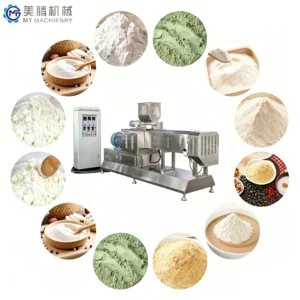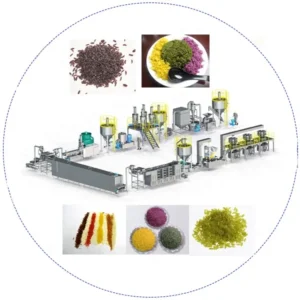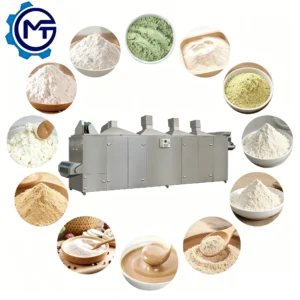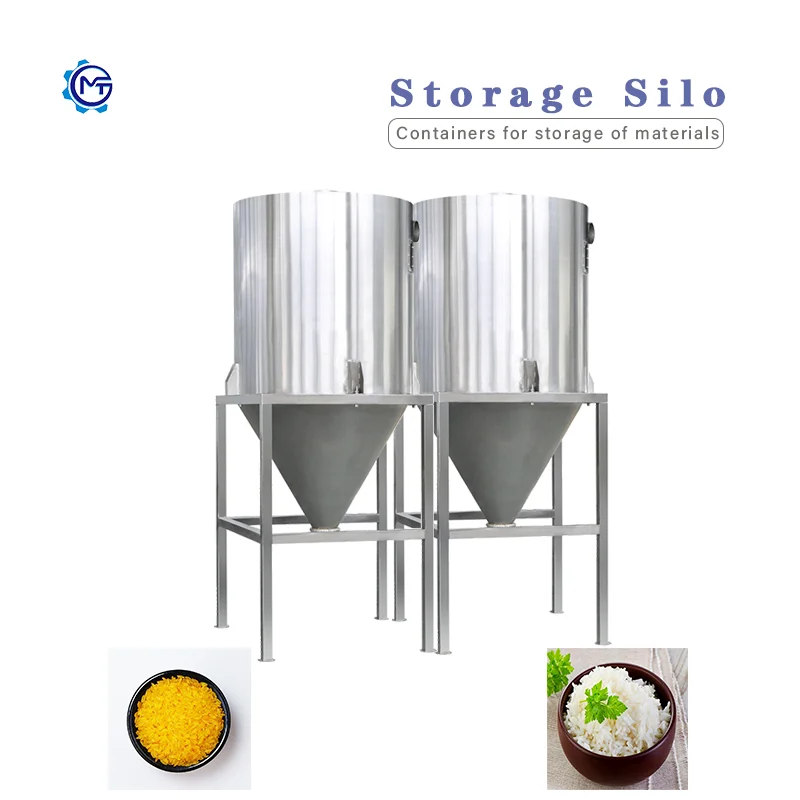
Line-Wide Equipment Matching — every station from mixing to packing is specified to the same throughput target, so no single machine chokes the output of an entire artificial rice production line equipment setup.
Technical Specifications
| Parameter | Value |
|---|---|
| Product Type | Twin Screw Extruder Artificial Rice Production Line |
| Models Available | MT65, MT70, MT85, MT75, MT95 |
| Screw Type | Twin-screw (single or double screw feeding system available based on material) |
| Installed Power | 85 kW (MT65) / 120 kW (MT70) / 235 kW (MT85) / 180 kW (MT75) / 260 kW (MT95) |
| Power Consumption | 60 kW (MT65) / 85 kW (MT70) / 165 kW (MT85) / 135 kW (MT75) / 195 kW (MT95) |
| Output Capacity | 80–100 kg/h (MT65, basis to be confirmed) / 100–120 kg/h (MT70, basis to be confirmed) / 200–300 kg/h (MT85, basis to be confirmed) / 300–500 kg/h (MT75, basis to be confirmed) / 800–1000 kg/h (MT95, basis to be confirmed) |
| Overall Dimensions (L×W×H) | 28×1.2×2.2 m (MT65) / 30×1.5×2.2 m (MT70) / 34×3.5×4.3 m (MT85) / 32×3.5×4.3 m (MT75) / 36×3.5×4.3 m (MT95) |
| Control System | Frequency speed control, high automation |
| Screw Material | Special wear-resistant technology |
| Lubrication & Cooling | Automatic lubricating and cooling system |
| Heating System | Integrated heating system for extrusion barrel zones |
| Dryer Heating Source | Electric or gas |
| Dryer Feature | Circulation drying process, frequency motor-controlled mesh belt speed |
| Voltage & Frequency | Customized to customer local voltage |
| Certifications | CE, ISO |
Application Suitability
| Application | Material or Output |
|---|---|
| Fortified rice kernel production | Broken rice and rice bran base with added vitamins and minerals |
| Artificial rice from alternative grains | Corn, millet, wheat, oats, buckwheat as primary ingredients |
| Nutritional grain reconstitution | Starch-based formulations with micro-nutrient supplementation |
| Institutional nutrition programmes | Standardized fortified rice kernels for large-scale distribution |
What "Capacity Rated at 80–1000 kg/h" Actually Depends On
Output numbers on an artificial rice production line equipment sheet only hold when raw material, moisture content, and recipe are locked in.
Buyers regularly compare extruder models by the headline throughput figure, then discover after installation that their actual recipe — perhaps a high-fiber broken rice blend with added calcium carbonate — behaves differently inside the barrel than the test material did. The twin-screw extrusion process is sensitive to starch content, particle size, and feed moisture, all of which shift the real output window. [NEED_CITE: influence of raw material moisture on twin-screw extruder throughput] Without a trial run on your specific formulation before shipment, the rated capacity remains a reference point rather than a guarantee.
How Each Station Fits the Extrusion Core
The MT series fortified rice extruder machine lineup covers five capacity tiers, but the extruder alone does not define line performance. Mixing must deliver a homogeneous blend before material reaches the hopper; vibrating conveyors must spread product evenly onto the dryer belt; and the cooling stage must bring kernel temperature down before packing to prevent condensation in sealed bags. Every station in this artificial rice production line equipment range is sized relative to the extruder output so that material flow remains continuous.
Why Dryer Configuration Matters as Much as the Extruder
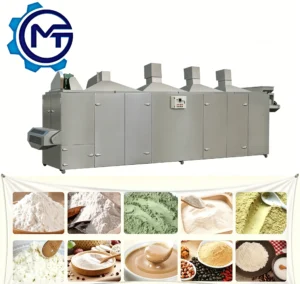
Low-temperature drying followed by high-temperature roasting is the sequence that gives artificial rice kernels their structural integrity and cooking behavior. The circulation drying oven uses a frequency motor-controlled mesh belt, allowing dwell time adjustment without stopping the line. If the dryer is undersized relative to extruder output, kernels exit with residual moisture that causes cracking during storage. [NEED_CITE: moisture equilibrium requirements for extruded grain products before packing] Electric or gas heating can be specified based on facility utility availability, and the choice affects both operating cost and temperature ramp speed.
Reading the Specification Sheet Beyond Horsepower
Installed power ranges from 85 kW on the MT65 to 260 kW on the MT95, but actual power consumption sits lower — 60 kW to 195 kW respectively — because heating zones cycle and motors rarely run at full load simultaneously. The twin-screw design with automatic lubricating and cooling keeps barrel temperatures stable across long production runs, which matters for kernel density consistency. The wear-resistant screw material extends intervals between replacements, reducing unplanned downtime. Frequency speed control on the main drive and dryer belt allows fine-tuning without mechanical gearbox changes, giving operators a practical way to adjust to recipe variations mid-shift.
The Hidden Cost of Undersized Supporting Equipment
When an extruder is purchased without matching dryer or cooler capacity, the bottleneck appears weeks after commissioning. Operators slow the extruder feed rate to let the dryer catch up, which means the line never reaches the throughput the buyer paid for. [NEED_CITE: line bottleneck effects when extruder output exceeds downstream drying capacity] Vibrating conveyors that spread unevenly cause some kernels to over-dry while others retain moisture, leading to inconsistent cooking performance that buyers notice at the retail level. These are not extruder failures — they are system design failures that a full-equipment catalogue approach prevents.
Why Source the Entire Line from One Equipment Supplier
Complete line coverage from mixing through packing means throughput calculations account for every transfer point, not just the extruder barrel. Screw configuration and die design are specified to your raw material — broken rice, corn, or multigrain blends — rather than copied from a generic build. The in-house testing workshop runs your actual recipe before shipment, producing a trial run report that confirms kernel shape, density, and cooking behavior. Electrical schematics arrive with voltage and frequency already confirmed for your facility, avoiding commissioning delays. Wear parts lists ship with the line, so screw and die replacements are identified before the first changeover is needed.
Documentation & Verification
- Line layout drawing with capacity calculation matched to your grain formulation
- Screw and die configuration record specific to your kernel shape target
- Trial run report on your raw material confirming output and product quality
- Electrical schematic with voltage and frequency locked to your facility standard
- CE declaration of conformity and ISO certificate for import clearance
- Operation and maintenance manual with wear parts replacement schedule
Installation, Commissioning & Support
- Foundation plan accounts for the MT95 line length of 36 m and dryer weight distribution
- Dedicated circuit sizing based on the confirmed installed power of your selected model
- Field assembly sequence planned around the 3.5 m width clearance requirement
- First-run parameter setting covers barrel zone temperatures and mesh belt speed calibration
- Operator training addresses frequency drive adjustment for recipe changes
- Wear parts list with reorder part numbers for screws, dies, and barrel liners
What to Include in Your Inquiry
Specify your primary grain material and any supplementary ingredients, along with the target kernel size and cooking characteristics your market expects. Provide your local voltage and frequency, workshop length and ceiling height, and whether gas or electric dryer heating suits your utility setup. If you have existing upstream milling or downstream packing equipment, note the interface requirements so the line layout accounts for connection points.
Frequently Asked Questions
Q: How is output capacity verified for each model, and what assumptions apply?
A: Published capacities for MT65 through MT95 are reference ranges. Actual throughput depends on your raw material composition, feed moisture, and kernel density target. A trial run on your specific formulation in the testing workshop confirms the realistic output before the line ships, so the capacity you plan around is based on your recipe, not a generic test.
Q: How do I select the right extruder model for my production target?
A: Start with your daily output requirement and the number of operating hours you plan. The five model tiers span different throughput windows. Beyond the extruder itself, the matching dryer length, cooler capacity, and packing speed must all align. The line layout proposal calculates throughput at every station to prevent bottlenecks.
Q: What determines whether single-screw or twin-screw feeding suits my material?
A: Materials with uniform particle size and free-flowing characteristics typically work with single-screw feeding. Blends containing fibrous components, high-moisture additives, or sticky supplementary ingredients benefit from twin-screw feeding, which provides positive displacement and prevents bridging in the hopper. The choice is confirmed during the pre-shipment trial run.
Q: Which dryer heating source should I specify — electric or gas?
A: Electric heating offers precise zone temperature control and simpler installation where gas supply infrastructure is limited. Gas heating typically reduces operating cost in regions with affordable natural gas and supports faster temperature ramp-up for the high-temperature roasting stage. The decision depends on your facility utilities and local energy pricing.
Q: What spare wear parts are included, and how are replacements handled?
A: Each line ships with a wear parts list identifying screws, dies, and barrel liners specific to your configuration. Replacement components are manufactured to the same wear-resistant specification. Keeping the original configuration record ensures that reorder parts match the screw profile and die geometry your recipe was tuned for.