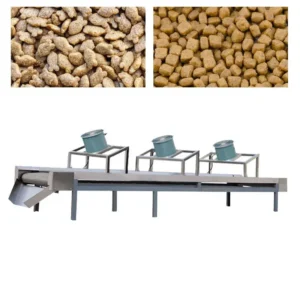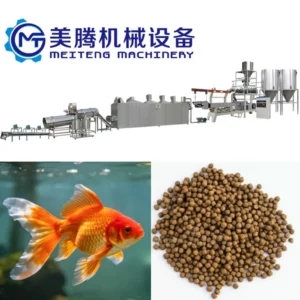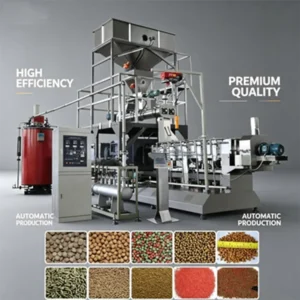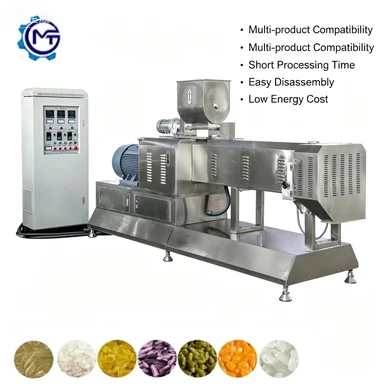
Integrated station alignment — Every feeding, mixing, extruding, and pelletizing station is catalogued together so throughput bottlenecks surface before the line is built, not after installation.
Technical Specifications
| Parameter | Value |
|---|---|
| Product Type | Twin Screw Aquatic Fish Feed Extrusion Line |
| Screw Configuration | Twin screw, configuration matched to raw material formulation and target pellet density |
| Pellet Diameter Range | 0.5 mm to 12 mm |
| Output Capacity | 500 kg/h (basis not stated in source — confirm raw material formulation, moisture content and pellet diameter) |
| Main Structure Material | Stainless steel (contact and main structural parts) |
| Control System | Simple control panel (PLC / MCC options available upon confirmation) |
| Automation Level | Fully automatic, continuous production capable |
| Line Stations Included | Feeding, mixing, extruding, pelletizing |
| Certifications | CE, ISO (certificate numbers available with documentation package) |
Application Suitability
| Application | Material or Output |
|---|---|
| Floating catfish feed production | Corn flour, soybean meal, fish meal, rice bran at adjusted moisture for low-density pellets |
| Sinking tilapia feed processing | Grain-based formulations with higher protein inclusion, conditioned for dense pellet output |
| Shrimp feed pellet extrusion | Fine-particle aquatic feed blends requiring 0.5–2 mm pellet diameter with slow water stability |
| Multi-species aquaculture feed | Variable formulations across growth stages, pellet size adjusted from fry to adult specifications |
Why the Dryer Question Matters Before You Commit to an Extruder
An extruder without a matched dryer and coating station is a bottleneck waiting to happen.
I have watched aquaculture feed producers invest in a twin-screw aquatic fish feed extruder full equipment range only to discover that the downstream dryer could not keep pace. Pellets piled up wet, starch retrograded unevenly, and the coating drum sat idle half the shift [NEED_CITE: throughput mismatch between extruder and dryer stations in feed lines]. The twin-screw aquatic fish feed extruder full equipment range listed here shows every station side by side — feeding, mixing, extruding, and pelletizing — so you can verify that each link in the chain carries the same throughput rating before a single machine is fabricated.
Station-by-Station Equipment Visibility
Browsing the twin-screw aquatic fish feed extruder full equipment range means you see the feeder, the ribbon mixer, the twin-screw extruder barrel assembly, and the pelletizing cutter as individual catalogue entries. Each station carries its own specification sheet, so a technical buyer can cross-reference motor ratings, contact materials, and footprint dimensions independently before assembling a line proposal. This visibility prevents the common situation where an extruder is ordered on nominal capacity while the downstream stations remain unspecified.
Throughput Matching Across the Line
Every station in this aquatic feed processing catalogue must pass the same kilogram-per-hour figure under the buyer’s actual raw material conditions. A twin-screw extruder rated at a given output on a standard corn formulation may deliver less on a high-fiber, high-protein aquatic blend. Reviewing the full equipment range lets you flag that discrepancy early, request a revised capacity calculation, and adjust dryer belt length or coating drum volume before the order is locked [NEED_CITE: raw material effect on extruder throughput in aquatic feed production].
Pellet Diameter and Screw Configuration Range
The 0.5 mm to 12 mm pellet diameter range covers fry feed through adult grow-out pellets for most warm-water aquaculture species. Achieving the correct diameter depends on die plate selection and screw element arrangement — forwarding elements for gentle conveying, kneading blocks for shear-intensive gelatinisation, and reverse elements for residence time control. The catalogue shows which die and screw options pair with each extruder frame, so a producer switching between floating catfish feed and sinking shrimp feed can confirm that one machine covers both targets.
Stainless Steel Construction for Feed-Grade Hygiene
Stainless steel contact surfaces resist the corrosion caused by fish meal salts, mineral premixes, and the high-moisture conditions inside an extruder barrel. Daily wash-down between formulation changes becomes straightforward when screws, barrel liners, and die holders are all food-grade stainless. For producers exporting to markets with strict feed safety audits, material traceability documents are available as part of the documentation package.
Reading the Specifications That Actually Matter
The twin-screw configuration gives processors a wider operating window than single-screw designs when handling the diverse raw materials common in aquatic feed — high-fat fish meal, fine-particle shrimp premix, and sticky starch binders all behave differently under shear. The L:D ratio of the barrel determines how long material stays in the cooking zone; a longer ratio allows more complete starch gelatinisation at lower barrel temperatures, which matters when heat-sensitive vitamin premixes are part of the formulation. Die plate hole diameter and open-area percentage set the extrusion pressure, which directly controls whether a pellet floats or sinks. Moisture injection — whether steam preconditioning or liquid addition at the feeder — shifts the expansion rate at the die face, meaning two identical formulations can produce opposite buoyancy results depending on how moisture is managed [NEED_CITE: relationship between moisture content and pellet buoyancy in extruded aquatic feed].
The Cost of Skipping Station Alignment
When a dryer is undersized relative to extruder output, pellets exit the belt with residual moisture above safe storage limits. Mold develops inside sealed bags within weeks, and an entire production run becomes unsaleable. When a coating drum is too small, fat and palatant application is uneven — some pellets are over-coated and greasy while others lack the attractant profile that the target species expects [NEED_CITE: post-extrusion coating uniformity and feed acceptance in aquaculture]. These failures are not extruder problems; they are line-integration problems that a full equipment range view is designed to catch before the purchase order is signed.
Why Source the Full Range from One Supplier
Sourcing every station from a single equipment catalogue means throughput calculations are performed on the complete chain, not pasted together from separate vendor quotes. Screw configurations and die designs are specified against the buyer’s raw material sample, not copied from a generic build. An in-house testing workshop allows trial runs on customer-supplied formulations before any station leaves the factory, so pellet density, buoyancy, and diameter are verified in advance. Pre-sales consultation covers line layout and utility planning, and on-site installation includes commissioning every station as a coordinated system rather than as isolated machines.
Documentation & Verification
- Line layout and capacity calculation showing throughput at each station for your formulation
- Machine specification sheet with screw type, barrel zones, and die configuration for target pellet
- Screw and die configuration record matched to your raw material and density requirement
- Electrical schematic with voltage, frequency, and control language confirmed for your market
- Trial run report produced on your raw material sample before shipment
- Factory test record documenting run parameters and pellet quality measurements
Installation, Commissioning & Support
- Foundation and floor space plan generated from the actual station footprint and total line length
- Dedicated power circuit specification based on the combined motor ratings of extruder and dryer
- Station-by-station assembly sequence so extruder, dryer, and coating drum are aligned on first install
- First-run parameter setting on your raw material with an engineer adjusting screw speed and barrel temperature
- Operator training covering die change procedures across the 0.5–12 mm pellet range
- Wear parts list identifying screws, barrel liners, and dies with stocking recommendations
What to Include with Your Inquiry
Send your raw material formulation with moisture content and particle size, the target pellet diameter and buoyancy requirement, and your daily production target in kilograms. Include the local voltage and frequency standard along with the preferred control panel language. If you have existing upstream or downstream equipment — a hammer mill, a silo system, or a bagging line — share those specifications so the new stations integrate without modification. Requesting a trial run on your material before shipment is strongly recommended.
Frequently Asked Questions
Q: What supporting stations are available to match this extruder’s throughput?
A: The catalogue includes dryers, coolers, fat-coating drums, and packing stations sized to the extruder’s confirmed output. Each station is listed with its own capacity rating so you can verify throughput alignment across the entire line before ordering.
Q: How is the screw configuration selected for floating versus sinking aquatic feed?
A: Screw elements are arranged based on your raw material and target pellet density. Kneading block placement, compression ratio, and die selection are adjusted so the extrusion pressure and starch gelatinisation level produce the correct buoyancy for your species.
Q: What voltage and control panel options are available for different export markets?
A: Motor ratings, heater elements, and control panels are configured to the buyer’s local voltage, frequency, and language requirements. These details are confirmed before production so commissioning proceeds without electrical rework on site.
Q: Can the line be expanded with additional stations after initial installation?
A: Yes. Because each station is catalogued individually with documented throughput ratings, additional dryers, coating drums, or packing lines can be integrated later as long as capacity calculations are updated to match the new configuration.
Q: What spare wear parts are stocked and what is the typical lead time?
A: Screws, barrel liners, and die plates are the primary wear items. A recommended spare parts list is provided with each order, and typical replacement lead times depend on the specific screw diameter and die configuration selected for your line.