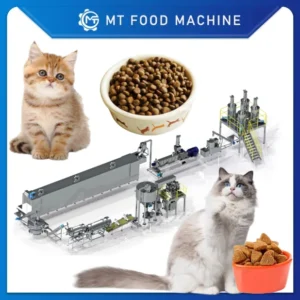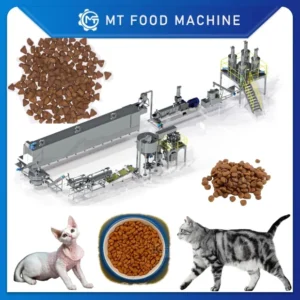
Complete Line Matching — Every station from batching through packing is sized to the same throughput target, so the extruder never waits on a dryer or a coating drum.
Technical Specifications
| Parameter | Value |
|---|---|
| Product Type | Twin Screw Pet Food Extrusion Production Line |
| Screw Type | Twin Screw |
| Applications | Dry pet food (dog and cat), aquatic feed (fish), grain-based extruded feed |
| Output Capacity | Up to 3 tons per hour (basis not stated in source — confirm raw material, moisture content and pellet size) |
| Warranty | 1-year warranty |
| Control System | Available with PLC or MCC control (configuration to be confirmed) |
| Rated Power | To be confirmed based on line configuration |
| Voltage & Frequency | Configurable to buyer’s local supply (to be confirmed) |
| Process Documentation | Process drawing included for aquatic feed line variant |
Application Suitability
| Application | Material or Output |
|---|---|
| Dry kibble production | Corn, wheat, rice, meat meal, bone meal blends for dog and cat food |
| Floating fish feed | Soybean meal, fish meal, starch binders for tilapia and catfish pellets |
| Sinking aquatic feed | High-protein formulations for shrimp and bottom-feeding species |
| Grain-based extruded feed | Corn grits, barley, sorghum for livestock and poultry supplements |
Why the Dryer Matters More Than the Extruder Motor
An undersized dryer will cut your actual output in half no matter what the nameplate says.
When I was on an installation last year for a kibble producer, their line was quoted on a nominal extruder capacity, but the dryer they received had half the belt area needed for the moisture load coming off the die. The extruder could push product, but the dryer became the choke point. Pellets came out sticky, clumped in the cooling conveyor, and the whole line had to be run well below spec just to get saleable product. [NEED_CITE: moisture removal rates in multi-pass belt dryers for extruded pet food]
This is the reason a pet food making machine for sale should always be evaluated as a matched system. The extruder barrel, the dryer passes, the flavouring drum dwell time, and the cooling conveyor length all have to agree on the same hourly throughput. If any single station is short, the buyer absorbs the loss.
How the Twin Screw Platform Handles Variable Formulations
A twin screw configuration gives the operator control over shear, residence time, and mixing intensity inside the barrel. For a pet food making machine for sale targeting both high-meat kibble and starch-heavy aquatic pellets, this adjustability is what keeps the line viable across recipe changes. Screw elements can be rearranged — conveying sections, kneading blocks, reverse-flight segments — to match the viscosity and gelatinisation behaviour of each formulation.
When a buyer switches from a corn-dominant dog food recipe to a high-protein cat food with fresh meat inclusion, the barrel temperature profile and screw speed need to shift accordingly. A single-screw extruder would typically require a full barrel swap or accept a compromise in texture. The twin screw platform absorbs that variation through configuration rather than hardware replacement.
Barrel Zones, Die Geometry, and the Expansion Question
The number of independent heating zones along the barrel determines how precisely the operator can stage gelatinisation. Fewer zones mean broader temperature swings between the feed section and the metering section, which shows up as inconsistent pellet density at the die face. [NEED_CITE: barrel zone count and temperature uniformity in food extrusion]
Die geometry — the number of orifices, their diameter, and the land length — directly governs the expansion ratio of the extrudate as it exits into ambient pressure. A short land length on a high-moisture recipe produces a fragile, over-expanded pellet that breaks during conveying. A longer land on a dry starch recipe can choke the die and spike motor amperage. Matching die design to the specific raw material blend is what separates a line that runs on day one from one that needs weeks of trial and error.
Reading the Spec Sheet Against Your Actual Raw Material
The L:D ratio and screw diameter define the mechanical work available per kilogram of material passing through the barrel. A higher L:D ratio gives longer residence time, which benefits recipes that need thorough starch gelatinisation or protein texturisation. For a simple corn-based kibble, an excessively long barrel wastes energy and increases wear on the screw flights without improving product quality.
Motor power must be evaluated against the toughest recipe in the buyer’s range, not the easiest. A line that runs comfortably on pure corn grits may stall or trip the overload when the formulation shifts to a high-fat, high-protein blend with greater viscous resistance. The voltage and frequency confirmation is equally practical: a motor wound for 380 V / 50 Hz running on a 440 V / 60 Hz supply will overspeed, altering the shear profile and potentially damaging the gearbox. [NEED_CITE: motor nameplate voltage and frequency mismatches in exported machinery]
The Cost of Skipping the Pre-Shipment Trial
I have watched lines arrive on site with a screw and die configuration that was copied from a generic build, producing pellets that sank when the market expected them to float. The buyer then spends weeks adjusting moisture, barrel temperatures, and cutting speed just to get something sellable, burning raw material and labour the entire time. A pre-shipment trial on the buyer’s actual formulation catches these mismatches while the machine is still in the factory, where screw elements and die plates can be swapped in hours rather than weeks.
Voltage mismatches create a different kind of delay. If the control panel is wired for a supply that does not match the buyer’s facility, the entire commissioning schedule stalls while transformers are sourced or panels are rewired. [NEED_CITE: commissioning delays caused by unconfirmed voltage and frequency in export machinery]
What a Matched Equipment Catalogue Actually Covers
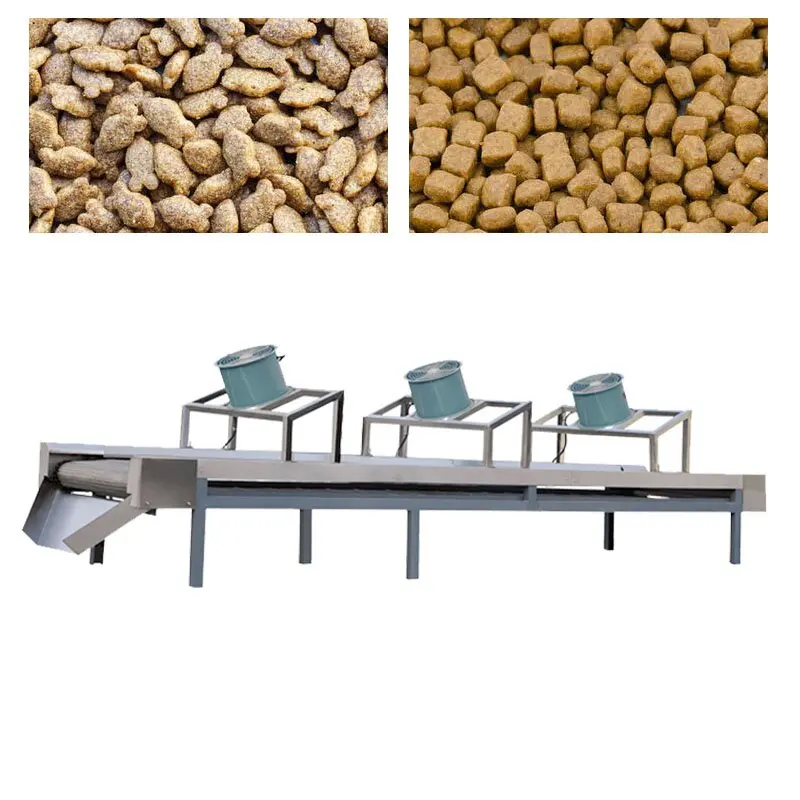
A twin screw extruder sitting alone on a factory floor does not make pet food. The full line requires a batching and mixing system upstream that delivers a uniform blend at a consistent feed rate. Downstream, a multi-pass dryer must have enough belt area and airflow to pull the moisture from the extruded pellets down to a shelf-stable level. A flavouring drum with adjustable dwell time applies fats and palatants evenly. A cooling conveyor stabilises the pellets before they enter the packing station.
Each of these stations has to be specified against the same throughput figure. When the line is sourced from multiple vendors, the risk is that each supplier sizes their equipment to a nominal number without knowing what the others are delivering. A single-supplier catalogue approach means the dryer belt width, the drum diameter, and the conveyor length are all calculated from the same extruder output, removing the bottleneck before it reaches the factory floor.
Documentation & Verification
- Line layout drawing showing station placement and throughput balance for your target kibble or pellet size
- Screw and die configuration record matched to your specific raw material blend and desired density
- Electrical schematic with confirmed voltage, frequency, and control language for your facility
- Factory test report on your raw material before dispatch, including pellet sample photographs
- Wear parts list identifying screw elements, die plates, and seals with replacement intervals
Installation, Commissioning & Support
- Foundation plan accounting for extruder weight and dryer length in your available floor space
- Dedicated circuit specification matching the confirmed motor power and voltage of your line configuration
- Modular shipment with reassembly sequence documented for the extruder barrel and dryer sections
- First-run parameter logging on your raw material to establish baseline screw speed and temperature profiles
- Operator training covering screw element swaps, die changes, and control panel navigation
- Spare screw flights and die plates shipped with the line so first replacement does not halt production
Before You Request a Quote
To size this line correctly, share the raw material formulations you plan to run, including protein and moisture ranges, along with the pellet dimensions and density your market expects. Confirm your facility’s available voltage, frequency, and the floor space allocated for the full line from mixer to packer. If you have existing upstream or downstream equipment that needs to interface with the extruder, include those specifications so the throughput matching accounts for the full system.
Frequently Asked Questions
Q: What supporting stations are included and how is throughput matched across the line?
A: The line covers mixing, extrusion, drying, flavouring, cooling, and packing. Each station is sized against the same confirmed output target so no single section creates a bottleneck. The dryer belt area, drum volume, and conveyor length are all calculated from the extruder throughput on your specific raw material and pellet size.
Q: How is the twin screw configuration and die design selected for my raw material?
A: Screw elements are arranged based on your formulation’s viscosity, moisture content, and target expansion. Die orifice count and land length are matched to the pellet density your market requires. A pre-shipment trial on your raw material validates the configuration before the line leaves the factory.
Q: What voltage, frequency, and control language options are available for my market?
A: The motor and control panel are configured to your facility’s supply before production begins. PLC or MCC control is available, and the HMI language is set to your operator preference. Confirming these details at the quotation stage prevents commissioning delays on site.
Q: Is a trial run on my raw material available before shipment?
A: Yes. Raw material samples are run through the extruder in the testing workshop before dispatch. The trial confirms pellet shape, density, expansion, and colour against your specification. Any screw or die adjustments needed are completed before the machine is packed for shipment.
Q: What wear parts are included and how are spares supplied after installation?
A: The initial shipment includes spare screw elements, die plates, and seals identified on the wear parts list. Replacement parts are manufactured to the same configuration record, ensuring interchangeability. Lead times for standard wear components are confirmed at the time of order.