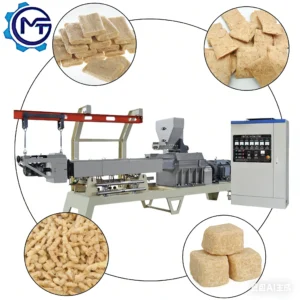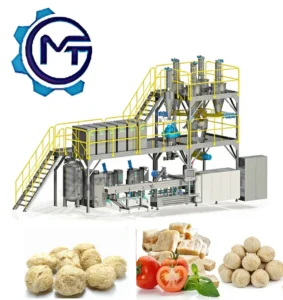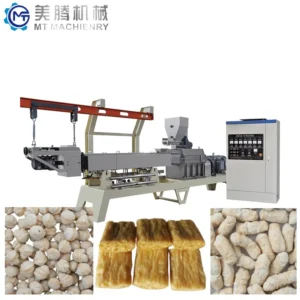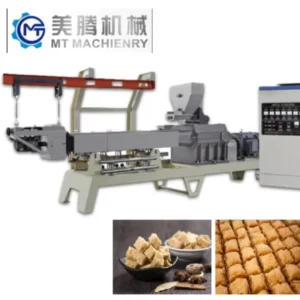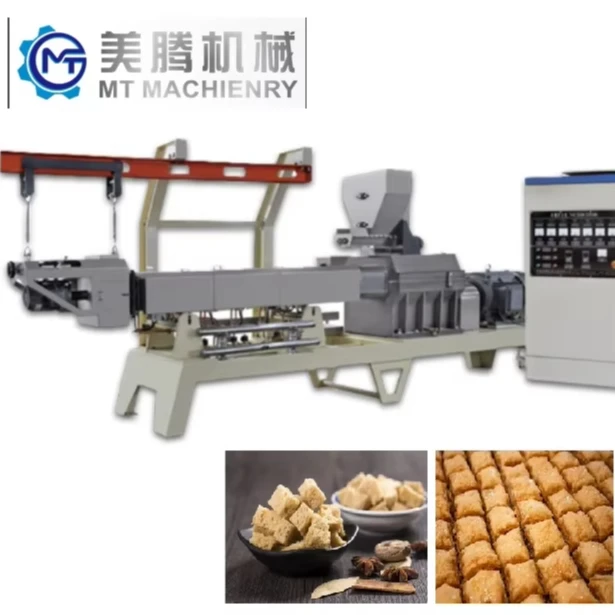
Complete line throughput matching — Every station from the vertical mixer to the multi-layer dryer is sized against the MT65 output so the plant-based meat line runs at rated pace without intermediate buffering or starvation.
Technical Specifications
| Parameter | Value |
|---|---|
| Model | MT65 |
| Product Type | Twin Screw Extruder for Texturized Vegetable Protein (TVP) |
| Screw Type | Twin Screw |
| Screw Length | 1050 mm |
| Main Motor Power | 22 kW |
| Installed Power | 84 kW |
| Power Consumption | 59 kW |
| Heating Power | 10 kW |
| Feeding Motor Power | 0.75 kW |
| Rotary Cutting Motor Power | 0.75 kW |
| Pump Motor Power | 0.37 kW |
| Output Capacity | 100–150 kg/h (basis not stated in source — confirm raw material formulation, moisture content, and die configuration) |
| Overall Dimensions (L×W×H) | 40000 × 1200 × 2200 mm |
| Control System | PLC and MCC |
| Mixer Capacity | 20–30 kg per batch |
| Mixer Power | 4 kW |
| Mixer Construction | Vertical, stainless steel 304 mixing ruler, carbon steel shelf |
| Dryer Type | Multi-layer, fuel / gas / electric heating options |
| Dryer Drive | Double pitch roller chain, round-trip drying |
| Line Stations | Mixer → Screw Conveyor → Twin Screw Extruder → Air Conveyor → Multi-layer Dryer → Cooling Machine |
| Standards | CE, ISO |
Application Suitability
| Application | Material or Output |
|---|---|
| Texturized vegetable protein (TVP / TSP) | Defatted soya flour, low-temperature soya flakes |
| Soya chunks and soya nuggets | Defatted soya flour with moisture conditioning |
| Vegetarian beef and meat analogues | Soy protein isolate blends, peanut dregs |
| Fortified meat substitutes | Soybean dregs, cereal-protein blends for nutrition programmes |
| Cereal and snack variants | Adjusted screw and die configuration for expanded formats |
Why Nominal Capacity Figures Mislead Plant-Based Meat Buyers
A twin screw food extruder for sale listed at 150 kg/h tells you nothing about what happens when your formulation includes pea protein or a higher fibre ratio. Capacity only matters when tied to your exact raw material and die setup.
I remember a Middle East customer who purchased a plant-based meat line after watching a trial run on standard soy protein isolate. The numbers looked solid. Then his local supplier substituted part of the soy with pea protein, and the expansion behaviour shifted entirely. The extruder could not hold consistent fibre structure, and the drying stage could not keep up with the altered moisture profile. First-week yield dropped sharply, and the customer spent weeks re-tuning on-site with no baseline data to work from [NEED_CITE: raw material variability impact on extrusion consistency].
That is why output figures without a stated raw material basis should be treated as reference only. The MT65 capacity range requires confirmation against your specific protein blend, moisture content, and target fibre density before it can be called a production commitment.
Screw Configuration as the Decisive Variable in Protein Texturisation
The twin screw architecture on the MT65 allows operators to adjust screw element sequencing along the 1050 mm barrel to control shear intensity and residence time. For defatted soya flour, a longer kneading section promotes protein alignment into layered fibre structures that resemble animal meat. Switching to a blend containing peanut dregs or soybean dregs requires shorter high-shear zones to prevent over-denaturing, which would collapse the fibrous matrix before the material reaches the die.
Die selection works in tandem with screw configuration. A restrictive die increases back-pressure and produces denser, chewier chunks suitable for vegetarian beef applications. A more open die yields lighter nuggets that absorb marinades quickly — preferred in fast-food and deep-freeze segments. The twin screw food extruder for sale here ships with a screw and die configuration record matched to the buyer’s trial material.
Drying and Cooling as Extensions of Extrusion Control
Extrusion does not end at the die face. The moisture content and internal steam pressure locked into the TVP strand at the cutting point determine what the dryer must handle. The multi-layer dryer on this line uses a double pitch roller chain to carry product through round-trip passes, with selectable heating sources — fuel, gas, or electric — to match local utility economics [NEED_CITE: industrial dryer heating source selection criteria].
Temperature and dwell time in the dryer set the final moisture and rehydration behaviour of the soya chunks. Under-dried product stores poorly and develops off-flavours; over-dried product shatters during packing and rehydrates unevenly in the end user’s kitchen. The downstream cooling machine stabilises the product before packing to prevent condensation inside sealed bags.
Reading the Specs Beyond the Nameplate
The 22 kW main motor and 84 kW installed power envelope indicate a machine built for the sustained thermal and mechanical load of protein texturisation, which demands more energy per kilogram than starch-based snack extrusion. The 10 kW heating circuit is distributed across barrel zones to maintain the temperature gradient necessary for progressive protein unfolding — typically starting lower in the feed section and rising through the metering and high-moisture cooking zones.
The PLC and MCC control architecture keeps barrel temperatures, screw speed, and feeder rate interlocked so that a deviation in one parameter triggers compensating adjustments rather than a scrap event. For buyers operating across multiple protein formulations, this level of control reduces the window between a good batch and an off-spec one. The vertical mixer with 304 stainless steel contact surfaces handles batch preconditioning at 20–30 kg per cycle, which must be timed against extruder throughput to avoid gaps or surges [NEED_CITE: batch mixer cycle time versus continuous extruder feed rate matching].
The Cost of Skipping the Trial Run
When a plant-based meat line ships without a trial on the buyer’s actual formulation, the first weeks of production become an expensive experiment. Screw elements get swapped, die plates get re-drilled, and dryer settings cycle through guesswork — all while raw material is being consumed and delivery deadlines are slipping. I have seen this pattern repeat across multiple markets: the machine itself was sound, but the configuration was based on a generic soy isolate benchmark that did not match the buyer’s regional supply chain [NEED_CITE: cost of post-installation extruder reconfiguration].
The hidden cost is not just scrap product. It is the loss of buyer confidence with downstream customers who expected consistent texture and rehydration behaviour from the first shipment.
Why Source This Line from Meiteng
Throughput matching across every station — mixer, extruder, dryer, cooler — means no single vendor can blame the other when the line underperforms, because the entire sequence was designed and supplied as one package.
In-house trial runs on your raw material before shipment produce a documented baseline, so you arrive at commissioning with known settings rather than starting formulation work from zero.
Screw and die configurations are specified to your protein blend and target product format, not copied from a generic build. The configuration record ships with the machine for future reference and reordering.
PLC and MCC control with voltage and frequency confirmed for your destination market prevents the commissioning delays that occur when a machine arrives wired for the wrong electrical standard.
CE and ISO documentation supports import clearance and local regulatory filing without last-minute surprises at customs.
Documentation & Verification
- Line layout with throughput calculations across all six stations for your target output
- Screw and die configuration record tied to your specific protein blend trial
- Trial run report on your raw material with product samples before dispatch
- Electrical schematic with voltage, frequency, and control language confirmed for your market
- Factory test record and CE declaration of conformity for customs clearance
Installation, Commissioning & Support
- Foundation and floor space planning based on the 40 m line footprint and 2.2 m headroom requirement
- Dedicated electrical circuit sizing for 84 kW installed load with confirmed local voltage and frequency
- Assembly supervision from mixer through cooling machine with station-by-station alignment checks
- First-run parameter setting using your trial run baseline to accelerate time to stable production
- Operator training covering screw configuration changes for different protein formulations
- Wear parts list with screw elements and die plates identified for initial stocking and reorder
What to Include in Your Enquiry
To receive a line configuration that reflects your actual production scenario rather than a generic quote, share the following with your enquiry: the protein sources in your formulation (soy, pea, peanut, or blends), your target product format (chunks, nuggets, shreds), and daily or shift-based volume targets. Include your facility voltage and frequency, available floor space, and whether you need the dryer configured for gas, electric, or fuel heating. If your raw material supply varies by season or supplier, note that so the screw configuration can account for it.
Frequently Asked Questions
Q: How is the MT65 output capacity verified before shipment?
A: Output is verified through a trial run on your actual raw material formulation in the testing workshop. The resulting trial report documents throughput, product texture, and moisture levels at each station, giving you a baseline for commissioning rather than relying on a generic soy isolate benchmark.
Q: Can the screw configuration be matched to our specific protein blend?
A: Yes. Screw elements are sequenced along the 1050 mm barrel to match your protein source and target fibre structure. A configuration record ships with the machine so you can replicate settings or reorder identical screw sets for future production runs.
Q: What voltage and control options are available for our market?
A: Voltage, frequency, and control panel language are confirmed during the specification stage before production begins. The PLC and MCC architecture is configured to your local electrical standard to avoid commissioning delays on arrival.
Q: Is a trial run on our raw material possible before we commit to shipment?
A: Trial runs are a standard step in the sales process. You send your raw material to the testing workshop, and the line runs your formulation through mixing, extrusion, drying, and cooling. You receive samples and a full report before approving dispatch.
Q: What spare wear parts should we stock from the start?
A: The primary wear items are screw elements and die plates. A wear parts list is provided with the machine identifying the exact part numbers for your configuration, along with recommended initial stock quantities based on your planned production schedule.