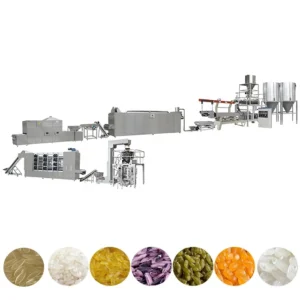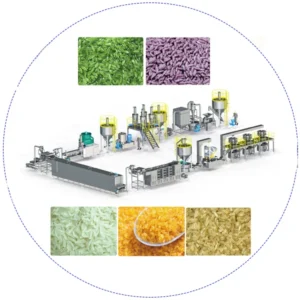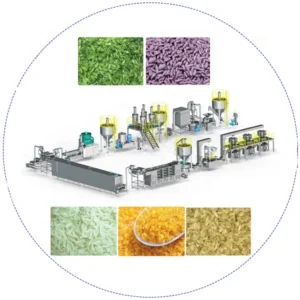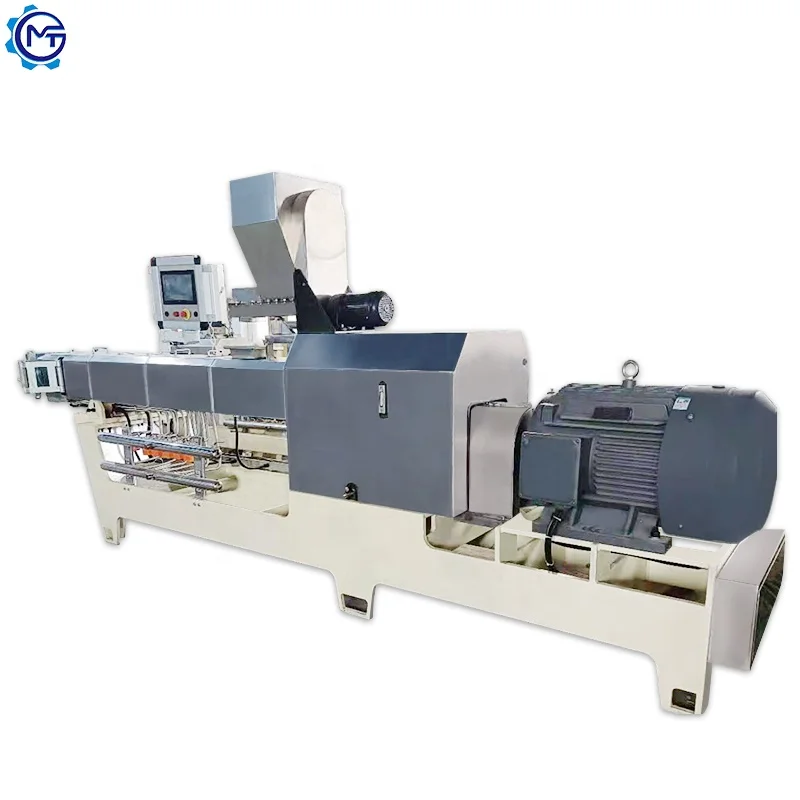
Throughput-matched stations — Every mixer, extruder, dryer and packer in this fortified rice line is sized so no single station chokes the others, validated against your actual grain and micronutrient blend before the machines leave the factory.
Technical Specifications
| Parameter | Value |
|---|---|
| Product Type | Fortified Rice Processing Line |
| Extruder Models Available | MT65 / MT70 / MT85 / MT75 / MT95 |
| Extruder Type | Twin screw |
| Installed Power | 85 kW (MT65); 120 kW (MT70); 235 kW (MT85); 180 kW (MT75); 260 kW (MT95) |
| Power Consumption | 60 kW (MT65); 85 kW (MT70); 165 kW (MT85); 135 kW (MT75); 195 kW (MT95) |
| Output Capacity | 80–100 kg/h (MT65); 100–120 kg/h (MT70); 200–300 kg/h (MT85); 300–500 kg/h (MT75); 800–1000 kg/h (MT95) (basis not stated in source — confirm raw material formulation and moisture content) |
| Overall Dimensions (L × W × H) | 28 × 1.2 × 2.2 m (MT65); 30 × 1.5 × 2.2 m (MT70); 34 × 3.5 × 4.3 m (MT85); 32 × 3.5 × 4.3 m (MT75); 36 × 3.5 × 4.3 m (MT95) |
| Control System | Frequency speed controlling |
| Lubrication | Automatic lubricating and cooling |
| Dryer Heating Source | Electric or gas |
| Production Procedure | Mixing → Extruding → Vibrating → Low-temperature drying → Cooling → High-temperature roasting → Cooling → Packing |
| Basic Raw Materials | Broken rice, rice, corn, millet, wheat, oats, buckwheat, bean, starch; vitamins and minerals as partial ingredients |
| Final Products | Artificial rice, fortified rice kernels |
| Certification | CE |
Application Suitability
| Application | Material or Output |
|---|---|
| Fortified rice kernel production for nutrition programmes | Broken rice and rice bran blended with vitamin and mineral premixes |
| Artificial rice manufacturing from grain by-products | Corn, millet, wheat, oats and buckwheat with added starch binders |
| High-nutrition rice products for food aid distribution | Multi-grain formulations with iron, zinc and vitamin A fortification |
| Value-added processing of broken rice streams | Graded broken rice reconstituted into uniform, cook-stable kernels |
| Infant and weaning food base production | Pregelatinised rice and bean blends with micronutrient dosing |
What "Rated Output" Means When Micronutrients Change the Recipe
A capacity figure tied only to plain rice flour becomes unreliable the moment vitamin and mineral premixes enter the barrel.
I learned this the hard way. A nutrition programme client ordered a line rated for standard grain extrusion. During the factory trial we ran their actual formulation — heavy on iron fumarate and calcium carbonate — and the dough viscosity shifted enough to collapse expansion at the die. The rated throughput number would have meant nothing on their real recipe. That is why every Fortified Rice Processing Line full equipment range we quote is validated against the buyer’s own raw material blend before a single machine ships [NEED_CITE: micronutrient impact on extrusion rheology]. Without that trial, you are commissioning a line on assumptions rather than data.
Matching Every Station from Batching to Packing
Surveying equipment for a fortified rice line means checking that no single station creates a bottleneck. The twin-screw extruder is the heart of the process, but the mixer upstream must discharge fast enough to keep the feed hopper full, and the low-temperature dryer downstream must have sufficient belt length and airflow to handle the moisture load leaving the extruder die. If the dryer is undersized, kernels pile up on the mesh belt, stick together and deform before they reach the roasting stage.
This full equipment catalogue lays out every station — mixing, extruding, vibrating, low-temperature drying, cooling, high-temperature roasting, secondary cooling and packing — so you can see the throughput path before committing to a layout. Frequency speed controlling on the extruder lets operators fine-tune screw RPM to match the specific gravity of a vitamin-loaded formulation without over-shearing the starch matrix.
How Screw Geometry Handles Fortified Formulations
Twin-screw extrusion gives operators independent control over shear, residence time and temperature profile inside the barrel. When a recipe contains coarse mineral particles, the screw configuration must generate enough mixing energy to disperse them uniformly while avoiding excessive wear on the flight edges. The automatic lubricating and cooling system on these extruders keeps barrel sections within a narrow temperature band, which matters because a drift of even a few degrees can alter starch gelatinisation and change the final kernel density.
Die design works hand in hand with screw geometry. A smaller die opening increases back-pressure, producing a denser kernel that better survives the high-temperature roasting stage [NEED_CITE: die geometry and extrudate density in grain processing]. For fortified rice kernels destined for cooking alongside natural rice, the target is a density and water-absorption rate that matches the long-grain varieties in the same pot.
Why Installed Power and Footprint Matter on the Shop Floor
The power draw across the model range spans from 60 kW to 195 kW in actual consumption, which dictates transformer sizing, cable runs and circuit breaker ratings at the installation site. Choosing between the compact MT65 line at 28 m long and the MT95 line at 36 m long is not just about output — it is about whether your building column spacing and ceiling height can accommodate the dryer and roasting modules, which on the larger models reach over 4 m in height.
The electric or gas dryer option affects utility planning in a different way. Gas-fired dryers require exhaust ducting, combustion air inlets and gas-pressure regulators, while electric dryers need dedicated high-amperage circuits. Confirming which heating source suits your factory before the layout is frozen avoids costly utility rework during commissioning [NEED_CITE: industrial dryer utility requirements for food extrusion lines].
The Hidden Cost of an Undersized Dryer
Buyers often focus on extruder capacity and treat the dryer as an afterthought. When the dryer cannot evaporate moisture fast enough, kernels exit with residual internal steam that condenses during cooling, causing surface checking and breakage in the roasting stage. The resulting waste accumulates quietly — a few percent of output lost per shift, noticed only when the packing station tally falls short of the production target. Sizing the dryer belt area and airflow to the extruder discharge rate is where line-level throughput is actually decided, not at the extruder nameplate.
Why Buyers Specify the Full Range Here
Complete station coverage from batching through packing means every conveyor, dryer and cooler is sourced against the same throughput calculation, eliminating the mismatch that occurs when equipment arrives from separate vendors. Screw and die configurations are documented against the buyer’s specific grain and micronutrient blend, not copied from a generic build sheet. An in-house testing workshop allows trial runs on the customer’s actual raw material before shipment, catching formulation issues while changes are still inexpensive. The line is backed by CE-certified equipment and full electrical schematics with voltage confirmed to the destination market, reducing the risk of commissioning delays caused by incorrect motor windings or control panel ratings.
Documentation & Verification
- Line layout drawing with station-by-station capacity calculation for your target output
- Machine specification sheet listing installed power, dimensions and utility requirements per model
- Screw and die configuration record matched to your grain and micronutrient formulation
- Electrical schematic with voltage and frequency confirmed for your local supply standard
- Factory trial run report on your raw material blend before dispatch
- CE declaration of conformity and ISO certificate on file
Installation, Commissioning & Support
- Foundation plan accounts for the 28–36 m line length and dryer height up to 4.3 m
- Power supply review confirms transformer capacity against 60–195 kW consumption range
- Equipment ships in modular sections for container loading and on-site reassembly
- First-run parameter setting covers screw RPM, barrel temperature zones and dryer belt speed
- Operator training addresses formulation changeover and frequency speed controlling adjustments
- Wear parts list covers screws, dies and mesh belt segments with recommended replacement intervals
Before You Request a Quote
To size the right Fortified Rice Processing Line full equipment range for your project, share your base grain type and the micronutrient premix composition, along with the daily or hourly output you need to hit. Confirm your factory ceiling height, available floor length, local voltage and frequency, and whether electric or gas heating is preferred for the dryer. If you have existing upstream milling or downstream packing equipment, include the make and throughput so the new line can be integrated without bottlenecks.
Frequently Asked Questions
Q: How do I confirm the extruder output against my fortified formulation?
A: We run your actual grain and micronutrient blend in the in-house testing workshop before shipment. The trial report records screw RPM, barrel temperatures, moisture content and achievable throughput, giving you verified numbers rather than generic ratings based on plain rice flour.
Q: Which extruder model fits my production volume and factory space?
A: Model selection depends on both target output and available floor space. The MT65 line starts at 28 m in length for lower volumes, while the MT95 extends to 36 m for higher-capacity programmes. We match the model to your daily target and building dimensions during the layout proposal stage.
Q: How do I avoid dryer and cooler bottlenecks on the line?
A: Every station is sized against the extruder discharge rate during the capacity calculation. The dryer belt area, airflow volume and cooling conveyor length are all specified to handle the moisture load and thermal mass leaving the extruder, preventing pile-ups that cause kernel deformation.
Q: What voltage and frequency options are available for my market?
A: Motors and control panels can be wound and configured for the voltage and frequency standard at your facility. We confirm these parameters before production begins so that the electrical schematic matches your local supply and avoids rewiring during commissioning.
Q: What spare wear parts should I stock for the first year?
A: Screws, dies and dryer mesh belt segments are the primary wear items. We provide a wear parts list with recommended replacement intervals based on your formulation abrasiveness, and parts are available for reorder so you are not searching for spares when the first changeover falls due.