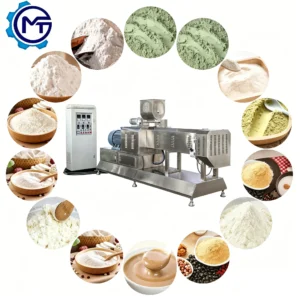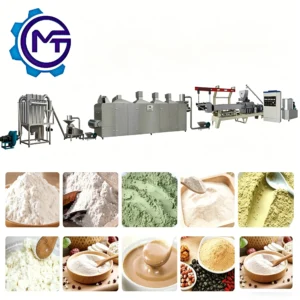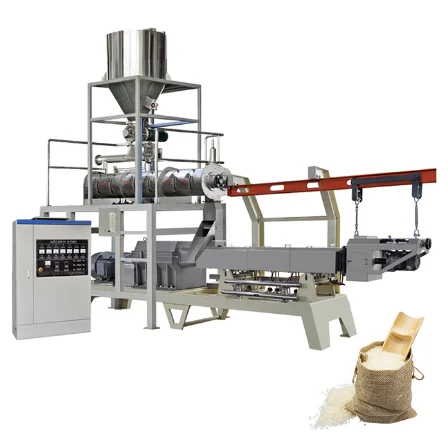
Integrated Equipment Sizing — Every station in the nutritional fortified rice machine full equipment range is throughput-matched so the extruder, dryer, and roaster hold nominal output together on your actual grain formulation.
Technical Specifications
| Parameter | Value |
|---|---|
| Product Type | Nutritional Fortified Rice Extrusion Line |
| Model | MT65 / MT70 / MT85 / MT75 / MT95 |
| Installed Power | 85 kW (MT65) / 120 kW (MT70) / 235 kW (MT85) / 180 kW (MT75) / 260 kW (MT95) |
| Power Consumption | 60 kW (MT65) / 85 kW (MT70) / 165 kW (MT85) / 135 kW (MT75) / 195 kW (MT95) |
| Output Capacity | 80–100 kg/h (MT65) / 100–120 kg/h (MT70) / 200–300 kg/h (MT85) / 300–500 kg/h (MT75) / 800–1000 kg/h (MT95) (basis not stated in source — confirm raw material formulation, moisture content, and kernel size) |
| Overall Dimensions (L×W×H) | 28×1.2×2.2 m (MT65) / 30×1.5×2.2 m (MT70) / 34×3.5×4.3 m (MT85) / 32×3.5×4.3 m (MT75) / 36×3.5×4.3 m (MT95) |
| Screw Type | Twin-screw (single-screw feeding system also available depending on material) |
| Control System | Frequency speed control, automatic lubrication and cooling |
| Line Stations | Mixing → Extruding → Vibrating → Low-temperature drying → Cooling → High-temperature roasting → Cooling → Packing |
| Drying Oven Heat Source | Electric or gas |
| Drying Method | Circulation drying with mesh belt speed controlled by frequency motor |
| Certification | CE, ISO |
Application Suitability
| Application | Material or Output |
|---|---|
| Fortified rice kernel production | Broken rice, rice bran, corn, millet, wheat, oats, buckwheat, beans with added vitamins and minerals |
| Artificial rice processing | Starch-based blends reconstituted into uniform rice-shaped kernels |
| Nutrition programme supply | Government and institutional distribution of vitamin/mineral-enriched rice |
| Value-added grain conversion | Broken rice and milling by-products transformed into high-value rice kernels |
What "Rated Capacity" Hides When the Raw Material Changes
An artificial rice processing line manufacturer quotes a throughput number, but that figure rests on assumptions about your grain blend, moisture level, and target kernel density — swap one variable and the whole line behaves differently.
Capacity only means something when it is verified on the material you will actually run.
I learned this the hard way on a Southeast Asian project. The trial runs in our Shandong workshop used standard rice flour, and the twin-screw extruder performed exactly as expected. When the customer switched to a high-fiber multigrain formulation on site, expansion collapsed and gelatinisation dropped. We spent an extra week reconfiguring the screw combination and adjusting barrel temperature zones to recover kernel quality. Since then, every artificial rice processing line manufacturer I work with insists on receiving the buyer’s actual raw material before dispatch [NEED_CITE: raw material variability impact on twin-screw extrusion output].
How Each Station Connects in the Fortified Rice Line
The nutritional fortified rice machine full equipment range sequences eight stations — mixing, extruding, vibrating, low-temperature drying, cooling, high-temperature roasting, cooling again, and packing. Each station is sized relative to the others so material flow remains continuous. When an extruder pushes 300 kg/h but the dryer can only handle 200 kg/h, wet kernels pile up, moisture migration becomes uneven, and kernel surface cracking follows.
The vibrating station after extrusion separates kernels before they enter the drying oven, preventing clumping that would otherwise create moisture variance across the batch. This variance directly affects how uniformly kernels roast in the high-temperature stage downstream.
Drying Oven Design and Kernel Moisture Control
Circulation drying with a frequency-controlled mesh belt lets operators adjust residence time based on the specific moisture target for each grain formulation. The heat source is available as electric or gas, selected according to local utility cost and availability. Low-temperature drying preserves the vitamin and mineral additives that would degrade under aggressive heat, while the subsequent high-temperature roasting stage develops the surface colour and texture buyers expect in reconstituted rice kernels.
If the oven belt speed is fixed rather than frequency-controlled, operators lose the ability to fine-tune moisture removal when switching between a corn-heavy blend and an oat-heavy blend [NEED_CITE: drying curve adjustment for grain-based extruded products]. The nutritional fortified rice machine full equipment range addresses this by linking belt speed to the same frequency control system governing the extruder screw speed.
Reading the Extruder Specifications for Your Production Target
The five models span installed power from 85 kW on the MT65 to 260 kW on the MT95. Power consumption figures sit lower — 60 kW to 195 kW — reflecting actual running load rather than peak motor draw. This gap matters for electrical planning: transformers and distribution panels must handle the installed power, while operating cost calculations should use the consumption figure.
The twin-screw configuration generates the shear and mixing action needed to gelatinise starch across diverse grain blends, from pure broken rice to multigrain mixes containing beans and buckwheat. Single-screw feeding systems are also available depending on material flow characteristics. Frequency speed control on the extruder allows operators to adjust screw RPM in response to kernel density readings taken during initial commissioning, maintaining batch consistency across production runs.
Overall dimensions scale from 28×1.2×2.2 m for the MT65 line up to 36×3.5×4.3 m for the MT95. The width and height jump noticeably at the MT85 tier because the drying oven and roasting stages expand to handle higher throughput volumes.
When Mismatched Stations Create Hidden Costs
A buyer once sourced an extruder and dryer from separate vendors to save on the initial purchase. The extruder outpaced the dryer, leaving wet kernels queued on conveyors. Surface moisture migrated inward during the wait, and the subsequent roasting stage produced kernels with hard centres and cracked surfaces. The rejection rate climbed, and the line ran well below its theoretical output [NEED_CITE: throughput mismatch consequences in food extrusion lines].
Another common failure pattern involves voltage and frequency assumptions. A line built for 380V/50Hz arrives in a market running 440V/60Hz. Motors overheat, frequency drives fault, and commissioning stalls until replacement components ship. These delays are preventable when electrical specifications are confirmed before production begins rather than after the line is crated.
Why Procurement Here Reduces Integration Risk
Every station in the nutritional fortified rice machine full equipment range is sourced and matched under one supplier, so throughput calculations account for actual material flow between extrusion, drying, roasting, and packing rather than relying on nameplate ratings from different vendors.
Screw configuration and die design are specified against the buyer’s grain blend, moisture content, and target kernel dimensions — not copied from a generic build. The in-house testing workshop runs the buyer’s actual raw material before shipment, generating a trial run report that documents expansion ratio, kernel density, and gelatinisation degree.
Pre-sales consultation includes line layout and capacity calculation documents showing how each station connects. On-site installation covers mechanical assembly, electrical termination, and parameter setting for local voltage and frequency conditions. Operator training addresses screw speed adjustment, oven temperature profiling, and wear part replacement procedures.
Documentation & Verification
- Line layout and capacity calculation matched to your grain blend and target kernel size
- Screw and die configuration record specifying geometry for your raw material formulation
- Electrical schematic with voltage and frequency confirmed for your local grid standard
- Trial run report on your actual raw material documenting kernel expansion and moisture content
- CE declaration of conformity and ISO certificate for import clearance
- Operation and maintenance manual covering every station from mixer to packing scale
Installation, Commissioning & Support
- Foundation leveling across the 28–36 m line length to maintain conveyor alignment
- Dedicated electrical circuit sized to the 85–260 kW installed power requirement of the selected model
- Low-temperature and high-temperature oven zones calibrated to your vitamin additive thermal tolerance
- Frequency drive parameters set for local voltage and confirmed during commissioning
- Spare screw elements, die plates, and mesh belt sections stocked with reorder lead times defined
- Lubrication and cooling system intervals scheduled around the automatic system monitoring points
What to Include in Your Inquiry
Provide your grain formulation — including the percentage of broken rice, alternative grains, and any vitamin or mineral premix — along with target kernel dimensions and daily output requirements. Specify your local voltage, frequency, and preferred control language. If you have existing upstream milling or downstream packing equipment, share the interface requirements so the nutritional fortified rice machine full equipment range connects without adaptation gaps. Sending a representative sample of your raw material enables a pre-shipment trial run in the testing workshop.
Frequently Asked Questions
Q: How is the output capacity of each model verified on my specific raw material blend?
A: Output capacity figures listed for the MT65 through MT95 are reference values. Actual throughput depends on your grain blend, moisture content, and target kernel size. We run your raw material in our testing workshop before shipment and document the verified capacity in a trial run report, so the number you plan production around is based on your actual formulation.
Q: What voltage, frequency, and control language options are confirmed before shipment?
A: Voltage and frequency are confirmed during the specification stage and documented in the electrical schematic before production begins. Control language is set according to your operator requirements. This prevents commissioning delays caused by mismatched electrical standards or unreadable HMI interfaces when the line arrives at your facility.
Q: How are dryer and roaster capacities matched to the extruder to prevent bottlenecks?
A: Each station in the line is sized based on the extruder’s verified output on your raw material. The drying oven mesh belt width, heating zone length, and roasting chamber volume are all calculated to handle the extruder’s actual throughput, ensuring wet kernels do not accumulate between stages and moisture removal remains uniform.
Q: Is a trial run on my raw material performed before the line ships?
A: Yes. We require a sample of your actual grain formulation and run it through the extruder and drying stages in our testing workshop. The trial run report records kernel expansion, density, moisture content after drying, and surface quality after roasting. Any screw or die adjustments needed are completed before the line is packed for shipment.
Q: What spare wear parts are included, and what is the reorder lead time?
A: The initial shipment includes spare screw elements, die plates, and mesh belt sections sized to your line configuration. A wear parts list with part numbers is provided in the documentation package. Reorder lead times are confirmed during commissioning so you can plan inventory around your production schedule and local shipping conditions.