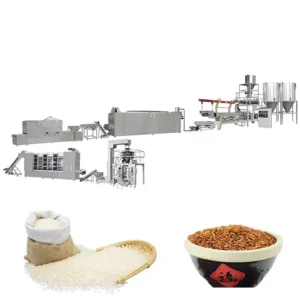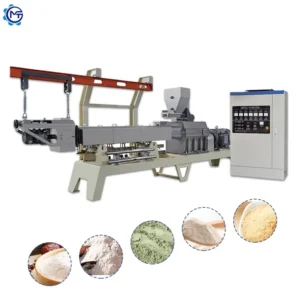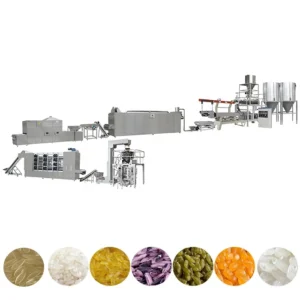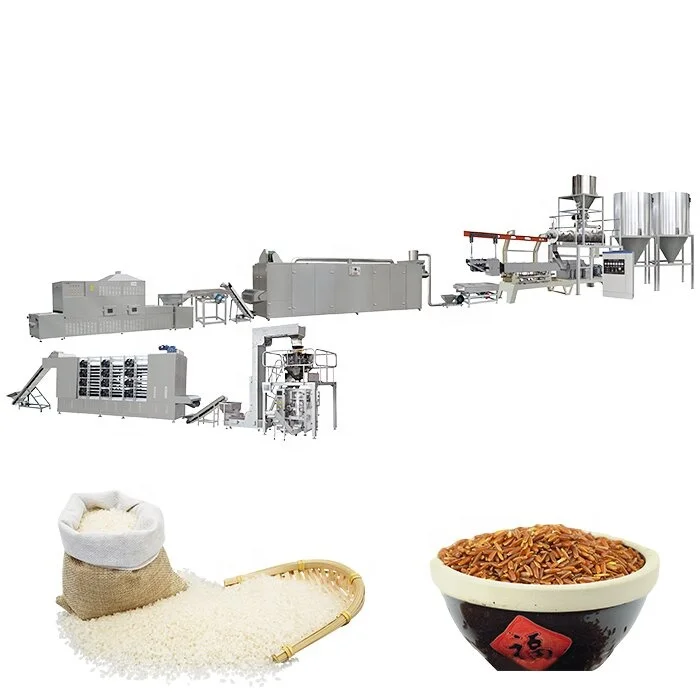
Thermodynamic profiling — screw configuration and barrel zones are matched to your fortification recipe before the line is finalized, not copied from a generic build.
Technical Specifications
| Parameter | Value |
|---|---|
| Product Type | Artificial Rice Extruder Production Line |
| Model Options | MT65 / MT70 / MT85 / MT75 / MT95 |
| Screw Type | Twin-screw |
| Installed Power | 85 kW (MT65) / 120 kW (MT70) / 180 kW (MT75) / 235 kW (MT85) / 260 kW (MT95) |
| Power Consumption | 60 kW (MT65) / 85 kW (MT70) / 135 kW (MT75) / 165 kW (MT85) / 195 kW (MT95) |
| Output Capacity | 80–100 kg/h (MT65) / 100–120 kg/h (MT70) / 300–500 kg/h (MT75) / 200–300 kg/h (MT85) / 800–1000 kg/h (MT95) (basis not stated in source — confirm raw material formulation, moisture content, and kernel size) |
| Overall Dimensions (L×W×H) | 28×1.2×2.2 m (MT65) / 30×1.5×2.2 m (MT70) / 32×3.5×4.3 m (MT75) / 34×3.5×4.3 m (MT85) / 36×3.5×4.3 m (MT95) |
| Control System | Frequency speed control with PLC automation |
| Feeding System | Single or double screw feeding depending on material characteristics |
| Lubrication | Automatic lubricating and cooling system |
| Dryer Heating Source | Electric or gas |
| Dryer Control | Frequency motor for mesh belt speed adjustment |
| Standards | CE, ISO |
Application Suitability
| Application | Material or Output |
|---|---|
| Fortified rice kernel production | Broken rice, corn, millet blended with vitamin and mineral premixes |
| Instant rice processing | Wheat, oats, buckwheat, and starch-based formulations for quick-cooking grains |
| Artificial rice for nutrition programmes | Bean flour and grain blends with micro-nutrient fortification |
Why "Rated Capacity" Means Nothing Without Your Recipe
The artificial rice extruder production line for sale in a brochure is never the same line that runs your specific formulation.
I remember setting up a fortified rice line where the trial ran perfectly on plain broken rice flour. When the buyer’s actual recipe arrived — loaded with whey protein isolate and iron chelate — the gelatinisation temperature shifted, and the extrudate came out sticky and misshapen. That gap between a catalogue number and a working production line is where budgets disappear. An artificial rice extruder production line for sale must be validated on the exact grain blend and fortification premix you intend to run, not on a reference material the manufacturer keeps on hand [NEED_CITE: raw material variability in extruded food processing].
Screw Geometry and Fortification Compatibility
The twin-screw configuration handles the wide range of particle sizes and fat contents that fortified rice recipes demand. Standard rice flour flows easily, but once you introduce lipid-based vitamin carriers or mineral salts, the friction profile inside the barrel changes. Screw element spacing and pitch are selected to manage that shift, maintaining consistent shear and residence time so every kernel exits with the same density and nutritional loading.
Multi-Stage Thermal Control for Kernel Integrity
Low-temperature drying followed by high-temperature roasting gives you two independent moisture-removal phases. The first stage pulls surface moisture without case-hardening the kernel, while the second develops the translucent appearance and firm bite that consumers associate with natural rice. Frequency-controlled mesh belt speed on the dryer lets operators fine-tune dwell time as ambient humidity changes across seasons.
Reading the Power and Capacity Data Correctly
Installed power and actual consumption differ noticeably across the MT65 through MT95 range because the heating zones, drive motors, and dryer elements scale independently. The capacity figures listed for each model are reference points, not guarantees — they depend on the starch-to-protein ratio in your blend, the target moisture at the die face, and the kernel dimensions you specify [NEED_CITE: extruder throughput dependence on formulation parameters]. Always request a capacity calculation based on your own recipe sheet before comparing models.
When a Copied Screw Profile Ruins a Production Run
A generic screw build might produce acceptable plain rice kernels but fails the moment the recipe changes. Protein-fortified blends need different compression ratios, and the wrong die aperture produces kernels that fracture during drying or cook into mush. Buyers who skip the raw-material trial often discover these problems only after the line is bolted to the factory floor, when re-engineering the screw stack means weeks of downtime and air-freight costs for replacement parts [NEED_CITE: die and screw configuration impact on extruded product texture].
Why Procurement Starts With Process Data
Every configuration decision on this line traces back to what happens between the hopper and the die. The feeding system switches between single and double screw depending on whether your premix is free-flowing or prone to bridging. The automatic lubricating and cooling system protects the gear train during continuous runs at high filler loading, where abrasion accelerates wear on standard components. Barrel zones are independently heated so the thermal profile matches the gelatinisation curve of your specific grain blend, rather than forcing one temperature map across every recipe.
Documentation & Verification
- Line layout showing throughput balance from mixer through packing station
- Trial run report produced on your grain blend and fortification formula
- Screw and die configuration record documenting element arrangement and aperture
- Electrical schematic confirming voltage, frequency, and PLC language for your site
Installation, Commissioning & Support
- Foundation plan accounts for the MT85 line length of 34 m and dryer load distribution
- Dedicated electrical circuits sized to the selected model’s installed power rating
- Modular station assembly allows sequential commissioning from extruder forward
- PLC parameters loaded with recipe profiles tested during the factory trial run
- Initial spare parts package includes matched screw elements and die plates
- Dryer mesh belt tensioning and frequency drive calibration covered in operator training
What We Need to Quote Your Line Accurately
Send your complete formulation sheet — base grain percentages, fortification additives, and target kernel dimensions. Confirm your site voltage and frequency, along with the PLC display language your operators require. If you have existing upstream milling or downstream packing equipment, share the interface specifications so the artificial rice extruder production line for sale integrates without bottlenecking adjacent stations.
Frequently Asked Questions
Q: How is the line capacity verified, and what raw material formulation is it based on?
A: We run your actual grain blend and fortification premix through our in-house testing workshop before shipment. The trial run report documents throughput, kernel density, and moisture at each station. Capacity figures in the specification sheet are reference values; your validated output is recorded during the trial and becomes the contractual baseline.
Q: What voltage, frequency, and control language options are confirmed before shipment?
A: The electrical schematic is prepared for your site’s specific supply — voltage, phase, and frequency — before production begins. PLC interface language is selected during the specification confirmation stage. We verify compatibility with local standards so commissioning proceeds without transformer or reprogramming delays [NEED_CITE: voltage and frequency standards by export market].
Q: How is screw and die configuration matched to my specific grain blend and fortification recipe?
A: Screw element arrangement, compression ratio, and die aperture are designed around your formulation’s starch gelatinisation behaviour and filler loading. The configuration record documents every element position and is kept on file so replacement parts match the original build exactly.
Q: Is a trial run on my raw material performed before the line ships?
A: Yes. We require a representative sample of your base grains and additives for a production trial in our testing workshop. The trial validates screw configuration, drying profile, and final kernel quality. Results are documented in a report you review before authorising shipment.
Q: What spare wear parts are supplied with the initial order?
A: The initial package includes screw elements, die plates, and mesh belt sections sized to your line configuration. A full wear parts list with part numbers is included in the documentation so reordering is straightforward when your first replacement cycle arrives.