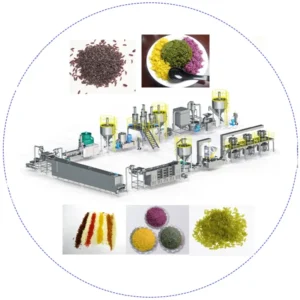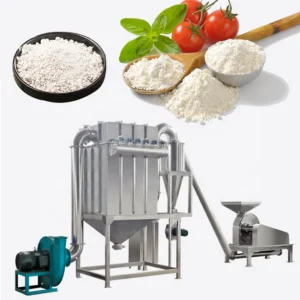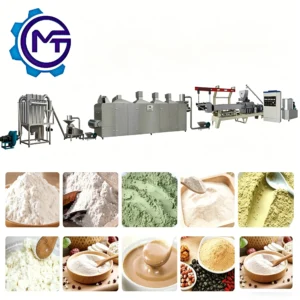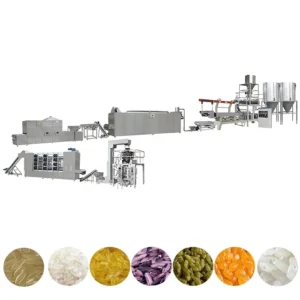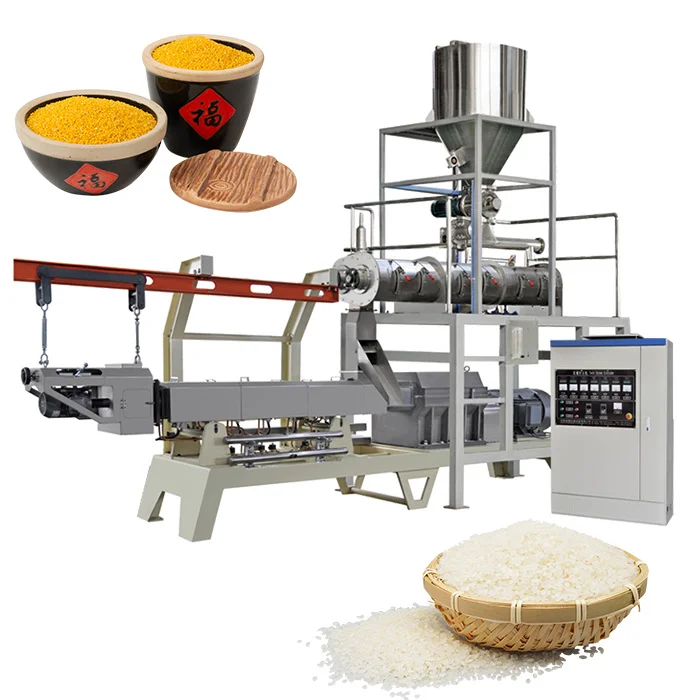
Matched station throughput — Every mixing, extrusion and frying unit in this artificial rice production line is balanced during engineering so no single stage bottlenecks your rated output.
Technical Specifications
| Parameter | Value |
|---|---|
| Product Type | Artificial Rice Production Line |
| Output Capacity | 70-300 kg/h (basis not stated in source — confirm raw material / moisture / pellet size) |
| Voltage & Frequency | 380V / 50Hz (configurable to target market grid) |
| Control System | Automatic control (PLC or MCC available based on site requirement) |
| Construction Material | Food-grade stainless steel contact surfaces |
| Line Stations Integrated | Mixer, extrusion system, fryer |
| Raw Material Compatibility | Rice flour and grain-based formulations |
| Customization Scope | Minor adjustments, drawing-based modification, and full custom design |
| Assembly State | Fully integrated continuous production line |
| Color | Silver (natural stainless steel finish) |
Application Suitability
| Application | Material or Output |
|---|---|
| Fortified rice manufacturing | Rice flour blended with micronutrient premix |
| Grain-based reformed rice | Multi-grain flour including sorghum, millet and wheat |
| Nutritional programme supply | Fortified kernel production for public health distribution |
| Value-added grain processing | Reformed rice pellets from broken rice flour streams |
Why the Raw Material Conversation Must Happen Before the Quotation
A capacity figure means nothing until it is tied to your exact flour blend and moisture content.
I learned this the hard way on a Middle East project. We trial-ran an artificial rice production line using standard rice flour at the factory, and everything held to spec. When the equipment reached site, the buyer switched to a chickpea and lentil composite flour. Gelatinisation behaviour shifted entirely, expansion dropped, and the final grain shape fell outside tolerance. We spent four days on the floor re-tuning barrel temperatures and screw speeds before the product met their nutritional specification [NEED_CITE: effect of legume flour substitution on extrusion gelatinisation]. That experience changed how I scope every inquiry: the first question is always your exact formulation, and the trial run must use your real material before the line ships.
Matching Each Station to the Extrusion Core
An artificial rice production line manufacturer that simply bolts a standard mixer and fryer to an extruder invites trouble. Rice flour dough is highly sensitive to hydration uniformity; if the mixer cannot deliver consistent moisture distribution before the material enters the barrel, the extruder compensates by over-working the starch, altering pellet density. Our engineering approach sizes the mixer batch cycle to match the extruder feed rate, so material never sits too long or starves the hopper.
Why the Fryer Cannot Be an Afterthought
The fryer directly governs final moisture content and surface texture of the reformed rice grain. Undersized fryer capacity means pellets queue up, sticking together and deforming before they pass through the oil bath [NEED_CITE: thermal transfer requirements for reformed rice pellet drying]. We calculate fryer belt length and oil turnover rate against the extruder output so that every pellet receives uniform heat exposure, producing the correct colour and crunch without scorching or oil saturation.
Reading the Specs That Matter Most
The 70-300 kg/h range covers small pilot runs through to mid-scale production, but the achievable throughput depends on your raw material density and target grain size. Voltage at 380V / 50Hz suits many Asian and Middle East grids, yet we reconfigure transformer taps and motor ratings when the destination market runs on different standards. Food-grade stainless steel across all product contact areas eliminates corrosion risk from wet flour dough and simplifies wash-down between product changeovers. The automatic control system maintains barrel temperature and screw speed within tight bands, which is essential when producing fortified rice — even minor temperature drift can degrade heat-sensitive vitamins in the premix.
The Cost of Overlooking Line Integration
Buyers who source individual stations from separate vendors often discover that the extruder and fryer were never rated against each other. The extruder pushes product faster than the fryer can handle, forcing operators to throttle output and effectively run below paid capacity. Worse, mismatched moisture targets between extrusion and frying can produce rice grains that fracture during packaging or fail shelf-life tests [NEED_CITE: moisture migration failure in extruded rice products]. These are problems that surface weeks after commissioning, long after the vendor has left site.
Why Buyers Source This Line From Our Workshop
We engineer the full artificial rice production line under one roof, meaning throughput calculations span every station rather than relying on individual machine ratings. Screw and die geometry is specified against your actual flour formulation, not borrowed from a generic rice template. Before dispatch, we run your material in our in-house testing workshop and document pellet shape, expansion ratio and moisture levels in a trial report you receive with the shipment. Electrical schematics and voltage configurations are confirmed against your facility grid before fabrication starts, so there are no commissioning delays over phase rotation or control language.
Documentation & Verification
- Line layout drawing showing station spacing and throughput balance
- Screw and die configuration record matched to your grain formulation
- Trial run report using your raw material before shipment
- Electrical schematic with confirmed voltage and frequency
- Operation and maintenance manual with wear parts schedule
- CE declaration of conformity where applicable
Installation, Commissioning & Support
- Foundation plan sized to line footprint and vibration load of the extruder motor
- Dedicated electrical circuit sized to total line rated power at confirmed voltage
- Modular station delivery allowing phased assembly in limited workshop clearances
- On-site barrel temperature and screw speed calibration using your flour blend
- Operator training covering control system interface and emergency stop sequences
- Wear parts list covering screws, dies and fryer belt sections with replacement intervals
What We Need to Start Your Line Design
Share your raw material formulation, including the percentage of rice flour, any legume or cereal additions, and the micronutrient premix loading. Let us know your target daily output and the shift pattern you plan to run. Provide the voltage and frequency at your facility, along with available workshop length and ceiling height, so we can draft a layout that fits your existing space and upstream milling equipment.
Frequently Asked Questions
Q: How is the 70-300 kg/h output capacity verified, and on which raw material formulation?
A: The stated range is indicative and must be confirmed against your specific flour blend, moisture content and target rice grain dimensions. We run your actual raw material in our testing workshop before shipment and document the verified throughput in a trial report, so the capacity figure you receive is tied to your real production conditions rather than a generic benchmark.
Q: What voltage and frequency configurations are available for different target markets?
A: The baseline configuration is 380V / 50Hz, which covers many Asian, Middle Eastern and African grids. We reconfigure motor ratings, transformer taps and control panel components to match your local supply before production begins, ensuring full compliance with regional electrical standards and avoiding commissioning delays on site.
Q: How are the mixer, extruder and fryer capacities matched to prevent line bottlenecks?
A: Each station is sized during engineering based on your confirmed extruder throughput. The mixer batch cycle is timed to the extruder feed rate, and the fryer belt length and oil volume are calculated so pellets pass through without queuing, maintaining continuous flow across every stage of the artificial rice production line.
Q: Can the screw and die configuration be specified to our raw material and target rice shape?
A: Yes. Screw element arrangement and die aperture geometry are designed around your flour formulation and the grain shape your market expects. We lock these parameters in the configuration record before fabrication and validate them during the in-house trial run using your material.
Q: What customization levels are available for this production line?
A: We support three tiers: minor adjustments such as hopper sizing or conveyor length, drawing-based modifications where we adapt station dimensions to your workshop layout, and full custom design when your process requires non-standard station integration or additional processing steps beyond the standard mixer, extruder and fryer sequence.