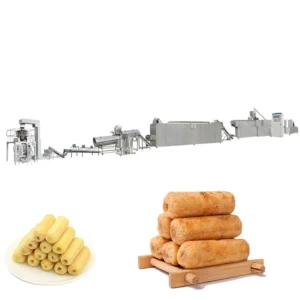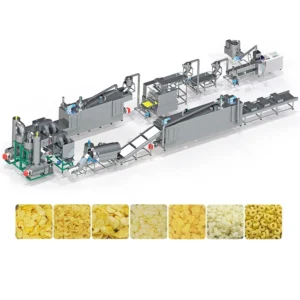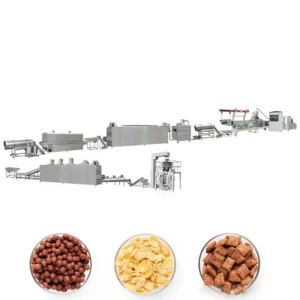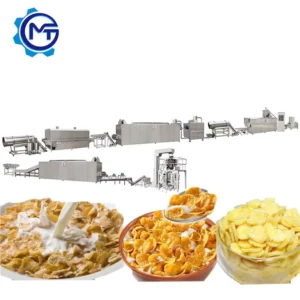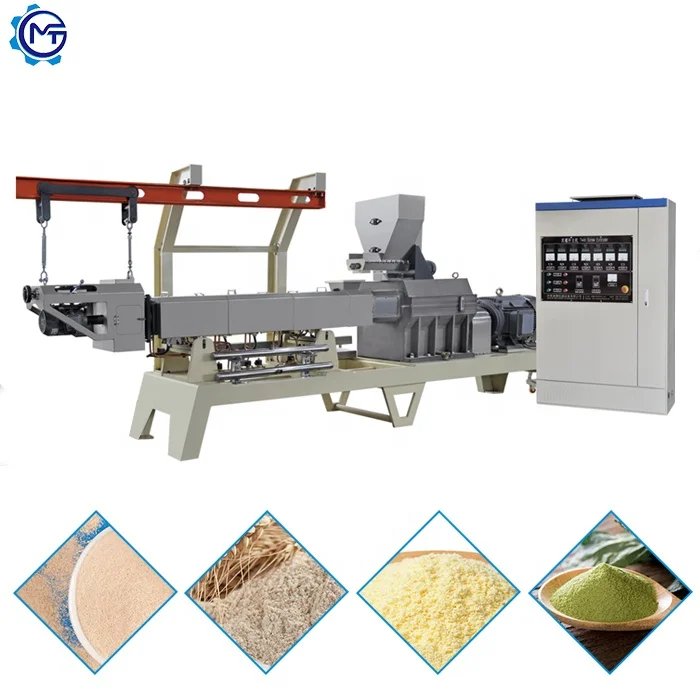
Station Matching — Every station from the batch mixer to the final cooler is sized against the same throughput target, preventing the dryer from choking when the extruder runs flat out.
Technical Specifications
| Parameter | Value |
|---|---|
| Model | MT70 / MT85 / MT75 |
| Product Type | Corn Flakes and Breakfast Cereal Production Line |
| Extruder Type | Twin Screw Extruder |
| Installed Power (MT70) | 160 kW |
| Power Consumption (MT70) | 120 kW |
| Output Capacity (MT70) | 150-200 kg/hr (basis to be confirmed) |
| Overall Dimensions (MT70) | 41 × 1.5 × 2.2 m |
| Installed Power (MT85) | 190 kW |
| Power Consumption (MT85) | 140 kW |
| Output Capacity (MT85) | 300-400 kg/hr (basis to be confirmed) |
| Overall Dimensions (MT85) | 43 × 1.5 × 3.2 m |
| Installed Power (MT75) | 210 kW |
| Power Consumption (MT75) | 150 kW |
| Output Capacity (MT75) | 300-500 kg/hr (basis to be confirmed) |
| Overall Dimensions (MT75) | 45 × 1.5 × 3.5 m |
| Screw Feature | Automatic lubricating and cooling function |
| Flaking Machine Control | PLC control system |
| Flaking Machine Drive | Hydraulic system for double rollers, double motors for separate roller driving |
| Flaking Temperature Control | Infrared sensor |
| Dryer Heating Source | Gas or Electric |
| Hot Air Roasting Oven | Vibrating pan, high temperature spraying tubes, conciliation burner, two separate circulating fans, cyclone dust removal device |
| Coating System | Double tumble for sugar melting, elevator, coating drum, spraying nozzle |
| Voltage & Frequency | Configurable (e.g., 415V 50/60Hz, 440V 50/60Hz, 220V 60Hz) |
| Standards | CE, ISO |
Application Suitability
| Application | Material or Output |
|---|---|
| Natural corn flakes production | Corn powder, corn grits |
| Sugar-coated corn flakes | Corn base with sugar syrup coating |
| Multi-shape breakfast cereals | Ball, tube, stick, ring, fruit loop, star, wheel, flower, heart shapes via die adjustment |
| Multi-grain cereal processing | Blends of corn, rice, wheat, oat, and barley powder |
| Instant porridge and nutritional cereal | Pre-gelatinised grain formulations |
| Baby food cereal | Fine-particle grain and nutritional blends |
Why Nominal Output Fails When the Grain Blend Changes
A line is only as fast as its weakest station once your actual raw material hits the hopper.
I have watched a breakfast cereal line get signed off at a comfortable rated capacity, then drop noticeably the moment the buyer switched from a fine-milled corn flour to a coarser local grit. The extruder could not gelatinise the starch evenly, the flakes came off the roller dense and under-expanded, and the dryer had to slow down to compensate. The entire breakfast cereal corn flakes machine full equipment range was suddenly out of balance. A capacity number without a stated raw material basis and moisture content is not a capacity — it is a guess [NEED_CITE: starch gelatinisation thresholds by grain particle size].
How the Mixer and Extruder Set the Floor for Every Downstream Station
The mixing stage determines particle hydration uniformity before the material ever enters the barrel. If the moisture is uneven, the twin-screw extruder will produce a mix of over-expanded and under-expanded pellets in the same batch. That inconsistency carries straight through the flaking rollers and shows up as variable thickness across the belt.
What the Flaking Roller and Roasting Oven Actually Decide
The PLC-controlled flaking machinery uses a hydraulic double-roller system with separate motor drives and infrared sensor temperature regulation to hold a consistent gap. Flake thickness directly controls how the hot air roasting oven dries and toasts each piece. The dual circulating fans and cyclone dust removal in the roasting oven are there to keep surface bubbles uniform and prevent fine dust from scorching on the flake surface [NEED_CITE: flake thickness tolerance and moisture gradient in cereal roasting].
Reading the Power and Dimension Figures Against Your Factory Floor
The installed power across the MT70, MT85, and MT75 models ranges from 160 kW to 210 kW, with operating consumption sitting noticeably lower. That gap between installed and consumed power reflects the headroom needed during start-up surges and when the extruder encounters a denser feedstock. The overall dimensions — stretching past 40 metres in line length — tell you this breakfast cereal corn flakes machine full equipment range needs a long, unobstructed floor with adequate ceiling clearance for the dryer and roasting oven exhaust ducting. Gas-heated dryers require a dedicated fuel supply line and combustion air intake, while electric versions demand a separate high-amperage circuit.
What Happens When Stations Are Sized Independently
When the extruder and the dryer come from different vendors with no shared throughput calculation, the dryer is often the first bottleneck. The extruder pushes out more mass than the dryer can handle at the required residence time, and moisture stays trapped inside the flake. The result is a product that feels crisp on the surface but goes soggy in the bowl — a defect that only shows up after packing and shipping. Coating drums that are too small for the line speed produce uneven sugar coverage, with some flakes over-glazed and others bare [NEED_CITE: moisture migration in packaged breakfast cereals].
Why This Line Is Configured as One System
Every station on this line is specified under a single supplier, so the mixer batch size, extruder output, flaking roller width, dryer belt area, and coating drum volume are all calculated against the same throughput figure. The screw configuration and die design are matched to your specific grain blend and target flake density rather than pulled from a generic build. An in-house testing workshop runs your actual raw material before the line ships, so the trial run report reflects your formulation — not a standard reference flour. Voltage, frequency, and control language are confirmed against your site electrical survey before production begins. Documentation includes a line layout matched to your factory footprint and a wear parts list covering screws, dies, and flaking roller surfaces.
Documentation & Verification
- Line layout and capacity calculation matched to your factory footprint and target throughput
- Screw and die configuration record specific to your grain blend and desired flake density
- Electrical schematic with voltage, frequency, and control language confirmed for your market
- Trial run report on your actual raw material performed in the testing workshop before shipment
- Factory test record covering every station from mixer through to the packing conveyor
- Wear parts list identifying screws, dies, and flaking roller surfaces with replacement intervals
Installation, Commissioning & Support
- Floor space exceeding 45 metres in length requires a level slab with anchor points matching the layout drawing
- Gas-heated dryer variants need a dedicated gas supply line and combustion exhaust routed to an external wall
- Electrical cabinet requires a dedicated circuit matching the confirmed voltage and frequency before the extruder motor is energised
- PLC-controlled flaking machinery is calibrated on-site with your specific flake thickness target during commissioning
- Operator training covers screw configuration changes for switching between corn, rice, and multi-grain recipes
- First-batch wear parts including screws, dies, and roller surfaces ship with the line for early replacement readiness
What We Need to Quote the Right Line
To configure a breakfast cereal corn flakes machine full equipment range that holds its output on your actual material, share your grain formulation, particle size distribution, and target moisture at each stage. Let us know the daily production target, your factory length and ceiling height, and the local voltage and frequency. If you plan to run both natural and sugar-coated variants, specify the coating ratio so the sugar melting and coating drum are sized accordingly.
Frequently Asked Questions
Q: How is output capacity verified on my specific grain formulation and moisture level?
A: We run your actual raw material through the twin-screw extruder in our in-house testing workshop before shipment. The trial run report documents the achieved throughput, flake density, and expansion profile on your specific grain blend, so the capacity figure you receive is tied to your formulation rather than a generic reference.
Q: What voltage, frequency, and control language options are confirmed before shipment?
A: We confirm your site voltage and frequency — such as 415V 50Hz or 440V 60Hz — against the electrical schematic before production. The PLC interface language is set to match your operator team. This prevents commissioning delays caused by mismatched electrical supply or unreadable control screens.
Q: How are the extruder, flaking rolls, dryer, and coating drum sized to avoid bottlenecks?
A: Each station is calculated against the same target throughput under one supplier. The extruder output, flaking roller width, dryer belt area, and coating drum volume are all matched so no single station forces the rest of the line to slow down during sustained production runs.
Q: Can I run a trial with my raw material before the line ships?
A: Yes. Our testing workshop accepts your grain samples and runs the full extrusion and flaking sequence. You receive a trial run report showing flake thickness, expansion, and surface quality on your material, allowing recipe adjustments before the equipment leaves the factory.
Q: What spare wear parts are included and how are replacements supplied?
A: The initial spare package covers screws, dies, and flaking roller surfaces identified in the wear parts list. Replacement components are manufactured to the same configuration record, so installing a new screw set maintains the extrusion profile established during your trial run.