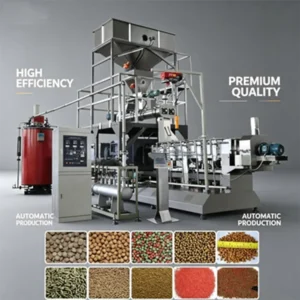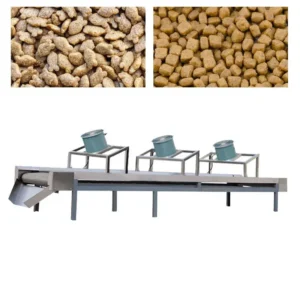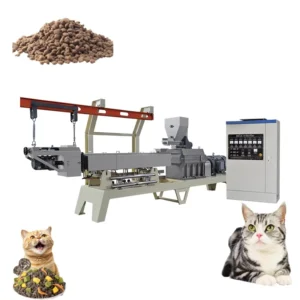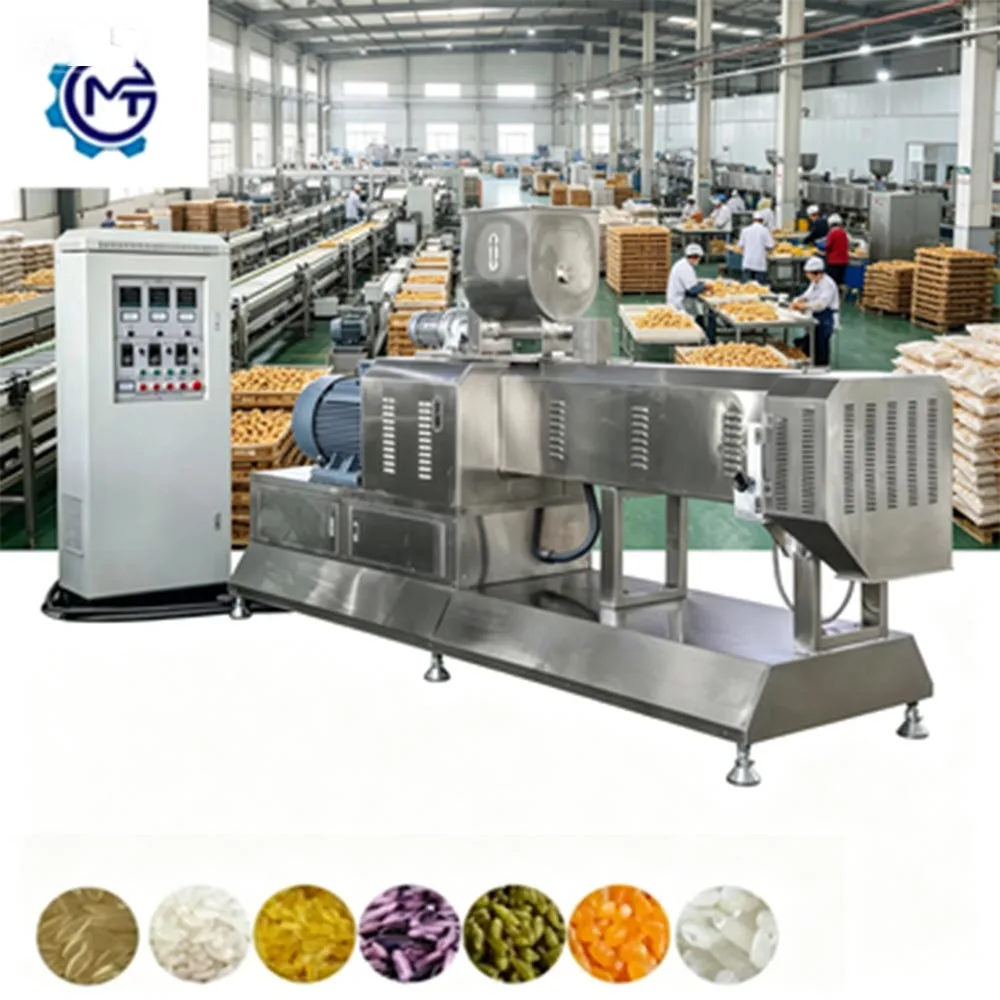
Matched Line Throughput — every station from mixer to packing is sized so the screening deck never starves or floods, confirmed by in-house trial runs on your raw material before dispatch.
Technical Specifications
| Parameter | Value |
|---|---|
| Product Type | Fish Feed Pellet Vibrating Screening and Grading Equipment |
| Machine Type | Vibrating Screening / Grading Sieve |
| Application Line | Fish Feed Extruder Production Line (mixer, extruder, dryer, seasoning coating machine, vibrating sieve, conveyor) |
| Control System | Intelligent PLC automatic control system |
| Material Contact Parts | Food grade 304 stainless steel |
| Automation Level | Full continuous automatic production |
| Output Capacity | Configured for medium to large scale industrial production (basis to be confirmed with target throughput and pellet size range) |
| Pellet Adjustability | Size, hardness, and buoyancy adjustable via upstream extruder settings |
| Power / Voltage & Frequency | Configurable to site requirements (basis to be confirmed) |
| Overall Dimensions | Determined by deck configuration and capacity (basis to be confirmed) |
| Screening Layers / Deck Count | Configurable based on pellet grading requirements (basis to be confirmed) |
| Screen Mesh Size Range | Matched to target pellet diameter specification (basis to be confirmed) |
| Vibration Frequency / Amplitude | Tuned to pellet density and moisture level (basis to be confirmed) |
| Key Features | Food grade contact surfaces, PLC integration, energy-saving transmission structure, continuous duty rated |
Application Suitability
| Application | Material or Output |
|---|---|
| Floating fish feed grading | Extruded pellets from fish meal, soybean meal, corn powder, and compound additives for tilapia and catfish |
| Sinking aquatic feed sorting | High-density pellets for shrimp and bottom-feeding species requiring tight size uniformity |
| Ornamental fish feed production | Small-diameter kibble for koi, goldfish, and tropical fish where pellet consistency affects water quality |
| Medium to large scale aquaculture operations | Continuous long-duration runs on compounded aquatic feed formulations |
| Line integration between dryer and packing | Pellet stream at controlled moisture requiring size classification before bagging |
Why "Rated Capacity" Without Context Fails on the Screening Deck
A vibrating sieve that looks adequate on paper can stall an entire aquatic feed line when upstream discharge exceeds its real throughput on your specific pellet formulation.
I once stood next to a screening station in West Africa where pellets piled against the side walls every twenty minutes. The extruder pushed out material faster than the screen deck could classify it, not because the sieve was undersized in general, but because the mesh aperture and vibration amplitude were set for a different pellet density. The dryer downstream starved intermittently, and operators kept shutting the line down to clear the backlog. When you evaluate a fish feed pellet vibrating screening machine, the question is never just what it can handle — it is what it can handle on your raw material, at your pellet diameter, at your moisture level coming out of the dryer. [NEED_CITE: throughput matching between extruder discharge and downstream screening equipment]
How the Sieve Fits Into the Full Equipment Catalogue
A fish feed pellet vibrating screening machine occupies a defined position between the seasoning drum and the packing station. Its job is straightforward: classify pellets by size, divert oversize and undersize fractions, and pass the specification-grade product forward. In a complete aquatic feed line, every station — mixer, extruder, dryer, coater, sieve, and conveyor — must move the same mass per hour. When one station lags, the entire sequence backs up.
This sieve is catalogued as a supporting station within the broader equipment range, meaning it is specified alongside the extruder and dryer rather than selected in isolation. The deck area, mesh count, and vibration parameters are calculated from the extruder’s confirmed output and the dryer’s discharge rate, so the screening step never becomes the constraint.
What the Stainless Steel Contact Surfaces Mean in Practice
Food grade 304 stainless steel on every material contact surface addresses a problem specific to aquatic feed: the combination of fish meal oils, residual moisture, and warm pellets accelerates corrosion on mild steel or lower-grade alloys. Over a production cycle, corrosion pits trap fines, contaminate subsequent batches, and shorten the intervals between screen deck replacements. [NEED_CITE: food grade stainless steel requirements for feed processing equipment]
The PLC control system ties the sieve into the line sequence so that start-up, shut-down, and fault response happen in coordination with upstream and downstream stations. An operator at the central panel sees screening status alongside extruder barrel temperatures and dryer inlet conditions, rather than managing the sieve as a standalone unit.
Reading the Specification Sheet Against Your Production Target
The vibration frequency and amplitude directly determine how aggressively pellets travel across the screen surface. Higher amplitude moves material faster but risks cracking fragile pellets, especially floating formulations with lower bulk density. Frequency affects stratification — whether smaller pellets reach the mesh surface to fall through or ride on top of larger ones to the oversize discharge.
The number of screen decks determines how many size fractions you can separate in a single pass. A two-deck configuration splits the stream into oversize, accept, and undersize. A three-deck setup adds a second accept band for producers running mixed pellet diameters on the same line.
Voltage and frequency must match the buyer’s facility before the motor and control panel are built. A 50 Hz motor on a 60 Hz supply runs at a different speed, changing the vibration characteristics and potentially overloading the drive. Confirming these parameters during specification avoids rework on site. [NEED_CITE: voltage and frequency standards by export market]
The Cost of Specifying the Sieve in Isolation
When a vibrating sieve is ordered without reference to the extruder discharge rate or dryer throughput, the mismatch surfaces during commissioning. Pellets accumulate at the feed end, the screen surface floods, and undersize material rides over the mesh into the accept stream. Operators compensate by reducing extruder speed, which drops the entire line below its intended output.
The other failure mode is undersizing the drive motor for continuous operation. Aquatic feed lines often run extended shifts, and a motor specified for intermittent duty overheats and trips. These problems are preventable when the fish feed grading sieve equipment is matched station by station during the layout phase. [NEED_CITE: common commissioning failures in aquaculture feed production lines]
Why Source This Equipment From a Complete Line Supplier
Throughput calculations are performed across every station, so the screening deck is sized to the actual extruder output on your raw material rather than a generic rating.
Screw configuration and die design on the upstream extruder determine pellet diameter and density, which directly set the mesh size and vibration parameters for the sieve — having both under one supplier eliminates specification gaps.
In-house testing with your raw material confirms that the screening station handles the actual pellet stream before any equipment leaves the factory.
Electrical schematics, voltage confirmation, and PLC language are locked in during the specification phase, matching your facility requirements rather than a default build.
Wear parts lists for screen meshes, vibration motors, and springs are provided with first replacement intervals, so production does not halt waiting for components.
Documentation & Verification
- Line layout showing screening station throughput matched to extruder and dryer discharge rates
- Machine specification sheet with deck configuration, mesh aperture range, and vibration parameters
- Electrical schematic confirming voltage, frequency, and PLC language for your facility
- Factory test record demonstrating screening performance on your pellet formulation before shipment
- CE declaration of conformity and ISO certificate included with dispatch documentation
- Wear parts list with screen mesh specifications and recommended replacement intervals
Installation, Commissioning & Support
- Foundation must be level and isolated from extruder vibration to prevent resonance transfer through the frame
- Dedicated electrical circuit sized to the confirmed motor power with appropriate overload protection
- Equipment ships partially assembled; screen decks and vibration motor are mounted and wired on site
- PLC parameters including vibration timing and fault response sequences are set during commissioning
- Operator training covers mesh changeover, tension adjustment, and daily inspection routines
- Spare screen meshes and spring sets are identified with part numbers for reordering
What to Include in Your Inquiry
To size this fish feed pellet vibrating screening machine correctly, share your target pellet diameter range, the extruder model and confirmed output rate, and the moisture content of pellets entering the sieve after drying. Include your facility voltage and frequency, preferred PLC interface language, and whether the line runs single or extended shifts. If you have an existing dryer or packing station, note its throughput so the screening capacity can be matched to the full sequence.
Frequently Asked Questions
Q: How is the screening capacity matched to the extruder and dryer to prevent bottlenecks?
A: The extruder discharge rate and dryer throughput are calculated first, then the sieve deck area, mesh aperture, and vibration amplitude are specified so the screening station passes the same mass per hour. This matching happens during line layout, not after individual machines are selected, so no single station constrains the others.
Q: What screen mesh sizes and deck configurations are available?
A: Mesh aperture is selected based on your target pellet diameter and the acceptable size tolerance. Deck count depends on how many size fractions you need — two decks for a standard oversize/accept/undersize split, three decks when running mixed pellet diameters on the same line. Both are confirmed during specification.
Q: How are voltage, frequency, and PLC language confirmed before shipment?
A: These parameters are locked in during the specification phase. Your facility voltage and frequency determine the motor winding and control panel components. PLC language is set to your operator preference. A confirmation document is signed off before production begins, so the electrical system matches your site on arrival.
Q: What spare wear parts should be planned for the first year?
A: Screen meshes are the primary consumable, with replacement intervals depending on pellet abrasiveness and daily run hours. Vibration motor bearings and isolation springs are also on the wear parts list. A recommended spare set with part numbers is provided at dispatch so replacements are available when first needed.
Q: Where does this vibrating sieve sit in the complete aquatic feed line?
A: It is positioned between the seasoning or coating drum and the packing station. Upstream, pellets arrive from the dryer at controlled moisture. Downstream, graded pellets move to weighing and bagging. The sieve is specified as part of the full equipment range alongside the mixer, extruder, dryer, and conveyors to maintain throughput balance.