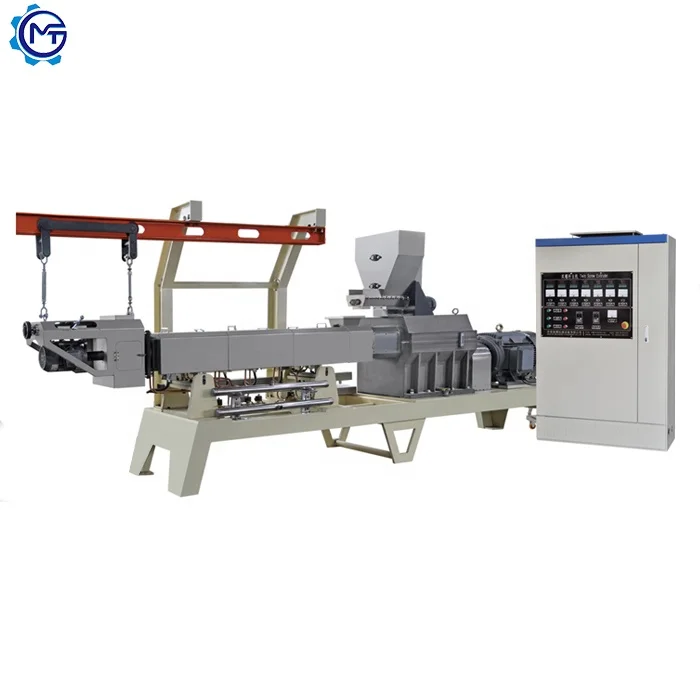
Automatic Fried Puffed Snacks Production Line for Rice Snacks – Complete Line
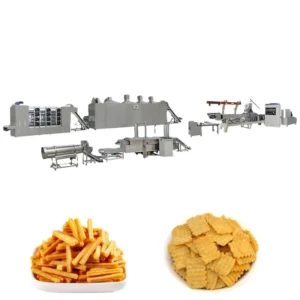
Integrated Station Matching — every mixer, extruder, fryer, and flavoring drum on this line is sized to the same throughput target, preventing the mid-line pile-ups that silently cut actual output.
Technical Specifications
| Parameter | Value |
|---|---|
| Product Type | Fried Puffed Snacks Production Line |
| Extruder Type | Single-screw extruder |
| Screw Configuration | High and low pressure screw |
| Rated Power | 50–70 kW |
| Voltage & Frequency | Three-phase 380V/50Hz; Single-phase 220V/50Hz (customizable) |
| Energy Source Options | Electricity / Gas / Diesel / Steam |
| Output Capacity | 120 kg/h (basis to be confirmed) |
| Overall Dimensions (L×W×H) | 12,000–26,000 × 1,200 × 2,200 mm |
| Material Construction | Food-grade stainless steel 201/304 |
| Die Configuration | Interchangeable dies for multiple shapes |
| Standards | CE, ISO 9001 |
Application Suitability
| Application | Material or Output |
|---|---|
| Secondary-puffing fried snacks | Wheat flour, corn starch, potato starch blends |
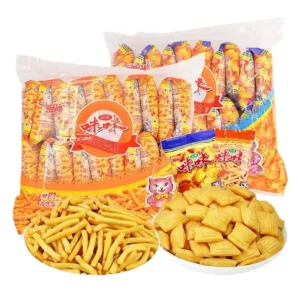
| Rice puff and golgappa shapes | Screw shell, round tube, square tube, ring, cartoon shapes |
| Pani puri and pasta-type formats | Starch-based dough with controlled moisture input |
| Snack food line expansion projects | Producers adding fried formats to existing extrusion capacity |
Why "Line Capacity" Means Nothing Without Station Alignment
A Fried Puffed Snacks Production Line manufacturer must match every station to the same throughput, or the slowest unit dictates real output.
I have watched extruders push product faster than the downstream fryer can handle, leaving half-formed pellets stacking on the conveyor belt. The moisture absorbed during that wait softens the surface, so the secondary puffing in the oil bath never fires correctly. Buyers see a nameplate capacity and assume the whole line delivers it, but the bottleneck is rarely the extruder — it is the station nobody thought to size properly [NEED_CITE: throughput matching principles in continuous food processing lines].
Single-Screw Extrusion and the High-Low Pressure Advantage
The single-screw extruder on this line uses a high and low pressure screw configuration that processes a wider range of starch ratios without pre-conditioning. This matters when buyers blend wheat flour with corn or potato starch at varying proportions to control raw material cost. The pressure zones inside the barrel handle the viscosity shifts, maintaining consistent expansion as the dough exits the die. A Fried Puffed Snacks Production Line manufacturer specifying this screw type reduces the need for reformulation trials every time a supplier changes flour grade.
Multi-Shape Output From One Die Station
Interchangeable dies allow the extruder to produce screw shells, round tubes, square tubes, rings, and cartoon shapes without swapping the entire barrel assembly. Changeover between formats takes minutes rather than hours, which keeps short production runs economically viable. Snack producers entering multiple market segments — children’s shapes for retail bags, round tubes for food-service pani puri — run the same base dough through different dies on the same shift. The die seat tolerance holds dimensional consistency across shapes [NEED_CITE: die interchangeability standards in snack extrusion equipment].
Power, Energy Source, and What They Mean for Your Utility Bill
The rated power of 50–70 kW covers the extruder drive and auxiliary motors, while total electrical consumption for the full line approaches 100 kW when running on all-electric heating. For markets where gas or diesel costs less per thermal unit, the fryer and dryer stations switch to those fuels, dropping electrical draw to approximately 50–60 kW. Voltage customization to the destination country’s three-phase standard prevents the transformer rentals that delay commissioning on arrival. The stainless steel 201/304 construction across all product-contact surfaces meets food safety audit requirements without secondary coating or cladding.
The Cost of Skipping the Fryer-Flavoring Synchronization
When the automatic fryer and flavoring drum are sourced separately from the extruder, their belt speeds and residence times rarely align. Product exits the fryer too hot for the seasoning drum, so flavor powder clumps on contact rather than coating evenly. Or the drum rotates too slowly, and snacks back up into the cooling conveyor still wet with oil. These mismatches do not appear in any single machine’s spec sheet — they only surface during the first live production run, when the buyer is already committed [NEED_CITE: consequences of unmatched line station throughput in snack manufacturing].
Why Source This Line From MT
Every station on this Fried Puffed Snacks Production Line is configured under one supplier, so the pulling-and-cutting machine speed, fryer belt length, and flavoring drum diameter all reference the same output target. The in-house testing workshop runs your actual wheat flour or corn starch blend before shipment, documenting shape fidelity, fry expansion, and seasoning adhesion in a trial report. Screw and die configurations are recorded against your target product specification, not copied from a generic build. Electrical schematics confirm voltage, frequency, and control language for your destination country before the crate is sealed.
Documentation & Verification
- Line layout with station-by-station capacity calculation for your target snack format
- Trial run report using your wheat flour or potato starch blend on the single-screw extruder
- Screw and die configuration record mapped to your requested shapes and density spec
- Electrical schematic confirming three-phase voltage and frequency for your facility
Installation, Commissioning & Support
- Foundation plan reflecting the 12,000–26,000 mm line length and utility connection points
- Dedicated circuit sizing for the 50–70 kW extruder drive and total line draw
- On-site assembly of conveyor links between extruder, fryer, and flavoring stations
- First-run parameter setting for screw speed, barrel temperature, and fryer oil temperature
- Operator training covering die changeover and high-low pressure screw adjustment
- Wear parts list identifying screws, dies, and fryer belt segments for first reorder
What to Include in Your Inquiry
Provide your primary raw material blend — wheat flour, corn starch, or potato starch — along with the target snack shapes and expected daily output in kilograms. Confirm your facility’s three-phase voltage and frequency, preferred energy source for the fryer station, and whether you need a trial run on your raw material before shipment.
Frequently Asked Questions
Q: How is the output capacity verified, and what conditions affect it?
A: Output depends on the raw material blend, moisture content entering the extruder, and the specific die shape selected. The single-screw extruder processes wheat flour, corn starch, and potato starch at different throughputs. We run a trial on your actual formulation in our testing workshop and document the measured capacity in the trial report before confirming the line specification.
Q: How are extruder, fryer, and flavoring capacities matched?
A: Each station is sized during the layout phase so that belt speeds, residence times, and drum volumes all reference the same throughput target. The pulling-and-cutting machine output rate sets the pace, and the automatic fryer belt length and flavoring drum diameter are calculated to handle that volume without product accumulation between stations.
Q: What voltage and control options are confirmed before shipment?
A: We confirm your facility’s three-phase voltage, frequency, and preferred control language before production begins. The electrical schematic is reviewed with your engineering team, and the energy source for the fryer — electricity, gas, diesel, or steam — is locked in based on your local utility costs and availability.
Q: How is the screw and die configuration selected for my product?
A: The high and low pressure screw configuration is matched to your raw material viscosity and target expansion ratio. Interchangeable dies are selected based on your requested shapes — screw shell, round tube, square tube, ring, or custom cartoon formats. Both are documented in the configuration record and validated during the pre-shipment trial run.