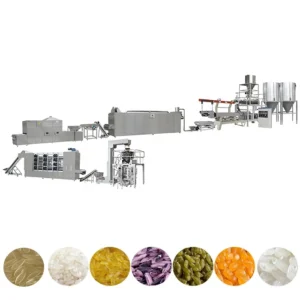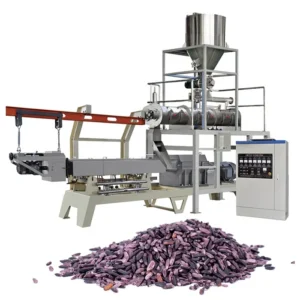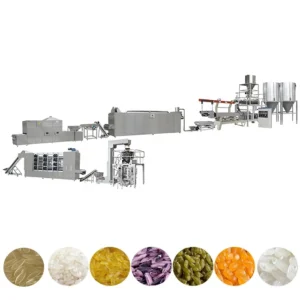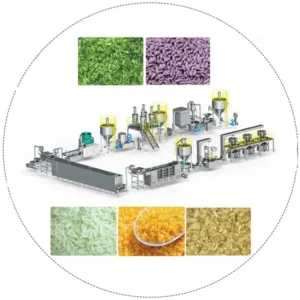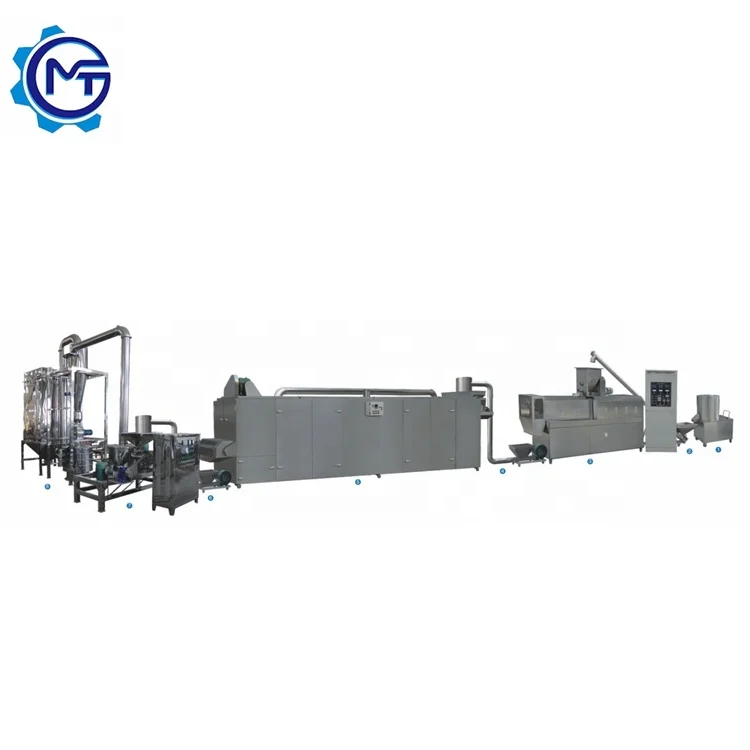
Throughput-matched line stations — every module from mixing through packing is sized to hold rated output on your actual cereal blend rather than assembled from separate vendors.
Technical Specifications
| Parameter | Value |
|---|---|
| Model | MT65 / MT70 / MT85 |
| Product Type | Nutritional Powder Extrusion Production Line |
| Screw Type | Twin-screw |
| Installed Power | MT65 — 66 kW; MT70 — 100 kW; MT85 — 130 kW |
| Real Power Consumption | MT65 — 50 kW; MT70 — 67 kW; MT85 — 80 kW |
| Output Capacity | MT65 — 100–150 kg/h (basis to be confirmed); MT70 — 200–240 kg/h (basis to be confirmed); MT85 — 400–500 kg/h (basis to be confirmed) |
| Voltage & Frequency | Three-phase 380 V / 50 Hz, Single-phase 220 V / 50 Hz (configurable to local standards) |
| Overall Dimensions (L×W×H) | MT65 — 19 000×1 200×2 200 mm; MT70 — 21 000×1 500×2 200 mm; MT85 — 30 000×3 500×4 300 mm |
| Machine Materials | Stainless steel, food-grade contact surfaces |
| Control System | PLC and MCC integrated across line stations |
| Line Stations | Mixing system → Extrusion system → Drying system → Milling system → Packing system |
| Standards | CE (since 2014), ISO certified |
Application Suitability
| Application | Material or Output |
|---|---|
| Infant baby food production | Cereal flours (rice, oat, wheat) blended with milk powder and natural flavors |
| Fortified blended food programmes (FBF, CSB, Samaposha) | Maize, soy, sorghum and pulse blends with vitamin-mineral premix |
| Instant breakfast flour and nutritional drink bases | Corn, wheat and oat flours with fruit or vanilla flavor inclusions |
| Institutional and relief nutrition supply | High-energy cereal-legume blends meeting WFP-style specifications |
What "Rated Capacity" Means When Your Formula Contains High-Fibre Grains
A nutritional powder processing line full equipment range only delivers its nameplate output when every station is matched to the buyer’s real formula, not a generic test flour.
I spent years on the factory floor running quality checks before moving into line configuration for buyers across Southeast Asia. One project stands out: a plant producing fortified infant porridge specified a line on standard rice flour, and trial runs looked fine. When the buyer switched to their actual recipe — a high-fibre blend of sorghum, soy and millet — the extrudate lost expansion, the powder clumped after milling and solubility fell well short of target. The screw profile and dryer residence time needed a full week of re-tuning on site. Since then I insist on seeing the buyer’s real material run through the testing workshop before any configuration is locked in. That single step separates a nutritional powder processing line full equipment range that performs on day one from one that burns through commissioning budget [NEED_CITE: common causes of extrusion line commissioning delays in tropical climates].
How Each Station in the Nutritional Powder Processing Line Full Equipment Range Connects
The sequence starts with a batching and mixing system that meters cereal flours, milk powder and micro-nutrient premix into a homogeneous feed. Uniform moisture distribution at this stage directly affects gelatinisation consistency inside the barrel.
The twin-screw extruder then applies controlled shear and heat, cooking the starch matrix to a degree that determines both digestibility and downstream milling behaviour. Barrel temperature zones and screw element spacing are specified to the buyer’s cereal blend so that the extrudate exits at the correct moisture and density for the dryer.
Matching Dryer, Mill and Packing to Extruder Output
A frequent bottleneck on nutritional powder lines is a dryer that cannot remove moisture fast enough to keep up with the extruder, forcing operators to cut feed rate. On this nutritional powder processing line full equipment range, the dryer belt length and air-flow volume are calculated against the extruder’s real power draw and expected evaporation load. The milling station that follows is selected for target particle size — typically below 200 microns for instant infant cereal — and the packing station is rated for the finished bulk density so that bag weights remain within tolerance [NEED_CITE: particle size targets for instant nutritional powders].
Reading the Power and Capacity Figures
Three extruder models — MT65, MT70 and MT85 — span distinct installed-power tiers from 66 kW to 130 kW, while real power consumption sits between 50 kW and 80 kW. The gap between installed and real power reflects motor start-up peaks and safety margin; utility planning should use the real power figure for continuous load calculation and the installed figure for cable sizing and breaker rating. Output capacity ranges from 100–150 kg/h on the MT65 to 400–500 kg/h on the MT85, though actual throughput depends on raw material density, moisture content and target expansion ratio. Always request a trial run report on your own formula before treating the capacity plate as a production commitment.
When a Mismatched Station Derails the Whole Line
Buyers sometimes source the extruder from one vendor and the dryer from another, only to discover that the dryer’s thermal capacity is too low for the extruder’s moisture load. The result is a nutritional powder that exits the mill above target moisture, leading to caking in storage and rejection at the packing station. Similar problems arise when the milling unit is specified for a coarser product than the buyer actually needs — re-milling adds heat and can denature heat-sensitive vitamins in fortified blends. These mismatches rarely show up in individual machine quotations; they only become visible when the entire nutritional powder processing line full equipment range is laid out as one throughput chain [NEED_CITE: effects of moisture imbalance on vitamin stability in fortified powders].
Why Source the Entire Line from One Supplier
Meiteng builds the nutritional powder processing line full equipment range as a single project, so throughput calculations run from the mixer through to the packing head under one responsibility. Screw configuration and die geometry are selected after reviewing the buyer’s cereal formula, not copied from a generic build. An in-house testing workshop allows trial runs on the buyer’s actual raw material before the line ships, reducing on-site rework. CE and ISO documentation covers the complete line rather than individual machines, simplifying import clearance. Pre-sales consultation, on-site installation, commissioning and operator training are handled by the same engineering team that designed the layout, keeping accountability in one place.
Documentation & Verification
- Line layout and capacity calculation showing throughput balance across every station
- Screw and die configuration record matched to your cereal blend and target fineness
- Trial run report on your raw material produced in the in-house testing workshop
- Electrical schematic with voltage, frequency and HMI language confirmed before build
- CE declaration of conformity and ISO certificate covering the complete line
- Operation and maintenance manual with wear-parts list for extruder screws and dryer belts
Installation, Commissioning & Support
- Foundation must carry the MT85 line footprint of 30 000×3 500 mm with level tolerance for continuous dryer belt alignment
- Dedicated three-phase circuit sized to the installed power of the selected extruder model plus dryer and mill loads
- Line ships in modular sections; extruder barrel segments and dryer panels reassemble on site with alignment checks
- First production run includes screw speed, barrel temperature and dryer airflow mapping to your formula
- Operator training covers PLC set-point adjustment, HMI navigation and emergency stop sequence in the confirmed language
- Wear-parts kit includes twin-screw elements, die plates and dryer belt sections for the first replacement cycle
What to Prepare Before Requesting a Quotation
Share your cereal formula with moisture percentage, target powder particle size and daily output goal. Include the local voltage, frequency and preferred control language so that the MCC and PLC are configured before dispatch. If your workshop has height or floor-load limits, send a dimensioned sketch so the layout can be adapted to the MT85’s 4 300 mm clearance or the more compact MT65 envelope.
Frequently Asked Questions
Q: How is output capacity verified on my specific cereal flour blend and moisture content?
A: Before shipment, your raw material is run through the in-house testing workshop on the selected extruder model. Screw speed, barrel temperature profile and die geometry are adjusted until the extrudate meets your target expansion and solubility. A trial run report documenting actual throughput and product quality is issued for your review.
Q: What supporting equipment is matched to each extruder model to prevent bottlenecks?
A: The dryer belt length, milling rotor diameter and packing auger speed are all calculated against the extruder’s real output on your formula. This ensures moisture removal, particle size reduction and bag filling keep pace without forcing the extruder to idle between batches.
Q: Can the line voltage, frequency and control language be configured for my country before shipment?
A: Yes. The standard three-phase 380 V / 50 Hz supply is configurable to your local utility specification. PLC and MCC programming, including HMI text and alarm messages, are set in your preferred language during factory assembly so that commissioning starts without translation delays.
Q: What is the difference between installed power and real power across the three models?
A: Installed power covers motor start-up peaks and safety margins used for cable and breaker sizing. Real power reflects continuous energy draw during steady-state production. Utility planning should use real power for load calculation — 50 kW for the MT65, 67 kW for the MT70 and 80 kW for the MT85.
Q: Is a trial run on my raw material conducted before the line ships?
A: Yes. The testing workshop runs your exact cereal blend through the configured extruder, dryer and mill sequence. Results including throughput, moisture content, particle size and solubility are recorded in a trial run report that you approve before the line is packed for dispatch.