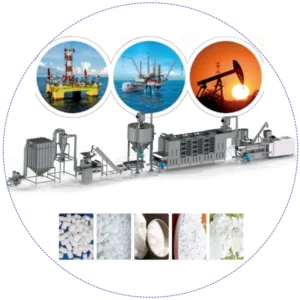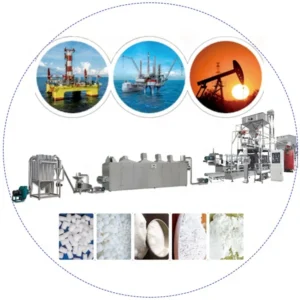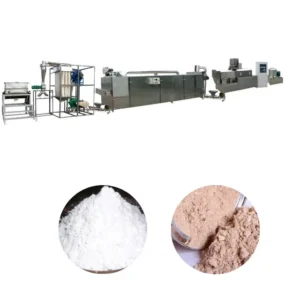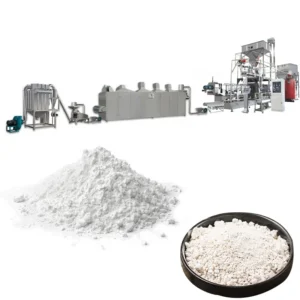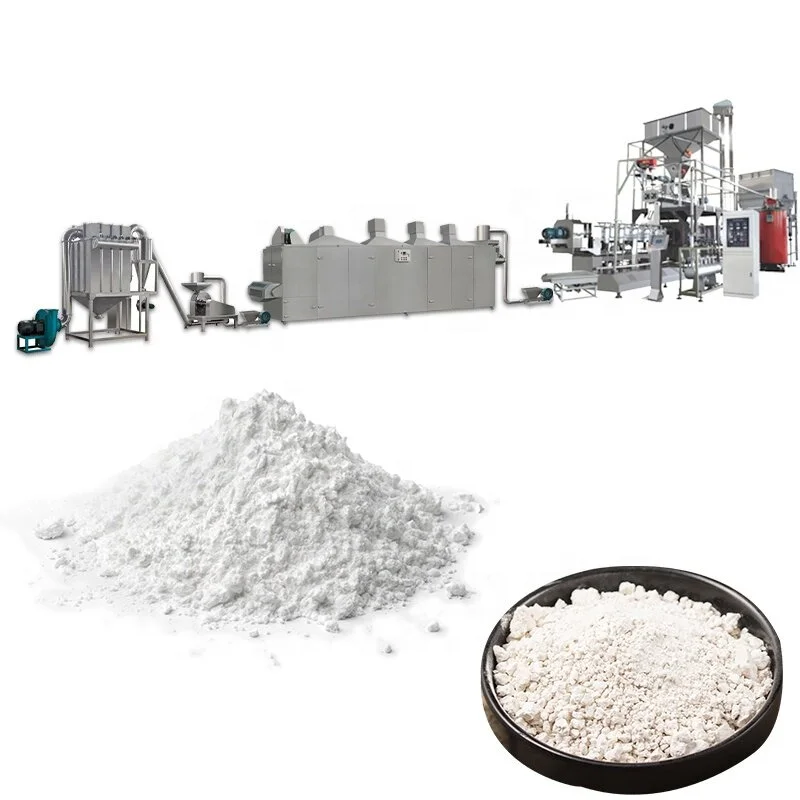
Integrated Line Throughput Matching — every station from raw starch feeding through extrusion to drying is sized to your specific modification target, eliminating the bottlenecks that plague multi-vendor assemblies.
Technical Specifications
| Parameter | Value |
|---|---|
| Product Type | Modified Starch Processing Line |
| Extruder Type | High-torque self-cleaning twin-screw extruder |
| Control System | PLC touchscreen control |
| Raw Material Compatibility | Corn starch, potato starch, tapioca starch, wheat starch |
| Barrel Temperature Control | Segmented temperature control |
| Product Variants | Pregelatinized starch, cross-linked starch, oxidized starch, cationic starch |
| Construction Material | SUS304/316 stainless steel (all material contact parts) |
| Process Stages | Raw material feeding, mixing, reaction, extrusion, drying, final packaging |
| Automation Level | Full-automatic (minimal labor required) |
| Output Capacity | (basis not stated in source — confirm raw material type, moisture content, and target starch modification) |
| Standards | CE, ISO |
Application Suitability
| Application | Material or Output |
|---|---|
| Food industry starch modification | Pregelatinized corn and potato starch for instant food, bakery, and confectionery use |
| Textile industry starch processing | Oxidized and cross-linked starch for warp sizing and fabric finishing |
| Paper making industry starch production | Cationic and oxidized starch for paper surface sizing and coating |
| Oil drilling starch applications | Modified tapioca and corn starch for drilling fluid viscosity control |
| Construction industry starch use | Pregelatinized starch as additive in gypsum board and dry-mix mortar |
| Adhesives manufacturing | Oxidized and cross-linked starch for corrugated board and label adhesives |
| Pharmaceutical industry starch processing | Pregelatinized starch as tablet binder and disintegrant |
What "Rated Capacity" Means When Your Raw Material Changes Weekly
A starch line quoted on one feedstock may produce entirely different throughput on another.
I have watched buyers commit to a modified starch processing line full equipment range based on a capacity figure tied to corn starch, only to discover the same extruder behaves differently on tapioca or potato starch. Gelatinization temperature, moisture absorption rate, and shear sensitivity all shift with the source material. A line that runs smoothly on one feedstock can stall, surge, or produce off-spec product when you switch. Capacity must always be tied to a named raw material and a named modification target [NEED_CITE: starch gelatinization behavior across different botanical sources].
Matching Barrel Zones to Starch Reaction Requirements
Starch modification inside a twin-screw extruder depends on precise thermal and mechanical input at each stage of the barrel. Segmented temperature control allows the operator to set distinct heating profiles along the barrel length, so the feed zone can remain cool enough to prevent premature gelatinization while downstream zones reach the temperatures required for cross-linking or oxidation reactions. A modified starch processing line full equipment range built without this zoning forces a single thermal compromise across the entire barrel, which limits the range of modification types you can produce reliably.
Why Stainless Steel Grade Matters Beyond Hygiene
SUS304 and SUS316 stainless steel in all material contact zones serve a purpose that goes beyond food safety compliance. Certain starch modification reactions — particularly oxidation with hypochlorite or cationic substitution with reagents — involve chemicals that corrode ordinary steel over time. Corrosion pits become contamination points and accelerate wear on screw elements. Specifying the correct alloy from the outset extends screw life and keeps heavy metal migration within pharmaceutical or food-grade limits [NEED_CITE: corrosion resistance comparison of SUS304 versus SUS316 in chemical processing].
Reading the Specs That Actually Govern Output
The high-torque twin-screw extruder at the center of this modified starch processing line full equipment range is specified by its screw diameter, length-to-diameter ratio, and motor power rather than a single throughput number. The L/D ratio determines residence time inside the barrel, which directly controls how thoroughly the starch granules undergo the intended chemical or physical modification. Shorter residence time favors pregelatinized starch where the goal is rapid granule disruption and cooling; longer residence time suits cross-linked starch where reagent penetration must be uniform. Motor torque defines how much mechanical shear you can apply without stalling the screws, which is critical when processing high-amylose corn starch that demands more energy to break down than waxy varieties.
The Cost of Undersized Drying
One of the most frequent mismatches I encounter on starch modification projects is a dryer that cannot keep pace with the extruder. Modified starch exits the die at high moisture and must be dried to a target level — typically between eight and twelve percent depending on the end use — before milling and packaging. If the dryer capacity falls short, wet product accumulates, clumps, and degrades. Buyers sometimes focus entirely on extruder specifications and treat the dryer as an afterthought, only to find that the entire line is governed by its slowest station [NEED_CITE: industrial drying requirements for modified starch moisture targets].
Sourcing Decisions Backed by Testing, Not Catalogue Numbers
Every modified starch processing line full equipment range we configure starts with your raw material sample arriving at our testing workshop. We run your actual starch — not a generic substitute — through the extruder with the screw configuration and barrel profile matched to your target modification type. The trial run report documents moisture input, barrel temperatures at each zone, screw speed, die pressure, and the measured modification rate of the output. This is the document you compare against your product specification before the line ships. Our strength lies in matching every station to the same throughput basis, so the mixer, extruder, dryer, and packaging system all operate at balanced capacity rather than one section waiting on another.
Documentation & Verification
- Line layout and capacity calculation based on your named starch source and modification target
- Screw and die configuration record tied to your trial run parameters
- Electrical schematic with voltage and frequency confirmed for your installation site
- Factory trial run report on your raw material documenting modification rate and moisture
- CE declaration of conformity and ISO certificate for customs and regulatory submission
- Operation and maintenance manual with wear parts list and replacement intervals
Installation, Commissioning & Support
- Foundation plan and floor space layout matched to the PLC-controlled line footprint
- Dedicated power circuit sizing confirmed against total connected load and local voltage
- Extruder barrel segments and screw elements shipped disassembled for site reassembly
- First-run commissioning with your raw material to validate segmented temperature settings
- Operator training on touchscreen interface, recipe storage, and emergency stop sequences
- Spare screw elements, die plates, and seals dispatched with initial shipment
What We Need Before Quoting Your Line
Send us the starch source you intend to process, the modification type you are targeting, and your daily output requirement in kilograms or tons. Include your site voltage and frequency, the language your operators need on the PLC interface, and whether you have existing upstream mixing or downstream milling equipment we must interface with. If you can ship a raw material sample to our workshop, we will run a trial and include the results with our proposal.
Frequently Asked Questions
Q: How is output capacity verified for different starch raw materials and modification targets?
A: We request a sample of your actual starch and run it through the twin-screw extruder in our testing workshop using the screw configuration and barrel temperature profile matched to your target modification. The trial run report documents throughput, moisture content, and modification rate, giving you a verified capacity figure tied to your specific raw material rather than a generic estimate.
Q: What screw configuration matches pregelatinized versus cross-linked starch production?
A: Pregelatinized starch requires aggressive shear and rapid heating to disrupt granule structure, so we use forward-conveying elements with high-shear kneading blocks concentrated in the early barrel zones. Cross-linked starch needs gentler conveying with longer residence time for reagent penetration, which means more mixing elements spread across the full barrel length and reduced screw speed.
Q: How does segmented temperature control affect starch modification rate and product consistency?
A: Each barrel zone is heated independently, so the feed zone stays cool to prevent premature gelatinization while reaction zones reach the exact temperature your modification chemistry requires. This zoning prevents thermal overshoot that would degrade the starch polymer and allows the operator to store distinct temperature profiles for each product variant in the PLC.
Q: What voltage and control language options are available for international installations?
A: The PLC control system and all drive motors are configured to your site voltage and frequency before shipment. We confirm these values during the proposal stage and document them in the electrical schematic. Touchscreen interface language is set to your preference, and all labels on the control panel are printed accordingly before factory testing begins.
Q: How are upstream mixing and downstream drying capacities matched to extruder throughput?
A: We calculate mixer batch size and cycle time so that continuous feed to the extruder is maintained without interruption. The dryer is sized for the specific moisture removal rate your modification process demands, ensuring that wet starch does not accumulate between the extruder die and the dryer inlet. Every station shares the same throughput basis documented in the line layout.