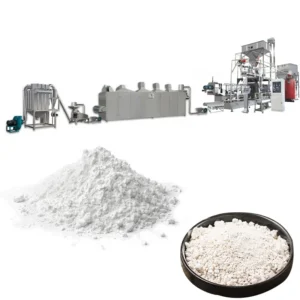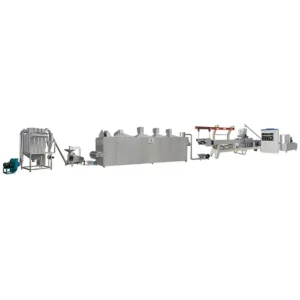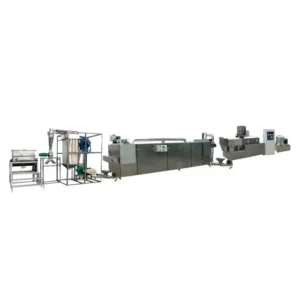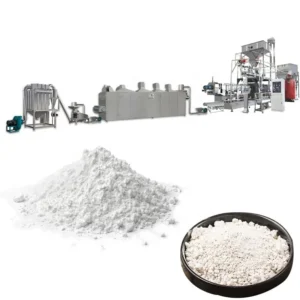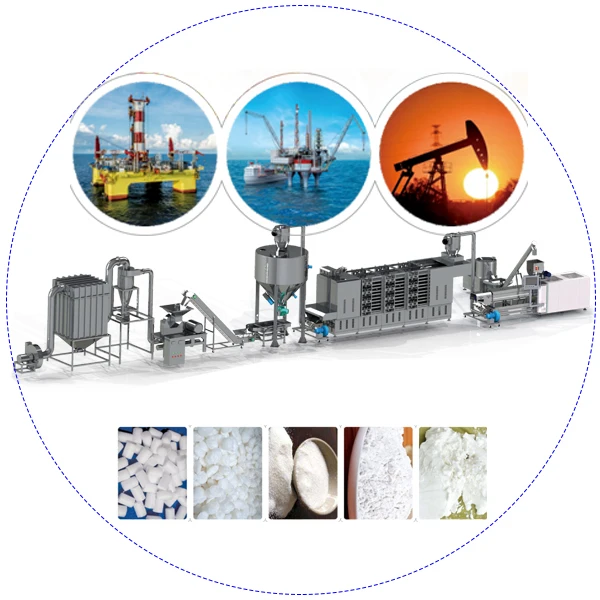
Integrated Line Throughput — Every station from the twin-screw extruder through the pulse grinder is matched on capacity so the modified starch processing line full equipment range runs at its rated output without downstream bottlenecks.
Technical Specifications
| Parameter | Value |
|---|---|
| Product Type | Modified Starch Processing Line |
| Screw Type | Twin-screw extruder |
| Power Range | 45–200 kW |
| Output Capacity | 100–1500 kg/h (basis not stated in source — confirm raw material, moisture content and target starch modification type) |
| Voltage & Frequency | 220–440 V, tri-phase (configurable to 380 V 50 Hz, 415 V 60 Hz, 220 V 60 Hz, etc.) |
| Net Weight | 1000–5000 kg |
| Control System | PLC and MCC |
| Assembly State | Complete line with multiple stations |
| Line Stations | Twin-screw extruder, cooling and air-drying conveyor, pulse grinder with cyclone discharge and dust collector |
| Raw Materials | Corn starch, wheat flour, cassava starch, rice flour, soybean flour, additive materials |
| Contact Material | Food-grade stainless steel (PVC used on some conveyors) |
| Fuel / Heating Options | Gas, diesel, electricity, steam (buyer to specify at quotation) |
| Standards | CE (since 2014), ISO certified |
Application Suitability
| Application | Material or Output |
|---|---|
| Food-grade pre-gelatinised starch | Corn starch, wheat flour, rice flour for bakery and instant food applications |
| Industrial modified starch | Cassava and corn starch for oil drilling mud and paper sizing |
| Nutritionally modified starch powder | Soybean flour and grain blends for fortified food and infant formula bases |
| Cassava deep-processing | Raw cassava starch converted to high-value modified starch for regional export markets |
Why the Extruder’s Nameplate Capacity Means Nothing Without the Rest of the Line
A modified starch processing line full equipment range is only as productive as its weakest station.
When buyers focus solely on the twin-screw extruder’s motor power or barrel count, the cooling conveyor and pulse grinder often end up undersized. The extruder pushes out gelatinised starch at a steady rate, but if the air-drying conveyor cannot reduce surface moisture fast enough, the material clumps before it reaches the grinder. The grinder then chokes, throughput drops, and the whole line runs well below what the quotation promised. I have seen plants where the extruder was capable of running far more, but the downstream equipment forced the operator to throttle back to a fraction of the nameplate figure [NEED_CITE: line throughput bottleneck causes in starch processing].
How Each Station Connects to the Next
The twin-screw extruder handles the core modification work: starch gelatinisation, shear-induced molecular breakdown, and moisture adjustment all happen inside the barrel. Screw configuration and die design are specified to the buyer’s actual raw material — cassava starch behaves differently from corn starch under heat and shear, so the screw profile and barrel temperature zones must be set accordingly. The extruded output exits as a continuous strand or ribbon that carries residual moisture and elevated temperature.
The cooling and air-drying conveyor takes over immediately. Low-power wind-knozzle fans blow across the strand to bring the temperature down and evaporate surface moisture without over-drying the core. If this stage is too short or the airflow too weak, the material enters the pulse grinder still tacky, causing screen blockages and inconsistent particle size.
What Happens Inside the Pulse Grinder and Cyclone
The pulse grinder reduces the cooled starch strand into the fine powder that downstream food or industrial applications require. A cyclone discharge system separates the powder from the air stream, and an integrated dust collector captures fines that would otherwise escape into the workshop. This closed-loop collection matters because modified starch powder is light and prone to dusting — product loss and workshop air quality are both at stake. The grinder screen size determines the final mesh of the modified starch, and this specification should be agreed before the equipment is built, not improvised during commissioning [NEED_CITE: particle size control in starch grinding operations].
Reading the Specs That Actually Matter
The power range of 45–200 kW across the line reflects the span from small pilot-scale production to large-volume output. A higher motor rating on the extruder means greater torque for viscous starch masses, which directly affects how thoroughly the material is gelatinised. Under-powered extruders struggle with cassava starch, which demands more shear energy than corn starch to reach full modification.
Voltage and frequency configuration must match the buyer’s factory supply before production begins. A 380 V 50 Hz machine shipped to a plant running 415 V 60 Hz will experience motor speed drift, which changes screw RPM and alters the residence time inside the barrel — the starch will not gelatinise as expected. PLC and MCC control allows the operator to set and lock barrel temperature profiles, screw speed, and feeder rates, giving repeatable batch-to-batch results once the correct parameters are established for a given raw material.
The Hidden Cost of Mismatched Stations
When the cooling conveyor is too short for the extruder’s output rate, partially cooled starch enters the grinder and creates a paste rather than a powder. The operator then slows the extruder to compensate, and the line runs at a fraction of its design capacity. Over time, the grinder screens wear unevenly from the sticky feed, and unplanned downtime for screen replacement becomes routine. These are not equipment failures — they are design mismatches that show up only after the line is running on the buyer’s actual raw material [NEED_CITE: consequences of undersized downstream equipment in extrusion lines].
Why Buyers Source the Full Range Here
The modified starch processing line full equipment range comes from a single manufacturer, so throughput calculations cover every station rather than just the extruder. Each line is designed so the cooling conveyor length, grinder capacity, and cyclone sizing all match the extruder’s confirmed output on the buyer’s specific starch type.
Screw configuration and die design are recorded for each project based on the raw material sample the buyer sends. The in-house testing workshop runs the buyer’s actual cassava, corn, or wheat starch through the extruder before shipment, so gelatinisation degree and expansion behaviour are validated in advance. CE and ISO certification is held across the equipment range, and documentation packages include the trial run report alongside the standard machine specification sheet and electrical schematic.
Documentation & Verification
- Line layout and capacity calculation matching every station’s throughput to the confirmed raw material
- Screw and die configuration record specific to the buyer’s starch type and target modification
- Electrical schematic with voltage and frequency confirmed against the buyer’s factory supply
- Trial run report on the buyer’s actual raw material from the in-house testing workshop
- CE declaration of conformity and ISO certificate for the complete equipment range
- Wear parts list covering screws, dies, grinder screens, and conveyor belts
Installation, Commissioning & Support
- Foundation and floor space planning based on the full line footprint from extruder to packing station
- Power supply verification for the configured voltage and frequency before the PLC and MCC cabinets are energised
- Barrel temperature profiling and screw speed calibration using the buyer’s raw material during on-site commissioning
- Operator training on PLC interface, grinder screen changes, and cyclone dust collector maintenance
- Wear parts stock recommendation covering screws, dies, and pulse grinder screens for the first replacement cycle
- Ongoing technical support for recipe adjustments when the buyer switches between corn, cassava, and wheat starch sources
What We Need to Move Forward
Send the specific starch type you plan to process — corn, cassava, wheat, rice, or a blend — along with the target modification outcome such as pre-gelatinisation or nutritional enhancement. Include your factory’s voltage and frequency supply, and whether your existing packing system needs to be integrated or if a new packing station is required. If you can ship a raw material sample to our testing workshop, we will run it before the line is built and share the trial results with the quotation.
Frequently Asked Questions
Q: What raw materials can this modified starch line process, and how does the extruder adapt?
A: The line handles corn starch, cassava starch, wheat flour, rice flour, soybean flour, and additive blends. The twin-screw extruder adapts through configurable screw profiles and barrel temperature zones matched to each material’s gelatinisation behaviour. A trial run on your actual raw material in our testing workshop confirms the correct configuration before the equipment ships.
Q: How is throughput matched across the extruder, cooling conveyor, and grinder?
A: Each station is sized based on the extruder’s confirmed output on your specific starch type. The cooling conveyor length and airflow, pulse grinder capacity, and cyclone discharge rate are all calculated so no station becomes a bottleneck. The capacity calculation document included with every quotation shows the matched throughput across the full modified starch processing line full equipment range.
Q: What voltage and frequency options are available, and how is the control language set?
A: The line is configurable to tri-phase supplies from 220 V to 440 V, including common configurations like 380 V 50 Hz, 415 V 60 Hz, and 220 V 60 Hz. Voltage and frequency are confirmed against your factory supply before production. The PLC and MCC control system can be set to the operator’s preferred language during commissioning on site.
Q: Can the same line produce both food-grade and industrial-grade modified starch?
A: Yes, the equipment handles both food-grade pre-gelatinised starch for bakery and nutrition applications and industrial modified starch for oil drilling and paper sizing. The screw configuration and barrel temperature profile are adjusted between product types, and the food-grade stainless steel contact surfaces meet hygiene requirements for both categories.
Q: What supporting stations are included, and can packing be integrated?
A: The standard line includes the twin-screw extruder, cooling and air-drying conveyor, and pulse grinder with cyclone and dust collector. Additional upstream stations like mixing and batching systems, and downstream packing machines, can be integrated into the line layout. The throughput of every added station is matched to the extruder’s confirmed output.