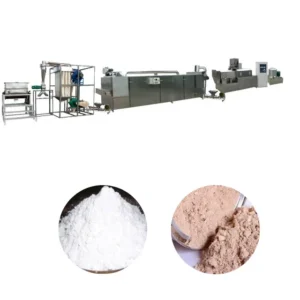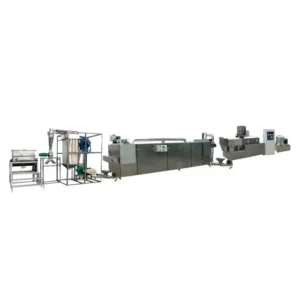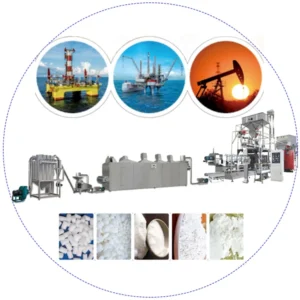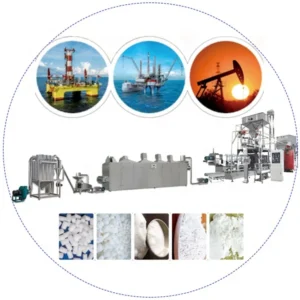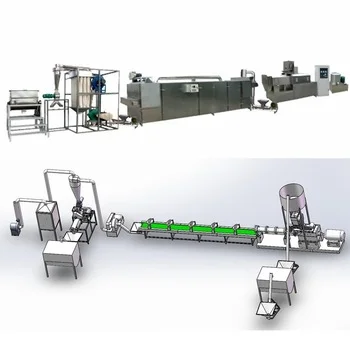
Complete Equipment Matched — Every station in this modified starch line, from twin-screw extrusion through cooling to pulse grinding, is throughput-balanced under a single supplier to eliminate mid-line bottlenecks that surface when equipment is sourced piecemeal.
Technical Specifications
| Parameter | Value |
|---|---|
| Product Type | Modified Starch Production Line |
| Rated Power | 45–200 kW |
| Voltage & Frequency | 220–440 V, tri-phase (configurable to site supply) |
| Control System | PLC |
| Output Capacity | 100–1500 kg/h (basis not stated in source — subject to raw material type, moisture content and degree of modification) |
| Net Weight | 1000–5000 kg |
| Assembly State | Complete line: twin-screw extruder, cooling conveyor, pulse grinder |
| Raw Materials | Corn starch, wheat flour, rice flour, soybean flour, potato starch, additive materials |
| Fuel Options | Gas, diesel, electricity, steam |
| Screw Type | Twin screw (three generations of design refinement) |
| Material Contact Parts | Food-grade stainless steel (select conveyors with PVC belting) |
| Standards | CE, ISO |
Application Suitability
| Application | Material or Output |
|---|---|
| Food-grade modified starch for thickening and stabilising agents | Corn starch, potato starch with chemical or physical additive modification |
| Oil drilling fluid starch additives | Corn starch, wheat flour processed for thermal stability and controlled viscosity |
| Paper industry binding and coating starch | Corn starch, rice flour modified for adhesive and surface-sizing performance |
| Pre-gelatinised starch for instant food blends | Wheat flour, soybean flour with moisture and shear-controlled gelatinisation |
What "Rated Capacity" Leaves Out About Starch Extrusion
A capacity figure means nothing until it has been validated against your specific starch source, additive formulation and target modification degree.
I once configured a starch modification line based on standard corn starch trial data, only to discover on arrival at the buyer’s plant that the actual feedstock was cassava starch. The viscosity curve was entirely different, the gelatinisation temperature shifted, and we spent nearly two weeks re-profiling barrel zones and screw elements before the output met specification. That kind of delay does not show up in a brochure capacity table. When evaluating any Modified Starch Processing Line manufacturer, the question is not what the nameplate says but whether the supplier has run your exact formulation through the extruder before the machine leaves the factory [NEED_CITE: importance of raw material trial runs in starch extrusion projects].
Barrel Temperature Profiling Across Starch Chemistries
Starch from different botanical sources gelatinises at different temperatures and responds differently to shear inside the barrel. Corn starch, potato starch and cassava starch each demand a distinct barrel temperature gradient and screw element sequence to achieve the target degree of modification without over-degrading the polymer chain. The PLC-controlled barrel zones on this line allow operators to set and hold independent temperature profiles across the full barrel length, so switching from one starch source to another is a recipe change rather than a mechanical rebuild.
Why Screw Element Sequencing Determines Modification Quality
The three generations of twin-screw design refinement behind this extruder address the specific challenge of starch processing: maintaining enough shear to complete the chemical or physical modification while avoiding excessive mechanical degradation that reduces final viscosity. Each screw section — feed, compression, gelatinisation, metering — is specified to the buyer’s formulation. This is where a generic screw build copied from a snack-food application falls short; the residence time distribution and shear history the material experiences inside the barrel directly determine the functional properties of the finished modified starch [NEED_CITE: twin-screw element configuration for starch modification].
How Pulse Grinding and Cyclone Discharge Control Particle Size
After extrusion and cooling, the modified starch must be ground to a consistent particle size that meets the buyer’s downstream application — whether that is a food thickener requiring a specific mesh count or a drilling fluid additive graded by particle distribution. The pulse grinder in this line discharges through a cyclone separator into a dust collector, which serves two purposes: it classifies particles by size so oversize material recirculates for regrinding, and it keeps the workshop floor free of airborne starch dust that poses both a health and combustion risk.
Reading the Specifications That Matter
The rated power band of 45–200 kW reflects the range of extruder sizes available across the line configurations, and the correct selection depends on your target throughput and the energy required to gelatinise your particular starch formulation. Higher amylose starches typically demand more mechanical and thermal energy input, which pushes the motor and heater sizing toward the upper end of that band. Voltage configurability from 220 to 440 V tri-phase means the motor, heaters and PLC are wound and specified for the buyer’s local utility before production begins, avoiding the step-down transformer losses and phase imbalance issues that frequently delay commissioning on export installations. Food-grade stainless steel on all product-contact surfaces is not simply a hygiene measure; it also prevents iron-ion contamination that can catalyse unwanted starch oxidation during processing. The PLC control system stores multiple recipes, allowing a single line to alternate between food-grade and industrial-grade starch batches with documented traceability per run [NEED_CITE: PLC recipe management in food extrusion lines].
The Cost of Undersized Downstream Stations
An extruder that outputs material faster than the cooling conveyor can handle creates a backlog of hot, sticky starch that mats together before reaching the grinder. I have seen installations where the grinder choked continuously because the cooling stage was sized to the extruder’s catalogue capacity rather than its actual output on the buyer’s formulation. The result is frequent line stoppages, inconsistent particle size and a maintenance burden that was entirely avoidable if every station had been throughput-matched from the outset [NEED_CITE: line balancing in extrusion-based processing plants].
Why Source Everything From One Supplier
When the extruder, cooling conveyor and pulse grinder come from separate vendors, nobody is responsible for the interfaces between them — the discharge height, the belt speed, the feed rate into the grinder hopper. MT supplies the full line with throughput calculations that document how each station’s capacity relates to the extruder’s actual output on your starch formulation. The screw configuration and die design are specified after a trial run on your raw material in the testing workshop, not copied from a generic template. Electrical schematics are drawn with your site voltage, frequency and control language confirmed before metal is cut. Documentation travels with the machine, including the trial run report, screw configuration record and factory test data, so your engineers have a baseline to work from on day one. CE and ISO certifications are maintained across the range, which matters for buyers importing into regulated markets where customs and safety inspections require conformity documentation.
Documentation & Verification
- Line layout and throughput calculation matched to your starch formulation and target capacity
- Screw and die configuration record specific to your raw material trial results
- Electrical schematic with site voltage, frequency and PLC language confirmed pre-production
- Trial run report on your actual starch sample performed before shipment
- Factory test record documenting run-in under load before crating
- Packing photographs and customs documentation support for export clearance
Installation, Commissioning & Support
- Foundation plan accounts for pulse grinder vibration isolation and extruder anchor points
- Dedicated tri-phase circuit sized to the 45–200 kW load with correct breaker rating
- Line arrives in sectional modules for workshop-door-clearance assembly sequencing
- First-run parameter logging sets PLC baseline recipes for your starch formulation
- Operator training covers screw element inspection intervals and barrel wear indicators
- Wear parts list identifies screws, dies and grinder screens with part numbers for reorder
- Preventive maintenance schedule tied to running hours on the extruder gearbox and grinder bearings
What We Need to Configure Your Line
Before quoting, we need to understand your starch source and any additive materials, your target modification degree and end-use application, and the daily or hourly output you intend to sustain. Equally important are your facility’s voltage and frequency standard, the control panel language your operators require, and the physical dimensions of the space allocated for the line. If you can send a representative sample of your raw material, we will run it through the extruder in our testing workshop and include the results with the proposal.
Frequently Asked Questions
Q: How is line capacity verified against my specific starch formulation and modification target?
A: We conduct a trial run using your actual raw material in our testing workshop before finalising the line configuration. The results — including throughput achieved, barrel temperature profile used and screw element sequence — are documented in a trial run report that accompanies the quotation, so the capacity figure you receive reflects your formulation, not a generic benchmark.
Q: What screw configuration and die design will be specified for my raw material?
A: Each screw section is selected based on your starch source’s gelatinisation behaviour and the modification chemistry involved. The configuration record is documented and shared with you before production. Die design is matched to the extrudate form that your downstream cooling and grinding stages require for efficient particle size reduction.
Q: Can voltage, frequency and control panel language be matched to my facility’s standards?
A: Yes. The motor, heating elements and PLC are specified to your site’s voltage and frequency after confirmation during the proposal stage. Control panel language is agreed before production begins, so operators can navigate recipes and alarms in their working language from the first day of commissioning.
Q: Is a trial run performed on my raw material before shipment, and what documentation comes with it?
A: A trial run on your supplied raw material is standard procedure. You receive a trial run report detailing throughput, temperature profile, screw configuration and product quality data, along with the factory test record confirming full-line operation under load before crating and dispatch.
Q: How are downstream stations sized to prevent bottlenecks at the extruder’s actual output?
A: Cooling conveyor length and belt speed, plus pulse grinder throughput rating, are calculated from the extruder’s verified output on your starch formulation during the trial run. The line layout document shows the capacity relationship between every station, so no single point constrains the line below its intended throughput.