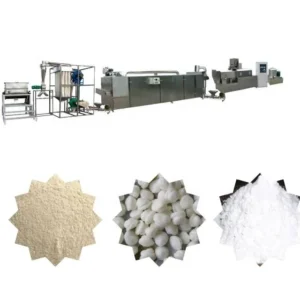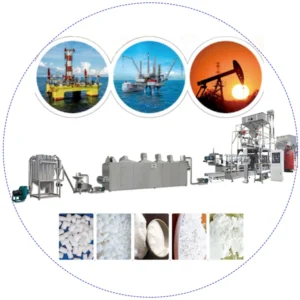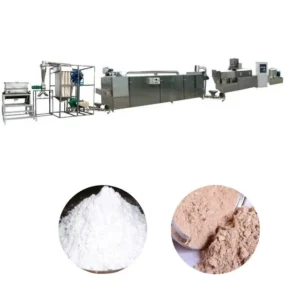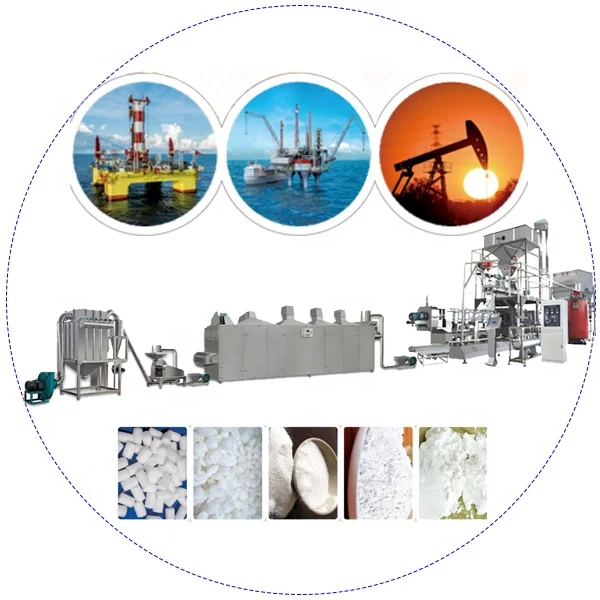
Integrated Equipment Catalogue — Every station from mixing through extrusion to pulse grinding is listed with rated specifications so you can survey the full modified starch processing line before committing to a layout.
Technical Specifications
| Parameter | Value |
|---|---|
| Product Type | Modified Starch Processing Line |
| Extruder Type | Twin-screw extruder |
| Line Capacity | 100–1500 kg/h (basis not stated in source — confirm raw material, moisture and end-product spec) |
| Installed Power Range | 45–200 kW (basis not stated in source — confirm total line or per-station) |
| Line Weight | 1000–5000 kg (basis not stated in source — confirm single machine or full line) |
| Voltage & Frequency | 220–440 V, tri-phase (Hz not specified) |
| Control System | Temperature controlled operation (PLC / MCC availability to be confirmed) |
| Contact Material | Food-grade stainless steel (304); PVC on select conveyor sections |
| Grinding System | Pulse grinder with cyclone discharge and dust collector |
| Line Stations | Twin-screw extruder, cooling conveyor, pulse grinder (mixing, drying, packing to be confirmed) |
| Certification | CE, ISO |
Application Suitability
| Application | Material or Output |
|---|---|
| Food-grade modified starch | Corn starch, wheat flour, rice flour |
| Pre-gelatinised starch | Potato starch, tapioca starch |
| Functional starch for industry | Oil drilling fluid additives, papermaking sizing |
| Fortified nutrition starch | Soybean flour and grain flour blends |
Why "Nominal Capacity" Means Nothing Without Raw Material Context
A modified starch processing line full equipment range is only as reliable as the match between its screw configuration and your actual feedstock.
When we first sent a twin-screw extruder to a Southeast Asian customer for tapioca-based modified starch, the trial run in our workshop used standard-grade starch. Their real material arrived with higher viscosity, and the gelatinisation parameters needed two full weeks of re-tuning on site [NEED_CITE: on-site commissioning delays from untested raw materials]. Since then, every modified starch processing line we ship gets a trial run with the buyer’s own material before crating.
Capacity ratings between 100 and 1500 kg/h mean very different things depending on whether you are running corn starch at standard moisture or a high-amylose potato blend. The extruder may hold its rated throughput on one feedstock and fall short on another. That is why the specification conversation must start with your raw material data sheet, not a brochure number.
Station-by-Station Equipment Survey
The modified starch processing line full equipment range begins with the twin-screw extruder, where starch gelatinisation and modification happen under controlled temperature, moisture and shear. Barrel zones are heated independently so the thermal profile can be adjusted from the feed section through to the die plate. Different starch sources — corn, wheat, potato, rice — each require a distinct screw configuration and barrel temperature curve to reach the target degree of modification without over-degrading the polymer chains.
Downstream of the extruder, the cooling conveyor uses wind-knife air drying to strip surface moisture from the extrudate without applying additional heat that could alter the starch functionality. This is critical for pre-gelatinised starch applications, where residual thermal energy can continue to modify the product after it leaves the die. The conveyor length and air velocity are matched to the extruder output rate so that material reaches the grinder at the correct moisture level.
Pulse Grinding and Closed-Loop Powder Handling
The pulse grinder sits at the end of the line and determines the final particle size distribution of the modified starch. It is fitted with a cyclone discharge system and an integrated dust collector, creating a closed-loop powder handling path that minimises product loss and keeps the workshop environment clean [NEED_CITE: dust control standards in starch processing facilities]. The grinder rotor speed and screen aperture are selected based on the target mesh size — finer grinds for food-grade instant thickeners, coarser fractions for industrial drilling fluid additives.
Having the grinder, extruder and cooling conveyor specified under one supplier means throughput is balanced across every station. An extruder running at its upper capacity range will overwhelm an undersized grinder, creating a bottleneck that forces the entire line to run below its potential. The modified starch processing line full equipment range presentation here lets you verify that each station can handle the throughput of the one before it.
Reading the Power and Capacity Specs Correctly
The 45–200 kW power range reflects different line scales, from a compact setup for pilot production to a high-volume industrial installation. The twin-screw extruder alone typically accounts for the largest share of that draw, with the cooling conveyor fan and pulse grinder motor adding to the total connected load. Before ordering, confirm with your electrical contractor whether the quoted figure covers the full line or individual stations, and whether your workshop panel can supply the required tri-phase voltage at 220–440 V [NEED_CITE: industrial voltage and frequency standards by export market].
Food-grade 304 stainless steel contact parts are standard across the extruder barrel, screws and product-contact surfaces of the cooling conveyor. Select conveyor sections use PVC belting where product adhesion is less of a concern and cost optimisation matters. The pulse grinder housing and cyclone are also stainless to meet hygiene requirements for food and nutrition starch applications, while industrial-grade lines can be configured with alternative materials where food contact is not a factor.
The Hidden Cost of Mismatched Station Capacity
When a buyer sources the extruder from one vendor and the grinder from another, nobody takes responsibility for the throughput gap between them. The extruder may push material faster than the grinder can process it, forcing operators to throttle back the feed rate and run the entire modified starch processing line below its design capacity [NEED_CITE: throughput bottlenecks in multi-vendor processing lines]. The result is not just lower output — it is inconsistent product quality because material residence time in the cooling conveyor varies from batch to batch.
Voltage and frequency mismatches create a different kind of hidden cost. A line wired for 380 V / 50 Hz shipped to a market running 440 V / 60 Hz will see motors spin faster, heaters draw more power and control boards fail prematurely. These issues rarely appear during the first week of commissioning — they surface months later as unexplained downtime.
Why Source the Full Range Here
Every station in the modified starch processing line full equipment range is specified under one supplier, so throughput matching between the extruder, cooling conveyor and pulse grinder is verified before the line ships rather than discovered during installation.
Screw configuration and die design are selected based on your raw material data sheet and target starch modification, not copied from a generic build that may suit corn starch but fail on high-amylose potato blends.
The in-house testing workshop runs your actual feedstock through the extruder before dispatch, confirming gelatinisation parameters and catching viscosity surprises that would otherwise require weeks of on-site re-tuning.
Line voltage, frequency and control language are confirmed during the specification stage, not left as assumptions that delay commissioning when the equipment arrives at your facility.
Documentation & Verification
- Machine specification sheet for each station with rated power and throughput
- Line layout drawing showing station sequence and material flow path
- Screw and die configuration record matched to your starch type
- Electrical schematic with voltage, frequency and phase confirmation
- Trial run report on your raw material before dispatch
- Factory test record documenting each station’s performance
Installation, Commissioning & Support
- Foundation plan provided based on total line weight up to 5000 kg and extruder vibration profile
- Dedicated tri-phase circuit required; confirm 220–440 V supply capacity before equipment arrival
- Stations ship in modular sections for container loading; on-site assembly follows the line layout drawing
- First-run parameter setting covers barrel temperature profile, screw speed and grinder screen selection
- Operator training includes screw configuration changes for switching between corn, wheat and potato starch
- Wear parts list covers screws, die plates and grinder screens with recommended replacement intervals
What to Include in Your Inquiry
To configure the right modified starch processing line full equipment range for your production target, share your raw material type and moisture content, your target starch modification and end-use application, and the particle size range you need from the pulse grinder. Also confirm your workshop’s available voltage and frequency, plus whether you need PLC or MCC control with a specific operator interface language.
Frequently Asked Questions
Q: What stations are included in the modified starch line and where does each fit?
A: The core sequence runs from twin-screw extruder through cooling conveyor to pulse grinder with cyclone discharge. Mixing and drying stations can be added upstream or downstream depending on your raw material moisture and target final specification. Each station’s throughput is matched to the others so no single point bottlenecks the line.
Q: How is the 100–1500 kg/h capacity range rated?
A: That range spans different line scales and configurations. The actual achievable throughput depends on your specific raw material — corn starch, potato starch or wheat flour — along with its moisture content and the degree of modification required. We confirm rated capacity during the trial run on your actual feedstock before finalising the quotation.
Q: Which raw materials work with the twin-screw extruder configuration?
A: Corn starch, wheat flour, rice flour, soybean flour, potato starch and tapioca starch are all compatible. Each material requires a specific screw configuration and barrel temperature profile to achieve proper gelatinisation. The screw and die setup is selected based on your raw material data sheet, not a generic default.
Q: Is the pulse grinder standard or optional on this line?
A: The pulse grinder with cyclone discharge and dust collector is included as a standard station because modified starch must be milled to a target particle size after extrusion and cooling. Screen aperture and rotor speed are configured to your required mesh size, whether for fine food-grade powder or coarser industrial starch fractions.