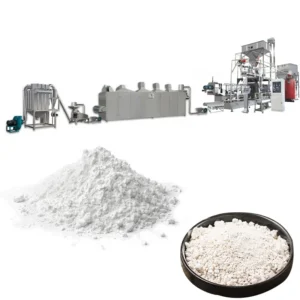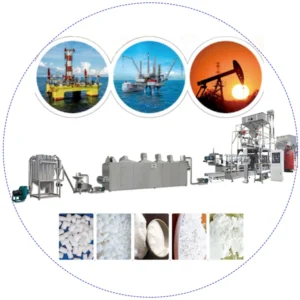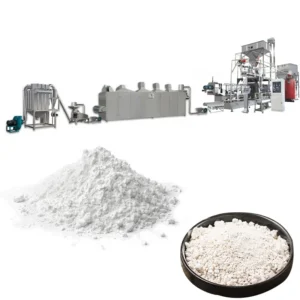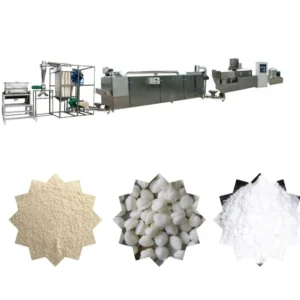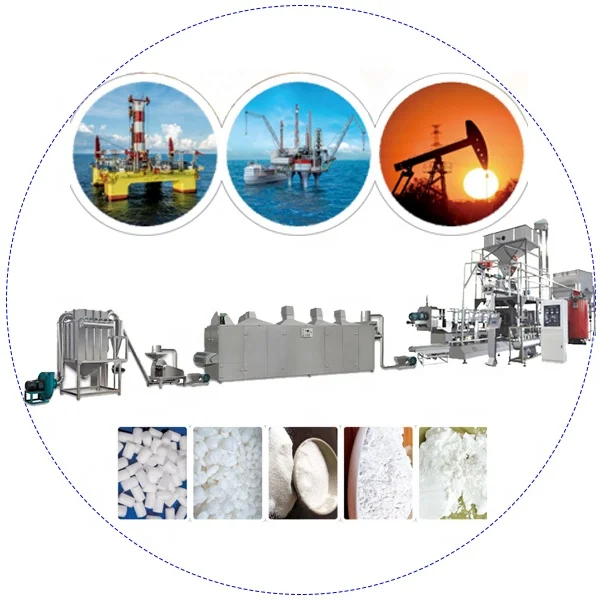
Complete Line Synchronization — Every station from raw starch batching through extrusion, drying, and final packing is throughput-matched under one supplier, eliminating the mid-line bottlenecks that plague multi-vendor setups.
Technical Specifications
| Parameter | Value |
|---|---|
| Product Type | Modified Starch Twin-Screw Extrusion Production Line |
| Model Options | MT70 / MT85 / MT100 |
| Screw Configuration | Twin-screw, 38CrMoAl nitrided steel elements |
| Screw Diameter (MT70) | 70 mm |
| Screw Length (MT70) | 1520 mm |
| Installed Power (MT70) | 160 kW |
| Power Consumption (MT70) | 120 kW |
| Main Motor Power (MT70) | 30 kW |
| Heating Ring Power (MT70) | 14 kW (7 × 2 kW zones) |
| Output Capacity (MT70) | 150–200 kg/h (basis not stated in source — confirm raw material type and moisture content) |
| Overall Dimensions (MT70) | 41000 × 1500 × 2200 mm |
| Extruder Standalone Dimensions (MT70) | 2900 × 900 × 1820 mm |
| Voltage & Frequency | 380 V / 50 Hz, three-phase (configurable to 380 V 60 Hz, 415 V 60 Hz, 220 V 60 Hz) |
| Control System | PLC and MCC automated control |
| Dryer Fuel Options | Gas, diesel, electricity, or steam |
| Contact Materials | Food-grade stainless steel throughout |
| Standards | CE, ISO |
Application Suitability
| Application | Material or Output |
|---|---|
| Pregelatinised starch for instant food mixes | Corn starch, wheat flour |
| Modified starch for textile sizing | Corn starch, wheat flour |
| Functional starch for paper coating | Corn starch, wheat flour |
| Thickening and gelling agents for food processing | Corn starch, wheat flour |
Why Nominal Capacity Figures Mislead Starch Buyers
A line rated at 200 kg/h on one starch type may deliver half that on your actual feedstock.
I have watched processors sign contracts based on a brochure number, only to discover during commissioning that their local cassava or waxy corn starch gelatinises at a completely different temperature profile. The extruder runs, but the material either passes through under-modified or burns inside the barrel. The modified starch processing line full equipment range you evaluate must be tested against your specific raw material before any capacity commitment is made [NEED_CITE: starch gelatinisation temperature variance by feedstock origin]. Without that trial, the number on the quotation is just a guess.
Barrel Zone Control and Starch Modification Precision
The twin-screw extruder in this modified starch processing line full equipment range uses seven independent heating zones, each rated at 2 kW, allowing operators to build a precise temperature gradient along the 1520 mm barrel. Starch modification depends on hitting a narrow gelatinisation window — too cool and the granules remain intact, too hot and molecular degradation destroys the functional properties. The cooling system integrated into the barrel jacket lets technicians pull heat out of exothermic reaction zones, maintaining the thermal profile that each starch variety demands.
Throughput Matching Across Every Station
A common failure in starch lines is an extruder that outpaces the dryer, forcing the entire system to throttle back. This modified starch processing line full equipment range addresses that by aligning the mixing batch cycle, extruder output, dryer residence time, and packing speed under a single engineering authority. When the MT70 extruder runs at its rated consumption of 120 kW, the downstream conveyor, multi-layer dryer, and cooling system are specified to handle that exact material flow. PLC and MCC control ties every station together, so a speed adjustment at the feeder automatically cascades through the line [NEED_CITE: throughput synchronization principles in continuous food processing lines].
Reading the Specs That Actually Matter
The screw diameter of 70 mm and length of 1520 mm on the MT70 give a specific length-to-diameter ratio that determines how long the starch stays inside the barrel. Longer residence time means more thorough modification but lower throughput — the configuration must match your target degree of substitution or pregelatinisation. The 38CrMoAl nitrided steel screws resist the abrasive wear that raw starch causes over thousands of operating hours. Voltage flexibility — configurable from standard 380 V 50 Hz to 415 V 60 Hz — matters because a motor wound for the wrong frequency will run at the wrong speed, altering screw RPM and destroying the shear profile your starch recipe depends on. The twin-screw design itself is chosen over single-screw because starch requires intense mixing and self-wiping action to prevent material buildup inside the barrel.
The Cost of Skipping Configuration Verification
Buyers who accept a generic screw and die setup often find their modified starch either under-processed or over-sheared. The wrong die aperture changes the pressure inside the barrel, shifting the gelatinisation point and producing starch that fails viscosity tests downstream. Dryer fuel selection — gas, diesel, electricity, or steam — affects not only operating cost but also the physical layout and utility connections of the entire line. A facility that specifies electric heating when gas is available locally will face higher energy bills and potentially insufficient drying capacity during peak production [NEED_CITE: industrial dryer fuel selection impact on facility utility planning]. These mismatches surface only after installation, when reconfiguration costs multiply.
Why Source the Full Range From One Supplier
Every station in this line is engineered together, so the mixer discharge rate feeds the extruder hopper without surging or starving. Screw configuration and die design are specified to the buyer’s actual starch type and target modification degree, not copied from a generic template. The in-house testing workshop runs trial batches on customer-supplied raw material before the line ships, catching gelatinisation mismatches early. PLC and MCC control is integrated across mixing, extrusion, drying, cooling, and packing — not retrofitted from separate control vendors. Pre-sales engineering consultation continues through on-site installation, commissioning, operator training, and ongoing maintenance support.
Documentation & Verification
- Line layout drawing showing throughput-matched station capacities for your starch type
- Screw and die configuration record specific to your raw material and target product
- Trial run report processed on your supplied starch in the testing workshop before shipment
- Electrical schematic confirming voltage, frequency, and control language for your facility
- CE declaration of conformity and ISO certificate for the complete line
- Wear parts list covering screws, dies, and heating rings with replacement intervals
Installation, Commissioning & Support
- Foundation planning based on the MT70 line footprint of 41000 × 1500 mm and station weights
- Dedicated three-phase power circuit sized for 160 kW installed load with correct voltage tap
- Line arrives in modular sections for sequential assembly from extruder through dryer to packer
- Commissioning includes screw speed, barrel temperature, and dryer airflow calibration on your starch
- Operator training covers PLC interface navigation, recipe storage, and emergency shutdown procedures
- Initial spare parts package with matched screw elements, die plates, and heating rings
What to Prepare Before Requesting a Quotation
Specify the exact starch variety you will process — corn, wheat, cassava, or a blend — along with its moisture content and source origin, because these determine the screw configuration and barrel temperature profile. Provide your target daily output and the number of operating shifts so the correct model — MT70, MT85, or MT100 — can be matched to your volume. Confirm your facility voltage, frequency, and preferred control panel language to avoid commissioning delays.
Frequently Asked Questions
Q: How is output capacity verified before the line ships?
A: The testing workshop processes your actual raw starch material through a trial run, measuring throughput, modification degree, and product quality. A report is issued showing real capacity on your feedstock rather than a generic figure. This trial happens before production begins, so any screw or die adjustments are made at the factory.
Q: Can one line process both corn starch and wheat flour?
A: The twin-screw extruder handles both materials, but screw configuration, die design, and barrel temperature profile must be adjusted for each. Lines are typically optimised for one primary feedstock. If you plan to switch frequently, discuss quick-change screw element sets during the specification phase.
Q: What dryer fuel options exist and how do they affect layout?
A: The dryer supports gas, diesel, electricity, or steam heating. Your choice affects utility connections, exhaust routing, and the physical space required around the drying section. Confirm fuel availability at your site early so the line layout and ductwork can be planned accordingly.
Q: How do I confirm electrical specifications before production starts?
A: Provide your facility voltage, phase configuration, and frequency during the inquiry stage. The electrical schematic and control panel language are confirmed in writing before manufacturing begins, ensuring the PLC interface and motor windings match your local power supply.
Q: Which spare wear parts should I order with the initial shipment?
A: Screw elements, die plates, and heating rings experience the most wear during starch processing. A recommended spare parts list is provided with the quotation, sized to cover your first year of operation based on your planned production schedule and the abrasiveness of your specific starch material.