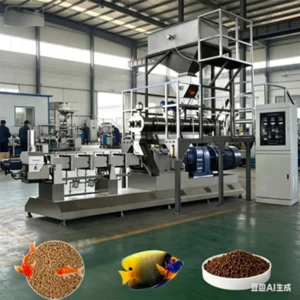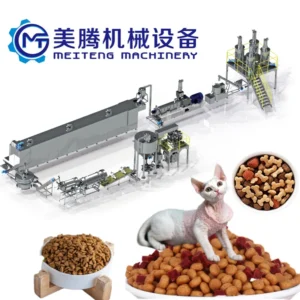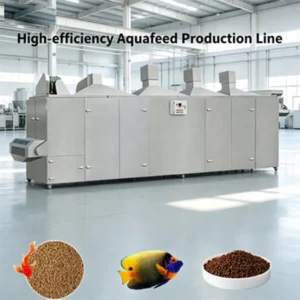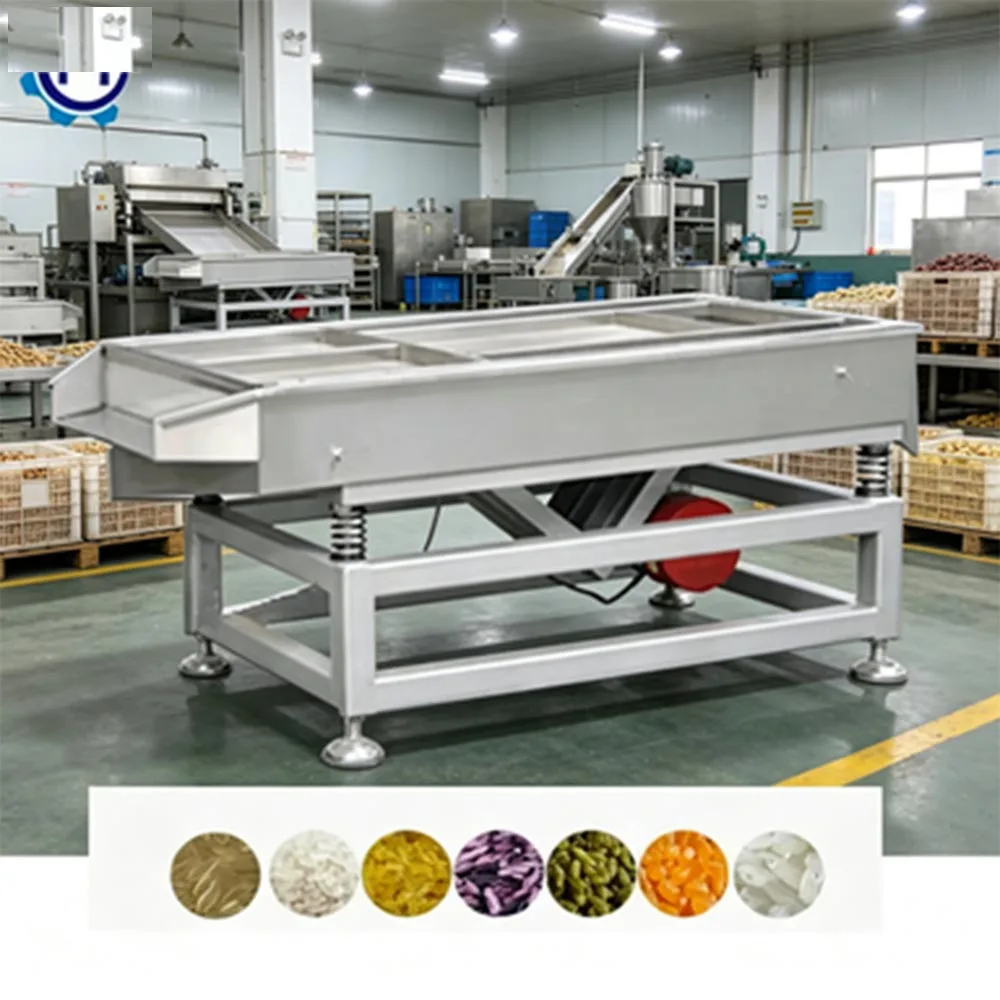
Integrated Station Matching — every conveyor, dryer and coating drum is sized to the extruder’s throughput target so the aquatic fish feed production line full equipment range runs without mid-line material pile-up.
Technical Specifications
| Parameter | Value |
|---|---|
| Product Type | Aquatic Fish Feed Extruder Production Line |
| Screw Type | Twin-screw |
| Control System | PLC automatic control |
| Material Contact Parts | Food-grade 304 stainless steel |
| Production Mode | Continuous automatic (mixing → extrusion → drying → seasoning → screening → discharging) |
| Line Stations | Raw material mixer, extruder, dryer, seasoning coating machine, vibrating sieve, conveyor equipment |
| Pellet Customization | Size, hardness, buoyancy (floating / sinking) adjustable |
| Output Capacity | Large stable processing capacity (basis to be confirmed) |
| Energy Feature | Optimized energy-saving transmission structure and heating system |
| Assembly State | Complete matched production configuration |
| Maintenance Design | Humanized operation interface, quick replacement of vulnerable parts |
| Standards | CE, ISO |
Application Suitability
| Application | Material or Output |
|---|---|
| Floating feed for koi and goldfish | Fish meal, soybean meal, corn powder, compound additives |
| Sinking pellets for tropical freshwater species | High-protein formulations with controlled density |
| Medium to large-scale commercial aquaculture feed | Continuous mass production from mixed raw materials |
| Ornamental fish feed manufacturing | Both floating and sinking pellet formats in one line |
Why "Rated Capacity" Means Nothing Without Dryer and Sieve Matching
A production line is only as fast as its slowest station, and the bottleneck is almost never the extruder itself.
I spent years running trial batches in our Shandong workshop before moving into line planning. One Middle East customer ordered a twin-screw extruder rated for high output, but the downstream dryer could not keep pace. Wet pellets stacked on the conveyor, clumped together, and the customer called us on the very first day of operation — not to thank us, but to complain. That failure was not mechanical; it was a planning failure. Every aquatic fish feed production line full equipment range we now configure starts with a station-by-station throughput calculation so that the mixer, extruder, dryer, seasoning drum and vibrating sieve all share the same target output. [NEED_CITE: importance of throughput balancing in continuous food processing lines]
When buyers compare quotations, the extruder capacity number is the easiest figure to grab. Yet an extruder pushing material faster than the dryer can handle simply moves the problem downstream. Material sits in the cooling belt, moisture migrates back into already-dried pellets, and the vibrating sieve receives an inconsistent feed that lets undersized pellets through. The line technically "runs," but the finished product fails the buoyancy test that the market demands.
Matching Every Station to the Same Throughput Target
The aquatic fish feed production line full equipment range covers raw material mixing, twin-screw extrusion, multi-pass drying, seasoning coating, vibrating screening and final discharge. Each station is selected so that its nominal capacity aligns with the extruder’s actual output on the buyer’s specific formulation — not a generic benchmark material. If a buyer’s recipe contains a high proportion of fish meal, which holds moisture differently from pure corn starch, the dryer residence time must be extended accordingly. This matching is done during the layout phase, not corrected on site after installation.
Buoyancy Control Across Floating and Sinking Formats
Producing floating pellets requires a specific combination of barrel temperature profile, screw configuration and die geometry that traps enough gas inside the pellet to keep it on the water surface. Sinking feed demands the opposite — higher density, lower expansion, and a die design that compresses the material more tightly. The twin-screw extruder in this line is configured with interchangeable screw elements and die plates so that the same machine can produce both formats, but the changeover procedure and the downstream drying parameters must also shift. [NEED_CITE: twin-screw extrusion parameters affecting pellet buoyancy in aquaculture feed] Our testing workshop runs the buyer’s actual raw material before shipment, documenting the screw arrangement and dryer settings that achieve the target buoyancy for each pellet type.
Reading the Specifications That Matter Most
The twin-screw design gives this line a wider processing window than single-screw extruders, handling formulations with varying fat and moisture levels without stalling. Food-grade 304 stainless steel on all material contact parts prevents corrosion from the salts and amino acids common in fish meal blends, extending the service life of barrels and screws. PLC automatic control stores recipes for different pellet sizes and buoyancy targets, so operators switch between floating and sinking production without manually resetting every temperature zone. The energy-saving transmission structure and heating system reduce idle power draw during product changeovers, which matters on lines running multiple pellet formats in a single shift. Die geometry directly governs pellet diameter and expansion ratio, and we keep a configuration record for each buyer so that replacement dies match the original tooling exactly.
What Happens When Stations Are Mismatched
A dryer that is too small forces the operator to slow the extruder, cutting actual output below the nameplate rating and raising per-kilogram energy cost. An undersized seasoning drum leaves coating uneven, so some pellets carry too much palatant while others carry none — and fish farmers notice the difference in feed acceptance. A vibrating sieve with insufficient deck area lets broken pellets and fines into the bagging station, and those fines dissolve on contact with water, defeating the purpose of controlled buoyancy. [NEED_CITE: effects of undersized downstream equipment on pellet quality in feed manufacturing] These problems are invisible in the quotation stage and only surface when the line runs under real production conditions.
Why Buyers Source This Line From One Supplier
The aquatic fish feed production line full equipment range comes from a single factory, so throughput calculations, electrical schematics and mechanical interfaces are coordinated in one set of drawings rather than stitched together from separate vendors. Screw configuration and die design are specified against the buyer’s actual raw material, not copied from a generic build. An in-house testing workshop runs trial batches on customer-supplied formulations before the equipment ships, producing a documented trial run report. PLC programs and HMI language are confirmed to match the target market before assembly, avoiding on-site reprogramming delays. Pre-sales consultation continues through on-site installation, commissioning and operator training, with a wear parts list provided so that screws, dies and seals are available when the first replacement is due.
Documentation & Verification
- Line layout drawing with station-by-station capacity matching for your formulation
- Screw and die configuration record tied to your raw material blend
- Trial run report on customer-supplied raw material before dispatch
- Electrical schematic with voltage and frequency confirmed for your market
- CE declaration of conformity and ISO certificate for customs and compliance
- Operation and maintenance manual with wear parts replacement intervals
Installation, Commissioning & Support
- Foundation plan based on the combined footprint of mixer, extruder, dryer and sieve
- Dedicated electrical circuit sized to the PLC-controlled extruder and heating load
- Modular station delivery allowing phased installation in limited workshop height
- First-run parameter setting for both floating and sinking pellet formats on site
- Operator training on recipe storage, screw changeover and die replacement
- Wear parts list covering screws, dies and seals with re-supply lead time confirmed
Preparing Your Inquiry
Send us your raw material formulation — including fish meal percentage, fat content and target moisture — along with the pellet diameter range and whether you need floating, sinking or both formats. Include your workshop dimensions, available voltage and frequency, and the PLC language your operators prefer. If you already run upstream grinding or downstream bagging equipment, share the model and throughput so we can match the interface.
Frequently Asked Questions
Q: How is line capacity verified and what raw material formulation is it based on?
A: We run your actual raw material blend in our in-house testing workshop and document the achievable throughput at each station. The capacity figure in the quotation is tied to that specific formulation, moisture level and pellet size, not a generic benchmark. If your recipe changes later, we re-test and adjust the station matching.
Q: How are dryer and seasoning drum capacities matched to extruder output?
A: During layout design, we calculate the extruder’s real output on your formulation and select a dryer with sufficient residence time and a seasoning drum with adequate dwell volume. This prevents material pile-up on conveyors and ensures even coating, eliminating the mid-line bottleneck that causes most start-up complaints.
Q: What screw and die configurations are available for floating versus sinking pellets?
A: Floating pellets use a screw arrangement that maximizes shear and gas entrapment, paired with a die that allows expansion. Sinking pellets require higher compression and a die with smaller land length. We record the exact element order and die specification for your product and supply matching replacement parts.
Q: How are voltage, frequency and PLC language confirmed before shipment?
A: We collect your site’s electrical specification during the quotation stage and build the control panel to match. The PLC interface language is set before assembly, and the electrical schematic is included in the documentation package so your local electrician can verify the wiring on arrival.
Q: What spare wear parts are included and how is re-supply handled?
A: The initial shipment includes a defined set of spare screws, dies and seals based on expected wear intervals. We keep the configuration record on file, so re-ordering replacement parts does not require re-measurement. Lead times for repeat orders are confirmed at the time of the original shipment.