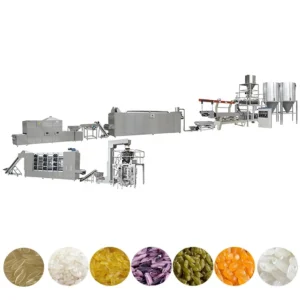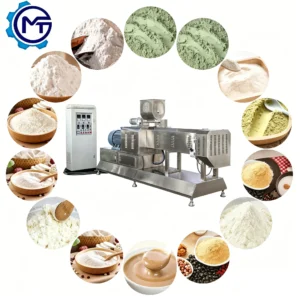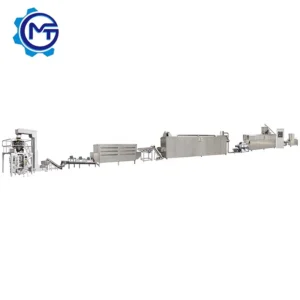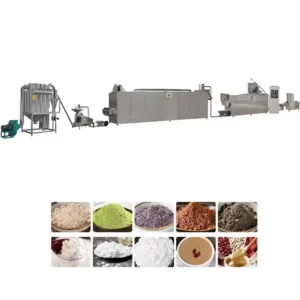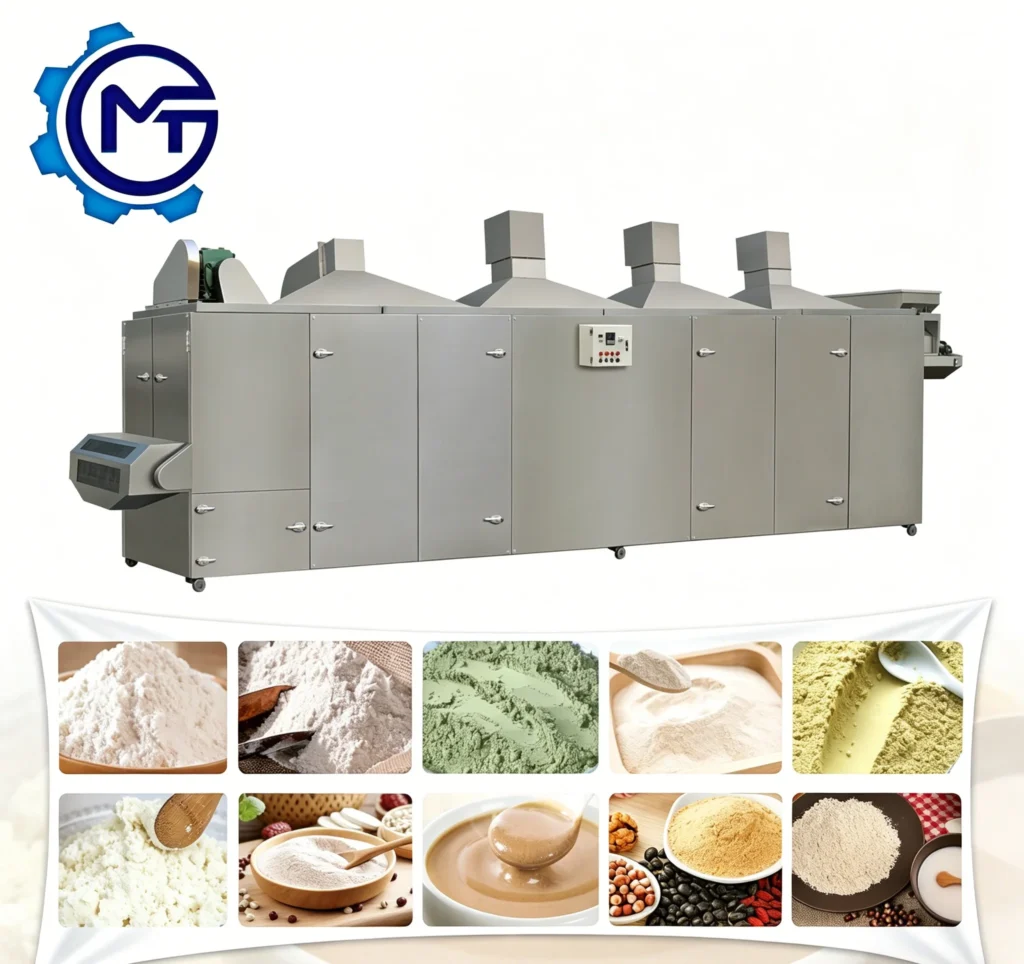
Screw and die configuration specified to your raw material — Every Baby Food Nutrition Powder Extrusion Processing Line we build is configured to your actual formulation before the extruder barrel is assembled.
Technical Specifications
| Parameter | Value |
|---|---|
| Product Type | Baby Food Nutrition Powder Extrusion Processing Line |
| Output Capacity | 200–500 kg/h (basis not stated in source — confirm raw material type, moisture content, and formulation) |
| Construction Material | Food-Grade 304 Stainless Steel |
| Control System | Touch Control Panel with Digital System |
| Heat Source Options | Electric, Gas, or Steam |
| Automation Level | Full Automatic |
| Key Line Stations | Mixer, Extruder, Baking Oven |
| Warranty | 1 Year |
| After-Sales Support | Overseas Engineer Service Available |
Application Suitability
| Application | Material or Output |
|---|---|
| Infant formula powder production | Rice, corn, and grain blends with added milk protein and micronutrients |
| Nutritional porridge powder processing | Multi-grain formulations including oats, barley, and legumes |
| Fortified baby food cereal lines | Pre-cooked grain bases blended with vitamins and minerals |
| Dietary supplement powder bases | Starch-rich raw materials processed into soluble powder carriers |
Why "500 kg/h" Means Nothing Without Your Formula
A nutritional powder production line manufacturer quoting a flat capacity number is only telling half the story. Throughput on a baby food nutrition powder processing line depends entirely on the formulation you actually run.
I once watched a line rated at 500 kg/h drop to barely half that when the buyer switched from pure rice flour to a blend loaded with whey protein isolate and trace minerals. The starch gelatinisation behaviour changed completely, the extruder barrel pressure spiked, and the downstream packaging station sat idle waiting for product that never came at the promised rate. [NEED_CITE: starch gelatinisation behaviour under varying protein and fat ratios in extrusion] When you are evaluating a baby food nutrition powder processing line, the capacity conversation must start with your exact recipe — protein content, fat percentage, fibre inclusion, and target moisture at the die face — not a generic grain baseline.
How Each Station Fits the Next
On a complete baby food nutrition powder processing line, the mixer output rate must match the extruder intake, and the extruder discharge must match the baking oven dwell time. If any station is oversized or undersized relative to the others, the entire line rhythm breaks down. We specify each station individually against your target output and formulation viscosity, so the conveyor transfer points and buffer hoppers are sized to hold steady state without surge or starvation.
Matching the Heat Source to Your Facility
The baking oven on this line can be configured for electric, gas, or steam heating. The choice depends on your factory utility infrastructure and local energy cost structure. Steam heating offers more uniform temperature distribution across wide oven belts, which matters when drying heat-sensitive nutritional powders where scorching destroys vitamin integrity. Gas firing tends to suit facilities with existing boiler rooms, while electric elements simplify installation where gas supply is limited. [NEED_CITE: thermal uniformity requirements for drying heat-sensitive nutritional powders]
Reading the Specs That Actually Matter
The food-grade 304 stainless steel contact surfaces across the baby food nutrition powder processing line are non-negotiable for infant food production, where regulatory audits will trace every wetted surface. The touch control panel with digital system allows operators to store recipe parameters — barrel zone temperatures, screw speed, feed rate — so batch-to-batch consistency does not rely on operator memory. Output capacity in the 200–500 kg/h range covers mid-to-large production volumes, but only when confirmed against your specific raw material blend and final moisture target. The full automatic control architecture means the line can run continuous shifts with minimal manual intervention at transfer points, provided the upstream batching system is matched to the extruder feed hopper capacity.
The Cost of Skipping the Trial Run
Buyers who accept shipment without a factory trial on their own raw material often discover problems only after installation. Incorrect screw configuration leads to incomplete gelatinisation, meaning the nutritional powder fails solubility tests. Undersized drying capacity leaves residual moisture above shelf-stable thresholds, inviting microbial growth in storage. [NEED_CITE: residual moisture thresholds for shelf-stable infant nutritional powders] These are not adjustments you fix with a parameter tweak — they require hardware changes that mean weeks of downtime and replacement parts flown in at premium freight cost.
Why Procurement Teams Specify This Line
Every station from mixing through packing is sourced from a single supplier, so throughput calculations are matched across the entire baby food nutrition powder processing line rather than stitched together from separate vendors. Screw configuration and die design are documented against your raw material sample before production begins. An in-house testing workshop runs your actual formulation before the line ships, generating a trial report you can review before accepting delivery. The twin-screw extrusion platform handles the wide formulation range that nutritional powder production demands — from pure grain bases to high-protein, high-fat infant formula blends.
Documentation & Verification
- Line layout drawing showing station-by-station throughput calculation for your target capacity
- Screw and die configuration record matched to your raw material sample
- Electrical schematic with voltage and frequency confirmation for your facility
- Trial run report on your formulation before shipment approval
- CE declaration of conformity and ISO certificate for the complete line
- Operation and maintenance manual with wear parts list
Installation, Commissioning & Support
- Foundation plan and floor loading data provided for each station footprint
- Dedicated circuit sizing specified for the extruder motor and oven heating elements
- Modular shipping configuration allows container loading without cutting the extruder barrel
- On-site commissioning includes recipe parameter setup on the digital touch panel
- Operator training covers screw speed adjustment and barrel zone temperature profiling
- Wear parts list identifies screw elements and die plates with recommended replacement intervals
What to Include in Your Inquiry
Send us your target formulation with raw material percentages, daily output target in kilograms, and the voltage and frequency standard at your facility. If you have existing upstream batching or downstream packing equipment, share the interface specifications so we can match transfer heights and conveyor speeds. Let us know whether you want a factory trial on your raw material before shipment — we recommend it for any formulation containing protein or fat above standard grain baselines.
Frequently Asked Questions
Q: What conditions must be met to achieve the stated 200–500 kg/h capacity?
A: That range is listed without a confirmed raw material basis. Actual throughput depends on your formulation’s protein content, fat percentage, fibre level, and target moisture at discharge. We calculate confirmed capacity only after reviewing your specific recipe and running a trial in our testing workshop on your raw material sample.
Q: How do you ensure each station on the line is matched in throughput?
A: We calculate mass balance across every station — mixer batch cycle time, extruder feed rate, oven dwell time, and packing speed — based on your target output. The line layout document shows each station’s rated capacity so you can verify the rhythm holds before production begins.
Q: Can the screw configuration be customised for my raw material?
A: Yes. Screw element arrangement and die geometry are specified after reviewing your formulation. High-protein blends require different compression ratios and residence times than pure starch bases, and the screw build reflects that difference.
Q: How are voltage and control language confirmed before shipment?
A: We request your facility voltage, frequency, and preferred control language during the specification phase. The electrical schematic and a signed voltage confirmation document are part of the pre-shipment documentation package.
Q: What is the replacement cycle for screws and dies on this line?
A: Wear rates depend on raw material abrasiveness and operating hours. We provide a wear parts list with each line and recommend stocking a first replacement set before commissioning. Our parts supply supports ongoing replenishment.