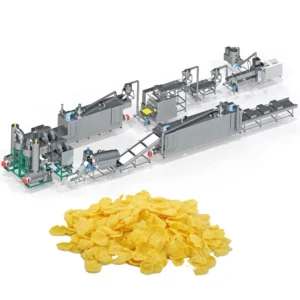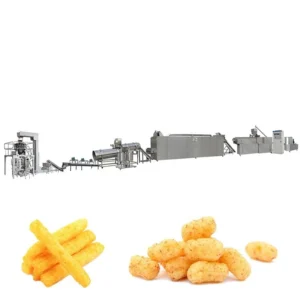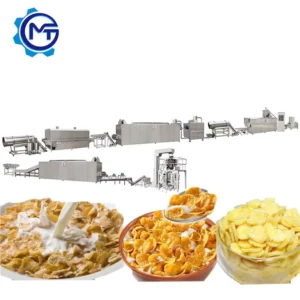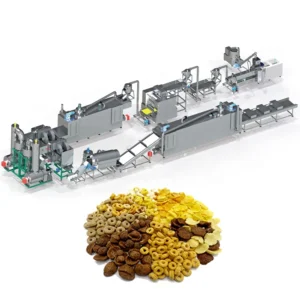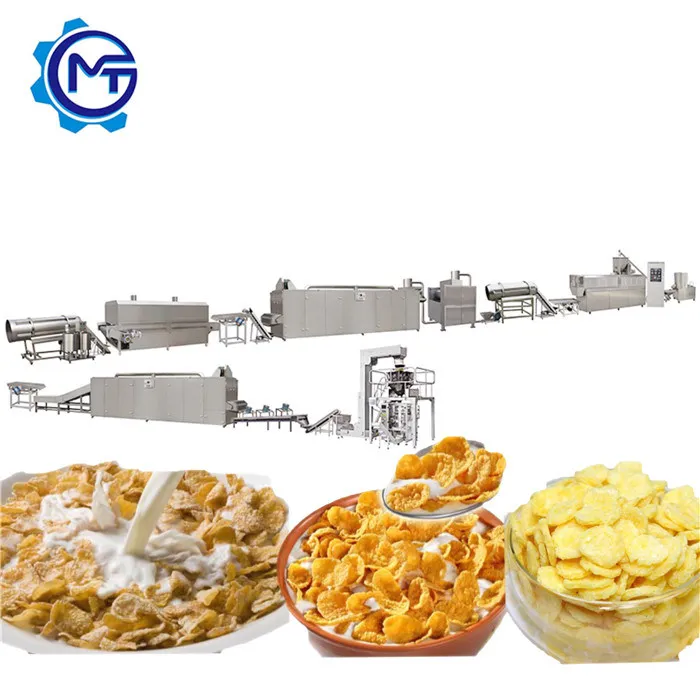
Hydraulic Flaking Precision — Infrared-monitored double rollers and PLC-controlled thickness ensure every cereal sheet holds the blister and crispness your market expects, station by station across the catalogue.
Technical Specifications
| Parameter | Value |
|---|---|
| Product Type | Corn Flakes Production Line |
| Model | MT75 (line) / MT-75 Twin Screw Extruder (extruder unit) |
| Screw Type | Twin Screw |
| Installed Power | 210 kW (line) |
| Power Consumption | 150 kW (line) |
| Output Capacity | 300-500 kg/h (basis not stated in source — confirm raw material, moisture, flake thickness) |
| Extruder Capacity | 200-300 kg/h (basis not stated in source — confirm raw material and moisture) |
| Overall Dimensions | 45 × 1.5 × 3.5 m (line) |
| Control System | PLC (flaking machinery); MCC and PLC (line-level) |
| Flaking Machinery | Hydraulic double rollers, dual independent motors, infrared temperature control |
| Dryer Heating Source | Gas / Electric |
| Roasting Oven | Hot air with vibrating pan, high temperature spraying tubes, conciliation burner, two separate circulating fans, cyclone dust removal |
| Coating System | Double tumble for sugar melting, elevator, coating drum, spraying nozzle |
| Lubrication | Automatic lubricating and cooling on extruder |
| Screw Material | Special technology, wear-resistant |
| Line Stations (Natural) | Mixing → Extruding → Flaking → Drying → Hot Air Roasting → Cooling → Packing |
| Line Stations (Sugar Coated) | Mixing → Extruding → Flaking → Drying → Hot Air Roasting → Sugar Spraying → Sugar Coating → Drying → Cooling → Packing |
| Standards | CE, ISO |
Application Suitability
| Application | Material or Output |
|---|---|
| Natural breakfast cereal production | Corn, rice, wheat, oat, barley in powder form |
| Sugar-coated corn flakes manufacturing | Extruded cereal sheets with sugar glazing and secondary drying |
| Multi-grain cereal blending | Mixed grain powders processed through twin-screw gelatinisation |
| Shaped breakfast cereals | Ball, tube, stick, ring, fruit loop, star, wheel, flower, heart via die change |
| Snack food production on shared stations | Extruded snacks using coating and roasting equipment from the same catalogue |
Why Dryer and Coater Sizing Decide the Real Line Output
A corn flakes machine full equipment range only holds its quoted throughput when every downstream station is matched to the extruder’s actual output on your specific grain blend.
I spent years on the buyer side watching lines stall at the drying tunnel because the roaster was spec’d to a brochure number that ignored the moisture load coming off the flaking rolls. When a cereal producer switches from standard corn grits to a fortified multi-grain formula, the gelatinisation behaviour shifts, the flake holds more moisture, and a roaster sized for plain corn simply cannot keep pace. The extruder keeps running, but wet flakes pile up before the oven, and the whole line drops to a fraction of its nameplate capacity. [NEED_CITE: moisture load calculation for cereal drying tunnels]
Catalogue Depth Across Every Processing Station
The corn flakes machine full equipment range covers each station as an individual catalogue entry so buyers can survey mixing systems, twin-screw extruders, hydraulic flakers, dryers, hot air roasters, and sugar coating drums before committing to a full line. Each station lists its own motor rating, utility requirement, and footprint, making it possible to compare a single replacement roaster against a complete new build without switching suppliers.
How Station-to-Station Throughput Matching Works
Throughput matching starts at the extruder output and works backward to the batching system and forward through flaking, drying, roasting, and coating. The MT-75 twin screw extruder delivers a defined mass flow per hour, and the hydraulic flaking machine must accept that flow without sheet buildup on the rollers. The dryer and hot air roasting oven are then sized to remove the exact moisture load that the flake carries at the oven inlet, with the conciliation burner and dual circulating fans calibrated to that thermal duty. [NEED_CITE: thermal duty calculation methodology for cereal roasting ovens]
Reading the Specs That Actually Matter for Corn Flake Quality
The twin-screw configuration gives the operator control over shear and residence time, which directly governs starch gelatinisation in corn, rice, wheat, oat, and barley blends. Incomplete gelatinisation produces a dense flake that will not blister properly in the roasting oven, while over-working the dough can cause the sheet to tear on the flaking rolls. The hydraulic double-roller system with infrared temperature control keeps the roll surface within a narrow band, preventing the dough from sticking on one side and pulling thin on the other. Automatic lubricating and cooling on the extruder barrel zones allows long production runs without thermal drift that would alter expansion at the die. The PLC on the flaking station and MCC at the line level mean roll gap, roll speed, and oven temperature all communicate on one bus, so a recipe saved for natural flakes can be recalled for sugar-coated runs without manual recalibration of each device.
What Happens When Stations Are Spec’d in Isolation
When a buyer sources the extruder from one vendor and the roaster from another, nobody owns the moisture balance between them. The roaster supplier assumes a flake moisture that the extruder never delivers, the drying curve misses its target, and the blister that defines a quality corn flake never forms. I have walked through plants where the coating drum was the right volume but the sugar melting tumble was undersized, so cold syrup hit warm flakes and crystallised into lumps instead of a uniform glaze. [NEED_CITE: sugar crystallisation defects in cereal coating drums]
Why Buyers Source the Full Catalogue Here
Every station in the corn flakes machine full equipment range is spec’d against the same raw material assumptions, so throughput calculations hold when your grain blend changes. Screw and die configurations are documented per order, meaning the same MT-75 extruder ships with a different screw profile for oat-heavy blends than for pure corn grits. The in-house testing workshop runs your actual material before dispatch, generating a trial run report that confirms flake thickness, blister behaviour, and coating adhesion. Electrical schematics and voltage confirmation are locked before production begins, eliminating the commissioning delays that happen when a 400 V roaster arrives at a 480 V plant. Wear parts lists ship with the line, covering screws, dies, and roller surfaces so the first replacement does not become an emergency sourcing exercise.
Documentation & Verification
- Line layout drawing showing every station footprint against your workshop dimensions
- Machine specification sheet for each unit confirming capacity match to the extruder
- Screw and die configuration record tied to your grain blend and target flake shape
- Electrical schematic with voltage and frequency confirmed for your local grid standard
- Trial run report on your raw material documenting flake thickness and roasting blister result
- Factory test record with photographs of each station running under load before crating
Installation, Commissioning & Support
- Foundation plan based on the 45 × 1.5 × 3.5 m line footprint and station weight loads
- Dedicated electrical circuit sizing for the 210 kW installed power across MCC panels
- Assembly sequence for the hydraulic flaker and roaster arriving in modular sections
- First-run parameter setting for PLC recipes covering natural and sugar-coated corn flakes
- Operator training on die change procedures for ball, ring, star, and heart cereal shapes
- Wear parts schedule listing screw, die, and roller surface replacement intervals
Preparing Your Enquiry
To move from catalogue browsing to a firm line proposal, share your target grain formula, the daily output you need to sustain, and the flake thickness your market demands. Confirm the voltage, frequency, and control language at your facility so the MCC and PLC panels are built to match. If you already run upstream milling or downstream packing equipment, note the interface points so the line layout bridges correctly.
Frequently Asked Questions
Q: How is each station’s capacity matched to the extruder’s actual throughput on my raw material?
A: We calculate the mass flow from the extruder based on your grain blend and moisture content, then size the flaker roll width, dryer belt length, and roaster thermal duty to that flow. The trial run in our testing workshop confirms the calculation before the line ships.
Q: What is the difference between the MT70, MT85, and MT75 models and which fits my production target?
A: The MT70 suits lower-volume producers with a 150-200 kg/h range, the MT75 covers 300-500 kg/h, and the MT85 sits between them at 300-400 kg/h on extruder output. Selection depends on your confirmed raw material throughput rather than brochure figures.
Q: Can the dryer, roaster, and coater be ordered individually as replacements for an existing line?
A: Yes. Each station is listed in the full equipment catalogue with its own specification sheet. We match the replacement unit to your existing extruder output and upstream flake moisture to avoid bottlenecking the line.
Q: What voltage, frequency, and control language options are confirmed before manufacturing begins?
A: We confirm your local grid voltage and frequency, then build the MCC and PLC panels to match. Control interface language is set during the specification phase so operators can navigate recipes and alarms from day one of commissioning.
Q: Which spare wear parts ship with the line and when is the first replacement due?
A: The shipment includes a wear parts list covering screws, dies, and flaking roller surfaces. Replacement intervals depend on your grain abrasiveness and daily run hours, documented in the operation manual with order codes for reordering.