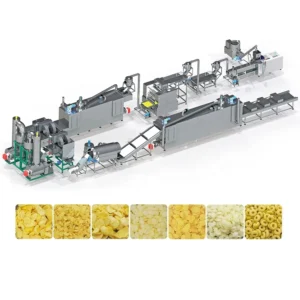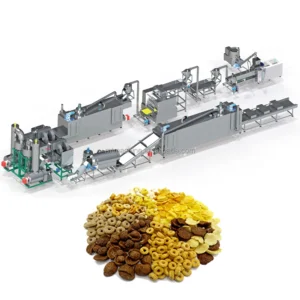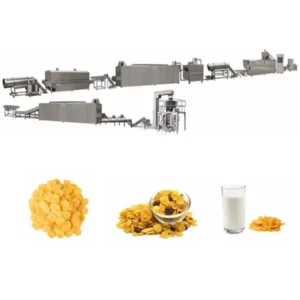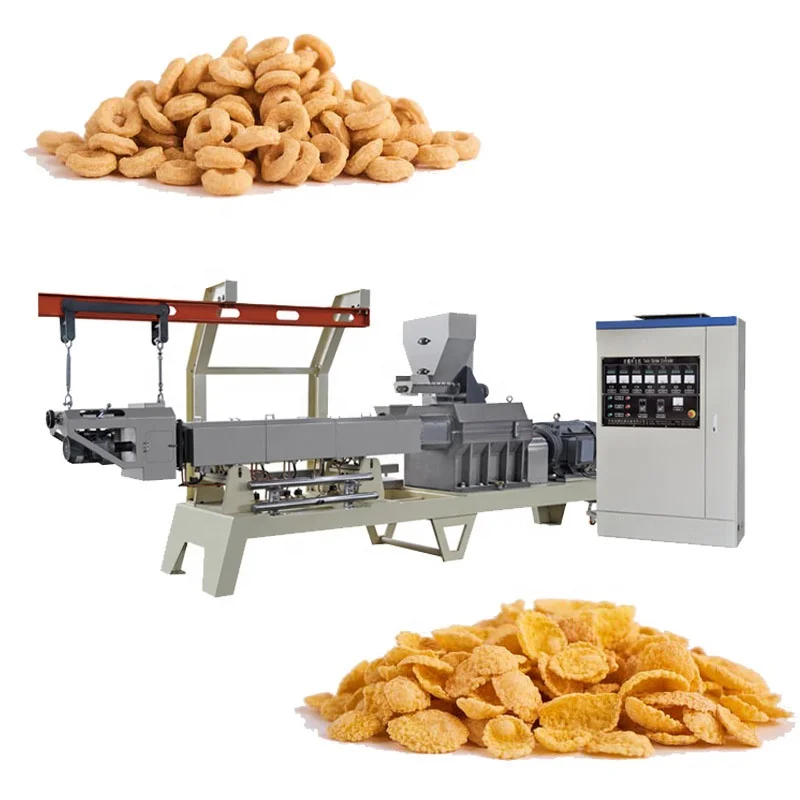
Throughput-Matched Line Design — Every station from the mixer through the sugar spraying system is calibrated to the same output envelope so the corn flakes production line full equipment range runs without bottleneck shifts between extrusion, pressing, and baking.
Technical Specifications
| Parameter | Value |
|---|---|
| Product Type | Corn Flakes Production Line |
| Extruder Type | Twin-screw, co-rotating, sectional screw modules |
| Installed Power (MT-65 / MT-70 / MT-75 / MT-85) | 84 kW / 132 kW / 186 kW / 239 kW |
| Real Power Consumption (MT-65 / MT-70 / MT-75 / MT-85) | 59 kW / 92 kW / 140 kW / 167 kW |
| Output Capacity (MT-65) | 120–150 kg/h (basis not stated in source — confirm raw material formulation and moisture content) |
| Output Capacity (MT-70 / MT-75 / MT-85) | 200–250 kg/h / 300–400 kg/h / 400–500 kg/h |
| Overall Line Dimensions (MT-65 to MT-85) | 12 m to 28 m length × 1.2–1.5 m width × 2.2–2.8 m height |
| Mixer Tank | φ600×500 mm, 4 kW |
| Screw Conveyor | 0.75 kW, 2700×500×2400 mm |
| Corn Flakes Press Machine | 16.12 kW, roller 510×310×1050 mm, adjustable gap, integrated cooling |
| High-Temperature Oven | 4.5×1.4×1.8 m, 3.75 kW, gas-fired, dual-side baking |
| Sugar Spraying System | 28.75 kW, roller Ø600×2700 mm |
| Control System | PLC and MCC, separate controller box for press machine |
| Key Features | Self-cleaning screws, forced automatic gear box oil lubrication, non-stop cutting system |
| Certifications | CE, ISO |
| Warranty | 1 year complete, lifetime maintenance |
| Lead Time | 5–30 days after advance payment |
Application Suitability
| Application | Material or Output |
|---|---|
| Breakfast cereal corn flakes | Corn grits, corn flour at controlled moisture |
| Corn puff snacks | Rice flour, wheat flour blends |
| Core-filled snacks | Soya bean, peanut, walnut with sugar coatings |
| Fortified cereal formats | Multi-grain blends with nutritional additives |
Why Nominal Capacity Figures Mislead Breakfast Cereal Buyers
Real throughput only matters when measured against your exact corn grits formulation and moisture level.
I once watched a corn flakes line — quoted at a confident hourly figure — choke within twenty minutes when we switched from the supplier’s standard corn flour to our own coarse corn grits. The extruder barrel pressure spiked, the flakes came out uneven, and the oven could not keep up with the inconsistent sheet density. That line never hit its brochure number in our plant. A corn flakes production line full equipment range should always be validated against the buyer’s actual recipe before any capacity claim is taken seriously [NEED_CITE: industrial extrusion output variability by raw material moisture and particle size].
How Each Station Connects in the Corn Flakes Line
The batching stage starts with the mixer and screw conveyor, which must deliver a consistent feed rate to the twin-screw extruder. If the mixer discharges faster than the extruder can process, material backs up; if slower, the extruder starves and flake density drifts. The corn flakes production line full equipment range addresses this by sizing every hopper and conveyor to the same throughput envelope.
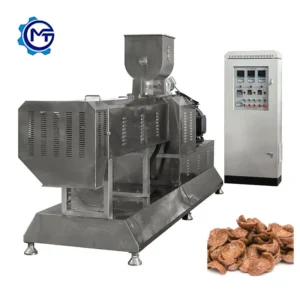
The twin-screw extruder then handles cooking, mixing, de-gassing, and forming in one continuous pass. Sectional co-rotating screw modules allow the configuration to be adjusted for different cereal formulations, whether the recipe calls for pure corn grits or a blend with rice and wheat flour.
Press and Bake: Where Flake Quality Is Won or Lost
The corn flakes press machine uses large-diameter rollers with an integrated cooling system and adjustable gap. Flake thickness directly affects oven residence time and final crispness — too thick and the centre stays soft, too thin and the flakes shatter during packaging. The separate controller box for the press allows operators to fine-tune gap settings independently from the extruder PLC [NEED_CITE: flake thickness tolerance impact on breakfast cereal texture].
The gas-fired high-temperature oven applies dual-side baking for uniform moisture removal. Uneven baking is a common cause of high breakage rates downstream, particularly when the oven airflow is not balanced across the belt width.
Reading the Specifications Against Your Production Target
The installed power versus real power consumption figures reveal how much electrical headroom each model carries. The MT-65 draws 59 kW in actual operation against 84 kW installed, leaving margin for startup surges and formulation changes that increase motor load. For buyers evaluating energy infrastructure, these two numbers matter more than the nameplate rating alone.
The overall line dimensions stretch from 12 metres for the MT-65 to 28 metres for the MT-85. Before specifying a model, the available floor length must account for operator walkways and maintenance access on both sides. Ceiling height must clear the 2.2 to 2.8 metre station heights plus overhead utility runs.
Raw material flexibility spans corn grits, corn flour, rice flour, wheat flour, soya bean, peanut, walnut, and sugar. Each material behaves differently under twin-screw shear and heat — corn grits require higher barrel temperatures and longer residence times than fine corn flour, which affects screw configuration and die selection.
The Cost of Undersized Supporting Stations
When the oven cannot match extruder output, wet flakes pile up on the belt, sticking together and creating waste that climbs as the shift goes on. I have seen producers lose a significant portion of a day’s run because the baking station was specified one size below what the extruder actually delivered. The sugar spraying system faces the same risk — if the coating drum cannot tumble flakes fast enough, the sugar layer builds unevenly and clumps form in the packaging [NEED_CITE: downstream bottleneck losses in cereal processing lines].
These mismatches rarely show up in a quotation’s headline capacity figure. They surface only when the line runs continuously on the buyer’s real formulation.
What This Supplier Brings to the Table
The corn flakes production line full equipment range is supplied as one integrated package — mixer, conveyor, extruder, press, oven, and sugar coating — from a single source, so throughput matching is engineered in rather than left to the buyer to reconcile across separate vendors.
Screw configuration and die design are specified to the buyer’s raw material and target flake texture before production begins, rather than copied from a generic template. The in-house testing workshop runs trial batches on the customer’s actual corn grits or flour blend before the line ships.
Pre-sales consultation covers line layout, utility planning, and capacity calculation. On-site installation and commissioning are followed by operator training, with wear parts lists and ongoing maintenance support included.
Documentation & Verification
- Line layout and capacity calculation showing throughput match between every station
- Machine specification sheet with screw and die configuration matched to your cereal formulation
- Electrical schematic and voltage/frequency confirmation for your local utility before production
- Factory test record and trial run report on your raw material before dispatch
- CE declaration of conformity and ISO certificate
- Operation and maintenance manual with illustrated wear parts list
Installation, Commissioning & Support
- Foundation must support line lengths from 12 m to 28 m with level tolerance for press roller alignment
- Dedicated electrical circuit required matching installed power from 84 kW to 239 kW depending on model
- Stations ship as individual assemblies for sequencing into the workshop through standard door clearances
- First-run commissioning includes screw speed, barrel temperature, and press gap calibration on your material
- Operator training covers PLC interface navigation and press controller box adjustments
- Spare screw modules, die plates, and press roller bearings listed in the wear parts manual for reorder
What to Include in Your Inquiry
Provide your target cereal format, the exact corn grits or flour blend you plan to run, and the moisture content of your raw material. Share your available workshop length, width, and ceiling height along with the local voltage and frequency. Let us know the control language preference for the PLC and whether you need a trial run on your own raw material before shipment.
Frequently Asked Questions
Q: How is output capacity verified against my specific raw material and formulation?
A: We run trial batches in the in-house testing workshop using your actual corn grits or flour blend at the moisture content you specify. The results are documented in a trial run report that records extruder barrel pressures, screw speed, flake thickness from the press, and final moisture after baking. Capacity figures are then confirmed based on those results, not generic brochure numbers.
Q: Which stations are included and how is throughput matched between them?
A: The line includes the mixer, screw conveyor, twin-screw extruder, corn flakes press machine, gas-fired high-temperature oven, and sugar spraying system. Each station is sized so its maximum throughput aligns with the extruder output, preventing material backlog or starvation at any point along the line.
Q: What voltage, frequency, and control language options are confirmed before production?
A: Electrical schematics and voltage specifications are confirmed against your local utility before production starts. The PLC and MCC control system language is set to your preference, and the press machine controller box is configured accordingly to avoid delays during commissioning.
Q: How do screw configuration and die design map to my target flake texture and density?
A: The sectional co-rotating screw modules are arranged to match your raw material’s behaviour under shear and heat. Corn grits require a different module sequence than fine corn flour. Die design controls the extrudate shape entering the press, which together with roller gap determines final flake density and bowl-life characteristics.
Q: What spare wear parts ship with the line and what is the reorder process?
A: The wear parts list included with the documentation covers screw modules, die plates, and press roller bearings. Initial spares ship with the line, and reorders are fulfilled against the configuration record on file, ensuring replacement parts match the original screw and die geometry specified for your formulation.