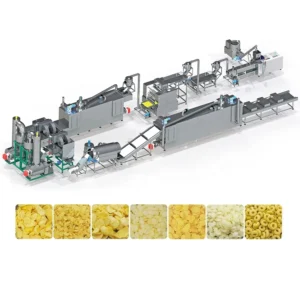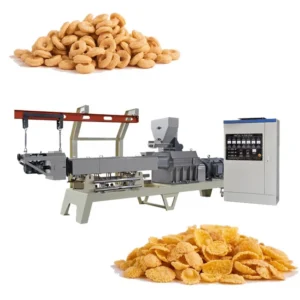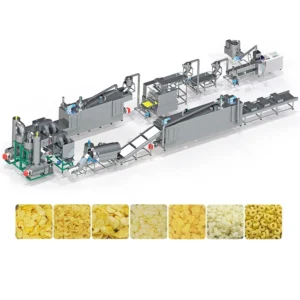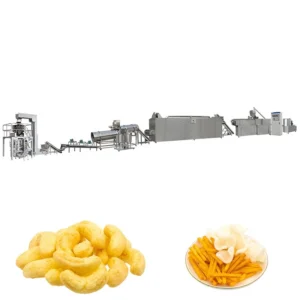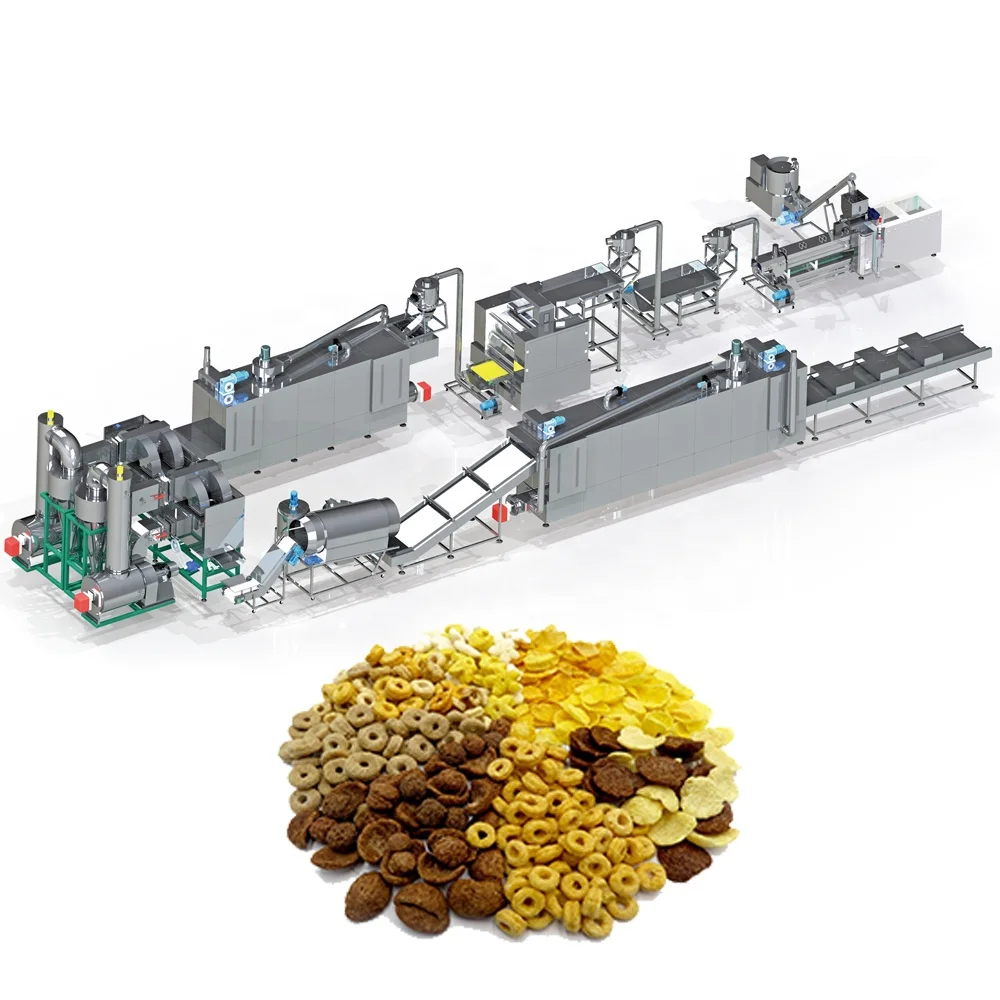
Complete Equipment Range — Every station from flour mixing through extrusion, flaking, drying, sugar coating to cooling is specified and matched for throughput, preventing upstream or downstream bottlenecks in breakfast cereal production.
Technical Specifications
| Parameter | Value |
|---|---|
| Product Type | Breakfast Cereal Corn Flakes Production Line |
| Extruder Model | MT-65 (Twin-screw, co-rotating, sectional modules) |
| Mixer Output | 10-30 kg/load |
| Mixer Power | 4 kW |
| Mixer Tank Size | φ600 x 500 mm |
| Screw Conveyor Power | 0.75 kW |
| Corn Flakes Press Machine Power | 16.12 kW |
| Corn Flakes Press Machine Roller | 510 x 310 x 1050 mm |
| High-temperature Oven Heating | Gas, both side baking system |
| High-temperature Oven Power | 3.75 kW |
| High-temperature Oven Size | 4.5 x 1.4 x 1.8 m |
| Sugar Spraying System Total Power | 28.75 kW |
| Sugar Spraying System Roller Size | Ø600 x 2700 mm |
| Control System | Separate Controller Box |
| Contact Material | Stainless steel (food-grade) |
| Standards | CE |
Application Suitability
| Application | Material or Output |
|---|---|
| Traditional Corn Flakes Production | Corn grits, corn flour |
| Multi-grain Breakfast Cereals | Rice, oat, wheat flour blends |
| Fortified Cereal Snacks | Grain powders with added vitamins or nutritional ingredients |
| Sugar-coated or Honey-coated Flakes | Flakes post-coating in sugar or honey syrup |
| Multi-functional Puffed Snacks | Alternative die shapes for ring, ball, star, stick formats |
Why the Dryer and Coating Capacity Must Match the Extruder
A breakfast cereal corn flakes machine for sale is only as effective as the weakest station in its line configuration.
Buyers often focus entirely on the extruder’s nameplate output, overlooking the downstream equipment. I have seen production floors where a high-capacity twin-screw unit pushes out a steady stream of cooked dough, only to have it pile up in front of an undersized oven or a coating drum that simply cannot keep pace. The result is not just a bottleneck; it is a continuous cycle of product degradation. Moisture content shifts, flakes stick together before drying, and the entire batch loses the crispness the market demands [NEED_CITE: throughput matching in multi-station food processing lines]. Securing a line where every station’s capacity is calculated against the extruder’s actual output on your specific raw material is the only way to ensure stable, continuous production.
Surveying the Full Equipment Range
Before specifying a final layout, technical buyers need to understand where each unit fits. The flour mixer initiates the process, blending grain powders with water and micro-ingredients before a screw elevator feeds the material into the MT-65 double-screw extruder. This co-rotating, sectional screw system handles forward transport, mixing, de-gassing, cooking, and forming in a single pass. The extruded dough then moves to the corn flakes press, where an adjustable roller distance determines the precise thickness of each flake before it enters the drying phase.
Understanding the Thermal and Coating Stations
The thermal processing stages are where texture and shelf life are determined. The gas-fired high-temperature oven utilizes a both-side baking system to drive moisture out uniformly, which is critical for achieving the characteristic crispness of a corn flake. Following this, the sugar spraying system integrates a conveyor, a melting tank, and a temperature-keeping roller (Ø600 x 2700 mm) into one station. This design maintains the viscosity of the sugar or honey coating during application, ensuring an even layer that will not weep or crystallize prematurely in the final package [NEED_CITE: sugar coating viscosity control in breakfast cereal production].
How Screw Modules and Roller Gaps Define the Final Flake
The geometry of the extruder and the press directly dictates the physical properties of the cereal. In the MT-65 extruder, the sectional screw modules can be arranged to alter shear, residence time, and the degree of starch gelatinisation. A higher shear configuration might be necessary for a tougher, multi-grain blend containing oat bran, while a gentler profile suits pure corn grits. This extrusion step sets the internal structure and density of the dough. Subsequently, the corn flakes press machine, with its 510 x 310 x 1050 mm stainless steel rollers and 16.12 kW drive, compresses the cooked dough pellets. The adjustable gap between these rollers is the final mechanical control over flake thickness, which in turn governs the bowl-life and the rate at which the flake absorbs milk.
The Cost of Unverified Raw Material Behaviour
Purchasing a line based on a supplier’s test run using standard, refined corn flour is a significant risk. When the equipment arrives and the buyer introduces their actual, locally sourced grain blend—which might contain higher fibre content, residual bran, or different moisture levels—the extrusion dynamics change completely. The dough may not expand or cook evenly, leading to a dense, hard flake that shatters during the pressing stage or turns to mush in the bowl. This forces days of unplanned downtime while process engineers experiment with screw speeds, barrel temperatures, and moisture addition to find a workable parameter set [NEED_CITE: impact of raw material variation on twin-screw extrusion outcomes]. This scenario underscores why a trial run on the buyer’s exact formulation before shipment is a non-negotiable step in the procurement process.
Engineering the Line Around Your Production Target
Selecting a supplier involves evaluating their ability to deliver a coherent system, not just a collection of machines. The provision of a complete line from batching to packing under one supplier ensures that throughput is matched across every station, from the 4 kW mixer to the final cooling conveyor, rather than assembled from disparate vendors with misaligned capacities. The screw configuration and die design are specified to the buyer’s raw material and target product shape, whether that is a traditional flake or a ring-shaped cereal. Furthermore, an in-house testing workshop allows for trial runs on the customer’s actual raw material before the equipment is shipped, validating the process and providing a baseline parameter set for installation. This is supported by comprehensive pre-sales consultation, on-site installation, commissioning, and ongoing maintenance support.
Documentation & Verification
- Line layout and capacity calculation showing matched throughput for all stations
- Machine specification sheet detailing power, dimensions, and utility needs per unit
- Screw and die configuration record matched to your grain formulation
- Electrical schematic and voltage confirmation for your local grid standard
- Trial run report generated on your specific raw material before dispatch
- Operation and maintenance manual with a complete wear parts list
Installation, Commissioning & Support
- Workshop layout planning to accommodate the 4.5-meter oven and cooling conveyor.
- Confirmation of 3-phase power supply for the 28.75 kW sugar spraying system.
- Assembly of factory-assembled stations and connection of the separate controller box.
- On-site parameter setting for the MT-65 extruder based on local grain blends.
- Operator training focused on adjusting the press roller gap and oven temperature.
- Supply of spare sectional screw modules and die plates for initial operation.
Defining Your Line Requirements
To receive a configuration that matches your actual production environment, we require specific data. Please provide your primary grain formulation and any secondary ingredients or fortification powders. Your target daily or hourly output, along with the available workshop floor space and ceiling height, will dictate the line’s physical arrangement. Finally, specify your local industrial voltage and frequency (e.g., 380V/50Hz), preferred control language, and whether you require a test run on your raw material prior to finalizing the order.
Frequently Asked Questions
Q: How is throughput matched between extruder, dryer and coating stations to prevent bottlenecks?
A: Throughput matching is achieved during the line layout phase by calculating the output of the MT-65 extruder on your specific raw material and then sizing the high-temperature oven and sugar spraying system to handle that exact mass flow, ensuring no station is over or under-capacity.
Q: What voltage and frequency options are available for different target markets?
A: The electrical systems and the separate controller box are configured to your local grid standards. Options typically include 3-phase supplies such as 380V/50Hz or 415V/60Hz, with control panel language set to your operational requirement.
Q: How are screw modules and die shapes selected for different grain raw materials?
A: The sectional screw modules within the co-rotating twin-screw extruder are arranged to provide the correct shear and cooking profile for your grain blend, while the die shape determines the initial form before the press creates the final flake.
Q: What is the footprint requirement for the complete line and how should the workshop be laid out?
A: The footprint depends on your target capacity and local building constraints. A detailed layout drawing is provided, positioning major stations like the 4.5m oven and the Ø600mm coating roller to optimize material flow and operator access.
Q: Can the line produce both corn flakes and other puffed snack formats on the same extruder?
A: Yes, the twin-screw extrusion platform is multi-functional. By changing the die at the extruder outlet and bypassing or adjusting the downstream flaking press, the same MT-65 unit can produce ring, ball, star, or stick-shaped puffed snacks.