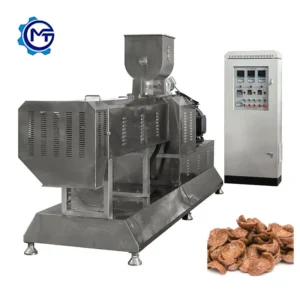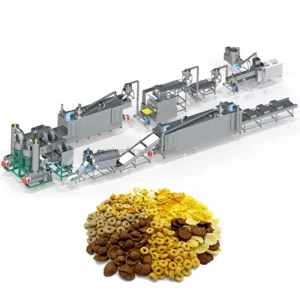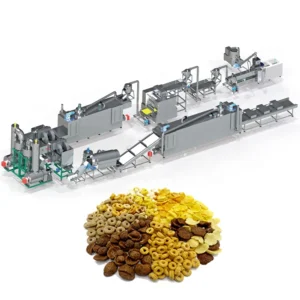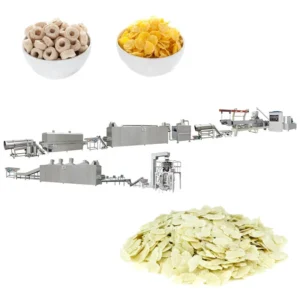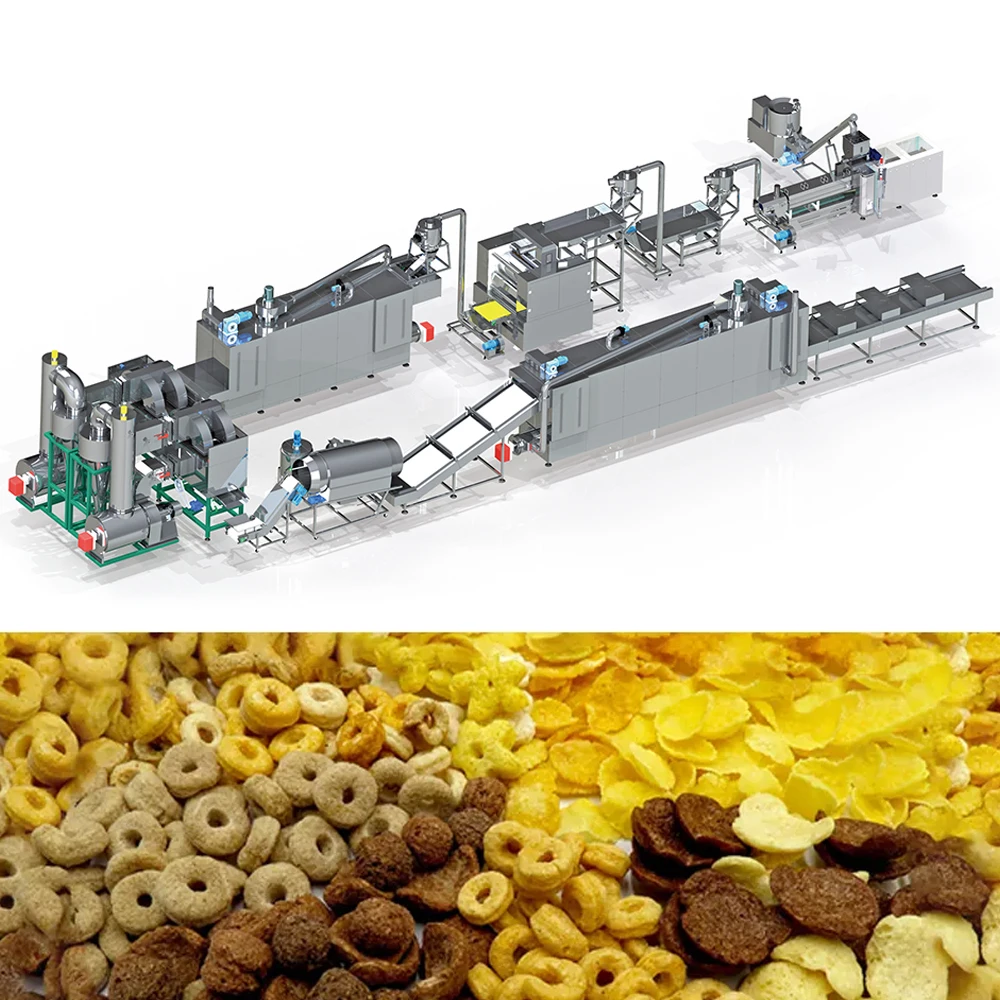
Matched Throughput Across Every Station — this corn flakes line balances extruder, flaking, and roasting capacities under one supplier to prevent mid-line bottlenecks.
Technical Specifications
| Parameter | Value |
|---|---|
| Product Type | Corn Flakes Breakfast Cereal Production Line |
| Line Configuration | MT75 (also available in MT70, MT85) |
| Installed Power | 210 kW (MT75 line) |
| Power Consumption | 150 kW (MT75 line) |
| Output Capacity | 300–500 kg/hr (basis not stated in source — confirm raw material, moisture content, and flake thickness) |
| Overall Dimensions (L×W×H) | 45 × 1.5 × 3.5 m (MT75 line) |
| Extruder Type | Twin Screw Extruder (MT-75) |
| Extruder Capacity | 200–300 kg/hr (basis not stated in source — confirm raw material and moisture) |
| Screw Feature | Automatic lubricating and cooling; wear-resistant special tech screw |
| Control System | PLC control (flaking machinery); MCC and PLC available |
| Flaking Machinery | Hydraulic double rollers, separate motor drives, infrared sensor temperature control |
| Dryer Heating Source | Gas or Electric |
| Hot Air Roasting Oven | Vibrating pan, conciliation burner, dual circulating fans, cyclone dust removal |
| Coating System | Double tumble sugar melter, elevator, coating drum, spraying nozzle |
| Line Stations | Mixing → Extrusion → Molding → Cutting → Drying → Flaking → Hot Air Roasting → Sugar Coating → Seasoning → Packing |
| Warranty | 24 months, lifetime service |
| Assembly State | Complete production line, turnkey |
| Standards | CE, ISO certified |
Application Suitability
| Application | Material or Output |
|---|---|
| Traditional corn flakes | Corn grits, corn flour, sugar or salt seasoning |
| Chocolate-coated breakfast cereal | Corn or wheat base with cocoa and sugar coating |
| Shaped cereal snacks | Corn, rice, oat, and multigrain blends in various die-cut formats |
| Puffed snack variants | Maize and starch-based formulations through extruder die changes |
Why the Dryer and Roasting Oven Must Match the Extruder Output
A corn flakes production line only runs as fast as its slowest station.
Buyers often focus on the extruder capacity and overlook what happens downstream. When the dryer or hot air roasting oven cannot keep pace with the MT-75 twin-screw extruder, material piles up, flakes stick together, and blistering becomes uneven. In my years working with breakfast cereal producers across the Yangtze Delta, I have seen lines rated for a certain throughput that could never sustain it because the roasting oven was undersized or the coating drum could not tumble fast enough. The result is the same every time: operators slow the extruder down, and the actual output drops well below what was quoted. [NEED_CITE: throughput matching principles in continuous food processing lines]
A complete breakfast cereal machine setup must account for moisture reduction at each drying stage, residence time in the roasting oven, and the sugar coating cycle to maintain consistent flake quality from the mixer all the way to packing.
Every Station From Batching to Packing in One Package
This corn flakes production line equipment package covers the full sequence: mixing and batching, twin-screw extrusion, molding and cutting, pre-drying, hydraulic flaking, hot air roasting, sugar or flavor coating, seasoning, and packing. Each station is sized to handle the output of the preceding one, so the line does not stall or accumulate work-in-progress at any point. When all stations come from a single supplier, interface dimensions and conveyor heights align without field modification.
How the Flaking and Roasting Stages Shape the Final Flake
The flaking machinery uses hydraulic double rollers with separate motor drives to press cooked extrudate into uniform flakes. An infrared sensor monitors roller temperature continuously, preventing sticking or uneven compression. After flaking, the hot air roasting oven uses a vibrating pan with a conciliation burner and two separate circulating fans to achieve the characteristic blistered surface and crisp texture. The cyclone dust removal device captures fines before they can contaminate downstream coating equipment. This station sequence determines whether the finished product meets the density and crunch specification that retail buyers expect. [NEED_CITE: flaking and toasting parameters for corn breakfast cereal quality]
Reading the Specifications That Matter Most
The MT-75 twin-screw extruder features automatic lubricating and cooling functions that maintain barrel temperature stability over long production runs, which directly affects starch gelatinisation consistency. The installed power of 210 kW across the full MT75 line covers all motors, heaters, and controls, while running consumption settles around 150 kW under normal operating conditions. The PLC-controlled flaking machinery allows operators to adjust roller gap and pressure from the central panel, keeping flake thickness within tolerance without manual intervention. For the roasting oven, the choice between gas and electric heating depends on local utility costs and available supply capacity — a decision that must be confirmed before manufacturing begins. The 45-meter line length reflects the full station sequence and must be verified against available workshop floor space and ceiling height before installation planning starts.
The Hidden Cost of Mismatched Line Configurations
When a line is assembled from separate vendors, the extruder may produce more than the dryer can handle, forcing operators to idle the upstream equipment. Screw and die configurations copied from a generic build can produce flakes that are too dense or too fragile for the roasting oven, resulting in high breakage rates and off-spec product. Voltage and frequency confirmed late in the process can delay commissioning by weeks while control panels are rewired. I have walked into factories where the coating drum was never matched to the line speed, leaving operators to hand-feed sugar syrup just to keep up. [NEED_CITE: common causes of downtime in cereal production lines]
Why Source This Line Here
Every station on this corn flakes production line equipment package is throughput-matched under one supplier, so the extruder, flaking rolls, dryer, and roasting oven are designed to run at the same cadence. Screw configuration and die design are specified to the buyer’s actual raw material and target flake density rather than pulled from a generic template. The in-house testing workshop runs trial production on customer-supplied material before shipment, so parameters are documented and repeatable from day one. Pre-sales consultation covers line layout, utility planning, and voltage confirmation through to on-site installation and operator training. Documentation includes the electrical schematic, screw and die configuration record, and trial run report tied to your specific formulation.
Documentation & Verification
- Line layout and capacity calculation showing throughput at each station of the MT75 configuration
- Screw and die configuration record matched to your corn flour or grits formulation
- Trial run report produced on your raw material in the testing workshop before dispatch
- Electrical schematic with voltage and frequency confirmed for your local grid
- CE declaration of conformity and ISO certificate for customs and regulatory clearance
- Operation and maintenance manual with wear parts list for screws, dies, and roller surfaces
Installation, Commissioning & Support
- The 45 × 1.5 × 3.5 m footprint requires a clear span workshop with adequate ceiling height for the dryer and roasting oven exhaust ducting.
- A dedicated power supply rated for the 210 kW installed capacity with voltage and frequency matching the confirmed electrical schematic.
- The twin-screw extruder ships with barrel and screw assemblies pre-fitted; final alignment and coupling to the feeder are completed on site.
- First production run includes PLC parameter setting for flaking roller gap, roasting oven temperature profile, and coating drum speed.
- Operator training covers screw and die changeover, hydraulic roller adjustment, and daily cleaning of the cyclone dust removal device.
- Wear parts inventory covers screws, dies, roller surfaces, and spray nozzles with recommended replacement intervals.
What to Prepare Before Requesting a Quotation
To configure the right line, share your raw material type and moisture content, target flake thickness and density, and whether you plan to produce sugar-coated, chocolate-coated, or natural variants. Confirm your local voltage and frequency, available workshop dimensions, and preferred heating source for the dryer and roasting oven. If you have an existing mixing or packing system that must interface with the new line, provide the connection point specifications so the layout can accommodate them.
Frequently Asked Questions
Q: What stations are included in the complete corn flakes line and how is throughput matched across them?
A: The line covers mixing, twin-screw extrusion, molding, cutting, drying, hydraulic flaking, hot air roasting, sugar coating, seasoning, and packing. Each station is sized so that the extruder output of 200–300 kg/hr is fully absorbed by the downstream dryer, flaking rolls, and roasting oven without accumulation or idle time.
Q: How is the screw and die configuration chosen for different raw materials and flake densities?
A: The screw profile and die geometry are specified based on your raw material composition, moisture content, and the target flake density. A trial run in the testing workshop validates the configuration before shipment, and the settings are recorded in the configuration document supplied with the line.
Q: Can the dryer and roasting oven heating source be specified as gas or electric based on local utility?
A: Yes. Both the dryer and hot air roasting oven are available with gas or electric heating. The choice is confirmed during the specification stage based on your local utility availability and cost structure, and the electrical schematic is updated accordingly before production begins.
Q: Is a trial run on my raw material performed before shipment, and what does the trial report cover?
A: Yes. Your raw material is run through the extruder, flaking machinery, and roasting oven in the in-house testing workshop. The trial report documents screw speed, barrel temperatures, roller gap, roasting profile, and the resulting flake density and texture against your target specification.
Q: What is the footprint of the complete line and what are the installation utility requirements?
A: The MT75 line occupies approximately 45 × 1.5 × 3.5 meters. Installation requires a dedicated electrical supply matching the confirmed voltage and frequency, gas supply if gas heating is selected, compressed air for pneumatic controls, and water for the extruder cooling circuit.