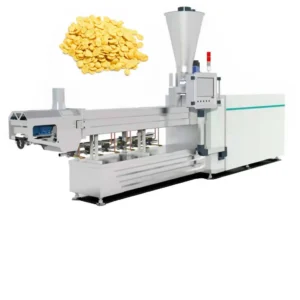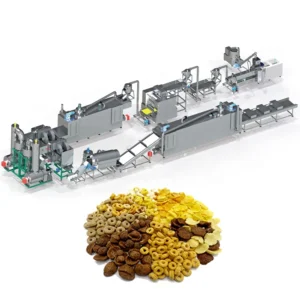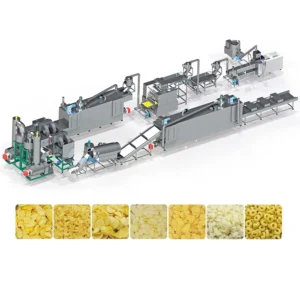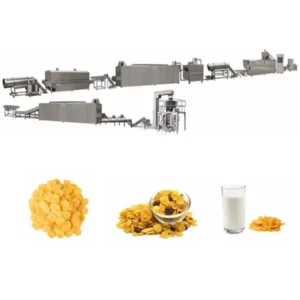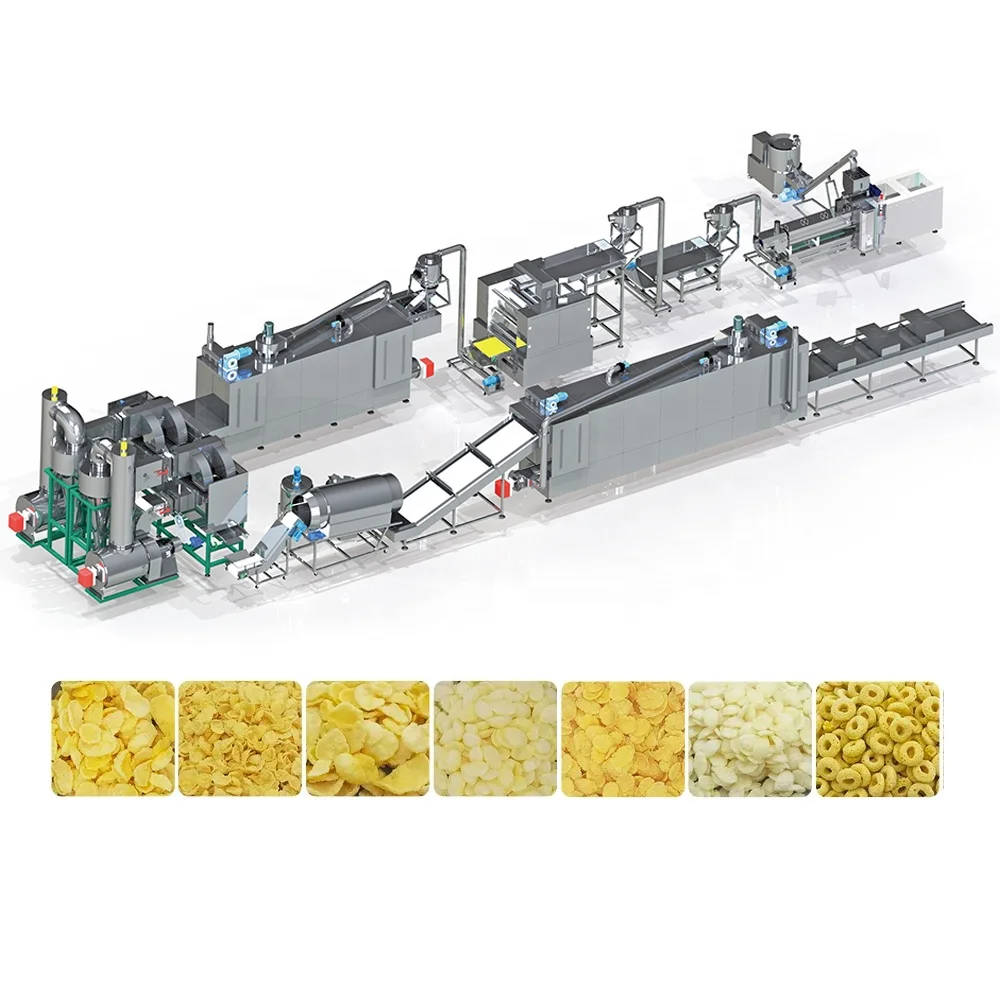
Matched Throughput Across Every Station — our single-supplier approach sizes the mixer, extruder, dryer, and coater to the same confirmed output, preventing the bottlenecks that arise when each station is sourced separately.
Technical Specifications
| Parameter | Value |
|---|---|
| Product Type | Twin Screw Extruder Breakfast Cereal Production Line |
| Extruder Model | MT-75 |
| Screw Type | Co-rotating twin screw with sectional modules |
| Mixer Output | 10–30 kg per load (basis to be confirmed) |
| Mixer Power | 4 kW |
| Mixer Tank Size | φ600 × 500 mm |
| Screw Conveyor Power | 0.75 kW |
| Corn Flakes Press Power | 16.12 kW |
| Corn Flakes Press Roller Size | 510 × 310 × 1050 mm |
| High-Temperature Oven Size | 4.5 × 1.4 × 1.8 m |
| High-Temperature Oven Power | 3.75 kW |
| Sugar Spraying System Power | 28.75 kW |
| Sugar Spraying Roller Size | Ø600 × 2700 mm |
| Die Configuration | Interchangeable moulds for ring, ball, star, and stick shapes |
| Line Stations | Flour Mixer, Screw Elevator, Extruder, Dryer, Coating Line, Cooling Conveyor, Packing Machine |
| Voltage | Configurable to local 3-phase supply (e.g., 380V/50Hz, 415V/60Hz) |
| Certification | CE |
Application Suitability
| Application | Material or Output |
|---|---|
| Corn flakes and toasted flakes | Maize grits, corn flour, rice grits |
| Extruded hoop and ring cereals | Wheat flour, oat flour, multi-grain blends |
| Sugar or honey coated snacks | Grain extrudates with syrup or glaze application |
| Fortified breakfast cereals | Grain bases blended with vitamin and mineral premixes |
Why Nominal Line Capacity Often Fails at Commissioning
We validate the throughput on your specific grain formulation before the line leaves our workshop.
A breakfast cereal production line equipment manufacturer often quotes an output figure derived from standard maize grits at a controlled moisture level. When a producer in a tropical market switches to a high-fiber wheat blend or a locally sourced cassava mix, the actual material behaves differently inside the barrel. The extruder may hold the nominal screw speed, but the gelatinisation window shifts, resulting in a dense, un-expanded product that the downstream dryer cannot fix [NEED_CITE: raw material variability in extrusion]. This mismatch forces the entire line to run below the quoted rate just to maintain acceptable texture.
Barrel Segmentation and Residence Time Control
The MT-75 twin screw extruder uses co-rotating sectional modules that allow the screw profile to change along the barrel length. For a breakfast cereal production line equipment manufacturer, this means the feeding zone can use deep-flight elements to draw in coarse grits, while the metering zone switches to shallow-flight kneading blocks to build the shear required for starch gelatinisation. Adjusting the module sequence is how process engineers match the extruder to a new recipe without swapping the entire screw set.
Die Geometry and Product Density
The interchangeable die moulds determine the cross-section of the extrudate and, critically, the pressure drop at the barrel exit. A ring die for choco hoops presents a different flow resistance than a narrow slit die for corn flakes. Selecting the wrong die for a given dough viscosity causes uneven expansion across the strand, leading to flakes that shatter in the press or hoops that collapse in the dryer [NEED_CITE: die design and extrudate expansion]. Our trial runs record the die number, land length, and orifice diameter that produced the target bulk density on the buyer’s sample.
Press Roller Gap and Flake Consistency
The corn flakes press machine features a 510 × 310 × 1050 mm roller set with an adjustable gap. When the extrudate arrives from the dryer at the correct surface moisture, the rollers flatten it into a uniform flake. If the gap is too wide, the flake remains thick and chewy after toasting; if too narrow, the starch matrix fractures and generates excess fines. The integrated cooling system on the press stabilises the roller temperature, preventing the sugar-rich surface from sticking and tearing during high-volume runs.
The Cost of Unmatched Drying and Coating Stages
An extruder that outpaces its dryer creates a backlog of high-moisture product that must wait before toasting, during which time the starch retrogrades and the final crispness is lost. Similarly, a sugar spraying system with a Ø600 × 2700 mm drum that spins too slowly relative to the extruder output will apply an uneven coat, leaving some pieces bare and others clumped [NEED_CITE: line balancing in food extrusion]. These imbalances are not visible on the specification sheet but appear as yield loss on the packing conveyor.
Sourcing From a Single Line Integrator
Our design process starts with your raw material sample and target bulk density, not a generic capacity table. The screw configuration and die selection are documented specifically for your recipe. Every station, from the 4 kW flour mixer through the 28.75 kW sugar spraying system, is sized so that no single machine dictates the pace of the entire line. The in-house testing workshop runs your grain blend before shipment, generating a trial report that locks in the operating parameters for your operators.
Documentation & Verification
- Line layout drawing matching your facility footprint and utility connection points.
- Screw module arrangement record specifying the kneading and conveying elements used for your trial.
- Electrical schematic confirming voltage, phase, and control panel language before fabrication.
- Factory trial run report documenting bulk density and moisture on your grain sample.
- Wear parts list detailing spare screw elements, die plates, and press roller shells.
Installation, Commissioning & Support
- Foundation plan provided for the 4.5 m high-temperature oven and heavy press machine.
- Power distribution list specifying the dedicated circuits for the 16.12 kW press and 28.75 kW coater.
- Modular station assembly supervised by our technician from extruder barrel alignment to packing interface.
- First-run parameter sheet populated with your local voltage and the trial-run screw speed.
- Operator training covers die changeover, roller gap adjustment, and syrup flow calibration.
- Spare screw elements and die moulds shipped with the line for the first replacement cycle.
Requesting an Accurate Line Proposal
To configure the breakfast cereal production line equipment manufacturer setup for your plant, we need the specific grain or flour blend you intend to run, along with any vitamin or fiber additives. Please confirm your local three-phase voltage and frequency, as well as the preferred language for the control interface. If you have a target daily output in kilograms of finished cereal, share that figure so we can match the mixer batch cycle to the extruder’s continuous feed rate.
Frequently Asked Questions
Q: How is line output verified on my specific grain blend before delivery?
A: We run your actual flour or grit sample in our testing workshop using the proposed screw configuration. The trial records the achievable throughput that maintains your target expansion and texture, and this verified rate forms the basis of the line specification rather than a generic catalog number.
Q: What voltage and control language options are confirmed before shipment?
A: The electrical schematic is reviewed and signed off by your team before fabrication. We build the control panel for your local three-phase supply, whether that is 380V at 50Hz or 415V at 60Hz, and set the HMI language to match your operators’ preference to avoid commissioning delays.
Q: How do you match the dryer and coater to the extruder capacity?
A: Each station is calculated based on the moisture removal and syrup application rate required for your specific product format. The high-temperature oven length and the sugar drum diameter are selected so that material flows continuously without queuing or starving any downstream machine.
Q: Can one extruder produce both corn flakes and extruded hoops?
A: The MT-75 platform supports both formats by changing the die plate and adjusting the screw module sequence. The corn flakes require a specific dough pellet that is later pressed, while hoops are cut directly at the die face, and both setups are validated during the pre-shipment trial.