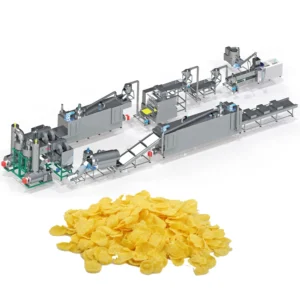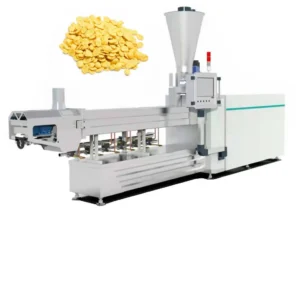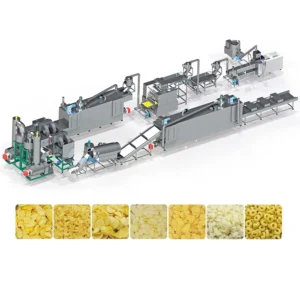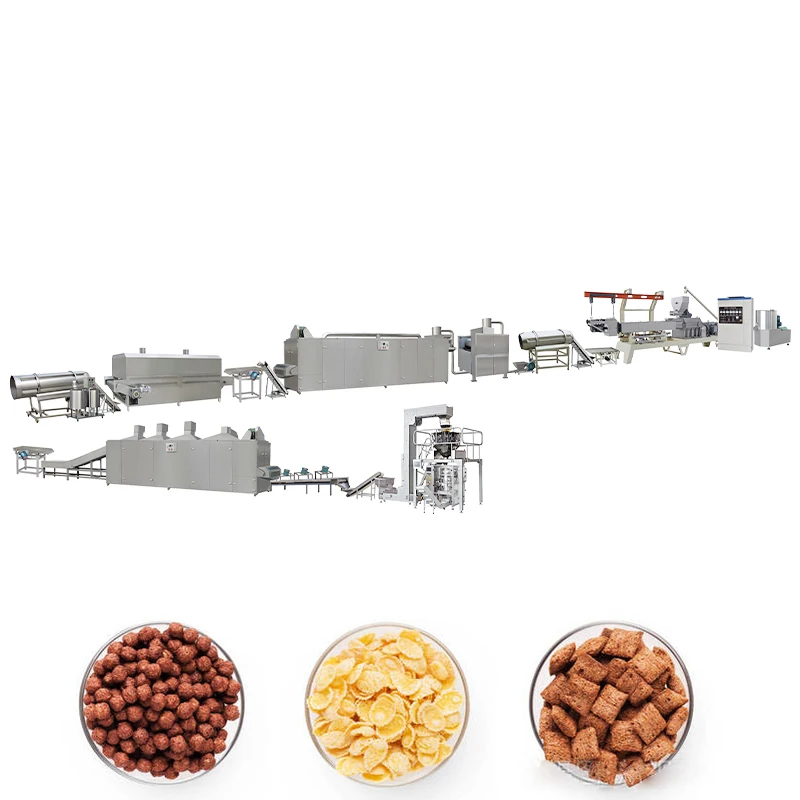
Integrated Station Matching — throughput across mixing, extruding, flaking, drying, roasting, coating and packing is calculated as a single system, preventing downstream bottlenecks on this breakfast cereal corn flakes production line equipment.
Technical Specifications
| Parameter | Value |
|---|---|
| Product Type | Breakfast Cereal Corn Flakes Production Line |
| Model | MT70 / MT85 / MT75 |
| Installed Power | MT70: 160 kW; MT85: 190 kW; MT75: 210 kW |
| Power Consumption | MT70: 120 kW; MT85: 140 kW; MT75: 150 kW |
| Output Capacity | MT70: 150–200 kg/h (basis to be confirmed); MT85: 300–400 kg/h (basis to be confirmed); MT75: 300–500 kg/h (basis to be confirmed) |
| Extruder Type | Twin-screw |
| Flaking Machine Drive | Double motors with separate roller driving; hydraulic system |
| Flaking Temperature Control | Infrared sensor for even temperature pipe control |
| Dryer Heating Source | Gas or Electric |
| Roasting Oven | Hot air roasting with vibrating pan, high temperature spraying tubes, conciliation burner, two circulating fans, cyclone dust removal |
| Coating System | Double tumble for sugar melting, elevator, coating drum, spraying nozzle |
| Control System | PLC with MCC integrated |
| Overall Dimensions (L×W×H) | MT70: 41 × 1.5 × 2.2 m; MT85: 43 × 1.5 × 3.2 m; MT75: 45 × 1.5 × 3.5 m |
| Standards | CE, ISO |
Application Suitability
| Application | Material or Output |
|---|---|
| Natural corn flake production | Corn grits and corn flour |
| Sugar-coated corn flake production | Corn base with sugar syrup coating |
| Multi-grain flake production | Rice, wheat, oat, barley powder blends |
| Extruded cereal shapes | Ball, tube, stick, ring, fruit loop, star, wheel, flower, heart via mould adjustment |
| Fortified breakfast cereal lines | Grain blends with nutritional additives |
Why "Rated Capacity" Means Nothing Without Your Grain on the Line
We verify throughput against your specific formulation before the line ships.
I once watched a cereal producer in Peru run corn flakes equipment rated for a certain output, only to find their local corn variety — higher in fiber, lower in starch — would not gelatinise at the barrel temperatures the factory preset. The line spent its first three weeks in trial-and-error mode while the roasting oven sat idle and orders backed up. A breakfast cereal corn flakes production line equipment purchase should never become a live experiment on your factory floor [NEED_CITE: grain composition variance across Latin American corn cultivars]. Running a trial on your exact raw material eliminates that risk entirely.
Screw Configuration Dictates Flake Density Before the Press Ever Touches the Pellet
The twin-screw extruder in this breakfast cereal corn flakes production line equipment uses screw elements and die geometry selected for your target product. Corn flakes demand a specific degree of starch gelatinisation — enough to bind the pellet for flaking, but not so much that expansion makes the pellet too porous to press flat. Changing screw pitch or adding a reverse element shifts residence time and shear inside the barrel, which directly alters the pellet structure the flaking rollers will later compress.
Hydraulic Flaking with Infrared Feedback Holds Thickness Across Long Runs
Flaking is where corn flakes earn or lose their market identity. The double-motor drive powers each roller independently, so roller speed stays matched even as surface wear progresses unevenly. The hydraulic system maintains pressing force, and the infrared sensor monitors temperature across the roller face. If one side of the roller heats faster from friction, the system adjusts to keep flake thickness consistent from the first kilogram to the last of a production shift. This level of control matters when your retail buyer specifies flake thickness within a narrow band [NEED_CITE: flake thickness tolerance standards for retail breakfast cereal packaging].
Reading the Specs That Actually Determine Line Behavior
The installed power figures — ranging from 160 kW on the MT70 to 210 kW on the MT75 — cover the full line, not just the extruder. When sizing your electrical supply, the power consumption values (120 kW to 150 kW) reflect typical running load, which is what your transformer and main breaker must sustain continuously. The PLC and MCC integrated control system coordinates every station from mixing through packing; if the extruder slows due to a feed interruption, downstream stations respond in sequence rather than running dry or overloading. The roasting oven relies on a conciliation burner with two separate circulating fans to distribute hot air evenly across the vibrating pan, which means flake surface blistering stays uniform regardless of where the flakes sit on the pan. The cyclone dust removal on the roasting oven captures fines before they recirculate, keeping the hot air clean and the product free from burnt particulate. Dryer heating is configurable between gas and electric, a decision that affects both your operating cost structure and your facility’s utility infrastructure requirements.
What Happens When Stations Are Sized Independently
I have seen lines where the extruder was specified correctly but the dryer was undersized, forcing the entire line to slow down to match the dryer’s throughput. The roasting oven then runs below its designed temperature profile because material moves through too slowly, producing flakes that lack the characteristic surface blistering buyers expect. On another project, a coating drum with insufficient tumble time left sugar syrup unevenly distributed, creating batches where some flakes were over-glazed and others nearly bare. These mismatches do not show up in individual machine specifications — they only appear when you map throughput across every station as a connected system [NEED_CITE: throughput balancing methodology for multi-stage food processing lines].
Why Procurement Through One Supplier Changes the Outcome
Every station on this line — mixing, extruding, flaking, drying, hot air roasting, sugar coating, cooling, packing — is specified against the others so throughput stays balanced. Screw and die configurations are documented for your specific raw material, not copied from a generic build. The in-house testing workshop runs your grain formulation through the extruder and flaking unit before shipment, generating a trial report you can review. Voltage, frequency, and control language are confirmed during the specification phase so commissioning proceeds without electrical rework. Pre-sales engineering consultation through on-site installation, operator training, and ongoing wear parts support stays under one responsible party.
Documentation & Verification
- Line layout drawing with throughput matched across all stations from batching to packing
- Trial run report produced on your corn or multi-grain formulation before dispatch
- Screw and die configuration record specific to your target flake density and shape
- Electrical schematic with voltage and frequency confirmed for your destination market
- Factory test record covering extruder, flaking unit, and roasting oven under load
- Operation and maintenance manual with wear parts list for screw elements and die plates
Installation, Commissioning & Support
- MT75 line requires approximately 45 meters of straight floor length with clearance for the 3.5-meter roof height
- Dedicated electrical circuit sized for the model’s power consumption with confirmed voltage and frequency
- Assembled station-by-station with flaking unit leveled and hydraulic system pressurized on site
- PLC parameters loaded and MCC wiring verified against local electrical code during first startup
- Operator training covers screw configuration adjustments and infrared sensor calibration on the flaking machine
- Wear parts inventory recommended for screw elements, die plates, and flaking roller surfaces
What We Need to Quote Your Line Accurately
Share your primary grain type and any blend ratios, along with the moisture content of your incoming material. Let us know your target daily output in kilograms and whether you plan to run natural flakes, sugar-coated, or both. Confirm your facility’s available voltage, frequency, and whether your workshop uses gas or electric heating. If you have existing upstream milling or downstream packing equipment, tell us the model and throughput so we can match interfaces.
Frequently Asked Questions
Q: How is line capacity verified against my specific raw material and formulation?
A: We run your actual grain blend through the extruder and flaking unit in our in-house testing workshop before the line ships. The trial records throughput, pellet structure, and flake thickness under controlled conditions, so the capacity figure in your quotation reflects your material, not a generic benchmark.
Q: What voltage, frequency and control language options are confirmed before production?
A: Voltage and frequency are confirmed during the specification phase based on your facility’s electrical supply, and the PLC interface language is set to match your operator team. These details are locked in writing before production begins to avoid commissioning delays.
Q: How are extruder screw configuration and die design selected for my target flake texture?
A: Screw elements are arranged to deliver the residence time and shear your grain formulation requires for proper gelatinisation. Die geometry is matched to the pellet shape that the flaking rollers will compress, ensuring consistent flake density and surface character.
Q: Is a trial run performed on my raw material before shipment, and what does the report include?
A: Yes. The trial run report documents extruder throughput, barrel temperature profile, pellet appearance, and flake thickness achieved on your raw material. You receive this report before shipment so you can approve the results or request adjustments.
Q: How is throughput balanced between the extruder, flaking unit, dryer and roasting oven?
A: Each station is sized so its maximum throughput exceeds the extruder’s rated output by a calculated margin. This prevents bottlenecks when the line runs continuously and allows headroom for formulation changes that may shift processing time at any single station.