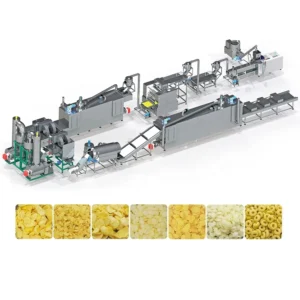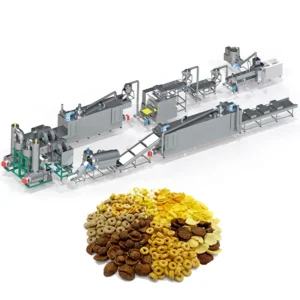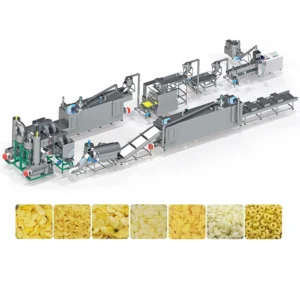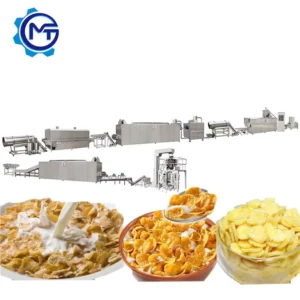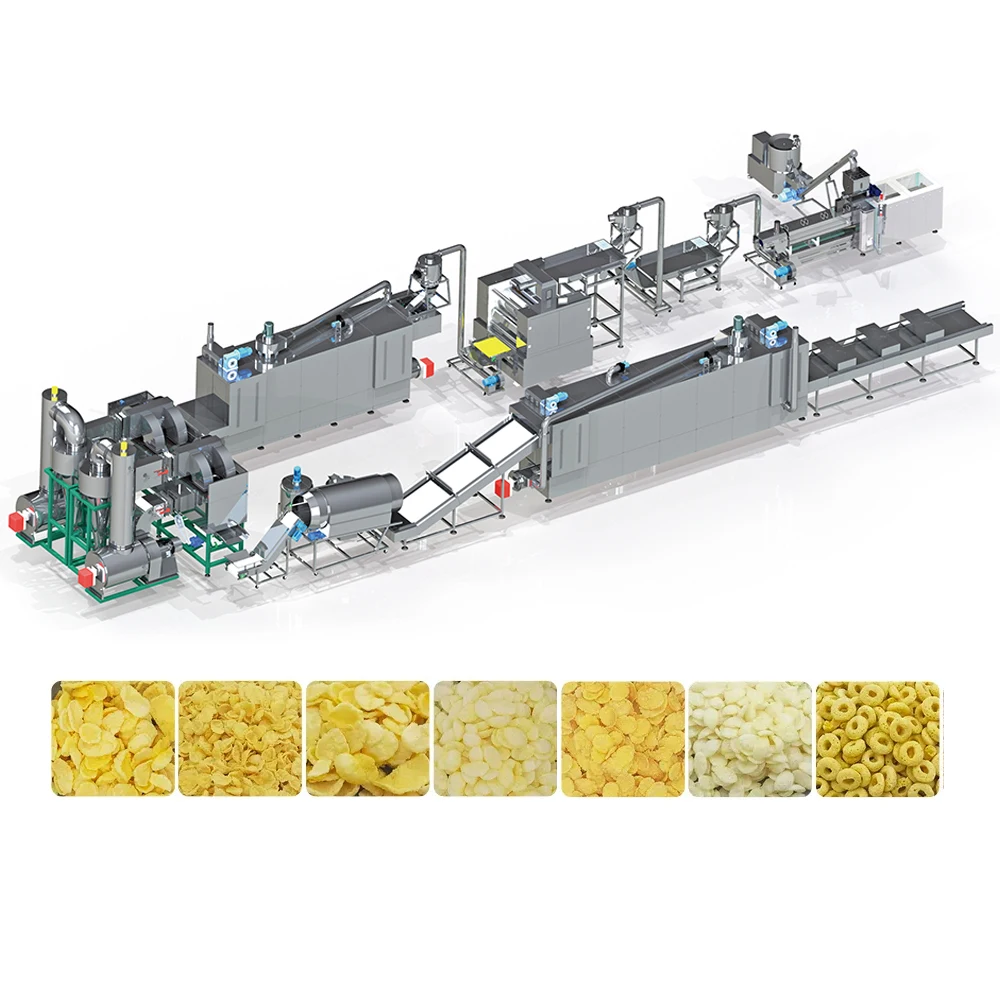
Complete Line Throughput Matching — every station from batching to packing is specified as one integrated system, preventing the common bottleneck where the extruder outpaces the dryer or flaking unit.
Technical Specifications
| Parameter | Value |
|---|---|
| Model | MT70 |
| Product Type | Corn Flakes Making Production Line |
| Installed Power | 160 kW |
| Power Consumption | 120 kW |
| Output Capacity | 150–200 kg/h (basis not stated in source — confirm raw material, moisture content and product format) |
| Overall Dimensions | 41 × 1.5 × 2.2 m |
| Screw Type | Twin Screw |
| Control System | PLC (flaking machine); MCC available for full line |
| Basic Material Input | Powder of corn, rice, wheat, oat, barley |
| Dryer Heating Source | Gas or Electric |
| Production Procedure | Mixing → Extruding → Flaking → Drying → Hot Air Roasting → Sugar Coating (optional) → Cooling → Packing |
Application Suitability
| Application | Material or Output |
|---|---|
| Natural corn flakes for breakfast cereal market | Corn powder processed through twin-screw extrusion and flaking |
| Sugar-coated corn flakes with glazed finish | Corn, rice or wheat base with double tumble sugar coating |
| Puffed snack variants in multiple shapes | Corn, rice, wheat, oat or barley powder with die changes (ball, tube, ring, star, flower) |
| Fortified breakfast cereal blends | Multi-grain powder blends including oat and barley |
Why "Rated Capacity" Means Nothing Without the Rest of the Line
An extruder that produces 200 kg/h is useless if your flaking machine can only handle 120 kg/h.
I have watched breakfast cereal lines in South Asia sit idle for weeks because the supplier quoted the extruder output in isolation. The flaking rollers could not keep up, wet flakes piled on the conveyor, and the dryer received material faster than it could remove moisture. The corn flakes making machine full equipment range matters because throughput must balance at every transfer point. When one station runs faster than the next, you get product degradation, not higher output [NEED_CITE: line throughput balancing principles in continuous food processing].
How Each Station Connects to the Next
The corn flakes making machine full equipment range begins with a mixing and batching system that feeds the twin-screw extruder at a controlled rate. The extruder gelatinises the starch in the corn or multi-grain powder under heat and shear, then delivers a continuous dough sheet to the flaking station. The flaking machine uses hydraulic double rollers with separate motor drives and infrared temperature sensors to press the extrudate into uniform flakes of consistent thickness.
From flaking, the material moves into the dryer where gas or electric heating removes surface moisture before the flakes reach the hot air roasting oven. This oven uses a vibrating pan with high-temperature spraying tubes, a conciliation burner combustion chamber, and two circulating fans with cyclone dust removal. The roasting step creates the characteristic surface bubbles that give corn flakes their crisp texture. Without matched capacity between the dryer and roaster, flakes either pass through under-dried and chewy, or over-dried and brittle.
The Flaking and Roasting Stage in Detail
The PLC-controlled flaking machine is where texture gets defined. Hydraulic pressure on the double rollers determines flake thickness, and the infrared sensor network across the temperature pipes ensures even heat distribution so flakes do not stick or tear during pressing. Downstream, the hot air roasting oven must receive flakes at a steady rate [NEED_CITE: starch retrogradation and moisture removal rates in cereal flake processing]. If the roaster is undersized, the residence time drops and the surface bubbles that create crispness never fully form. The cyclone dust removal device in the roaster also keeps fines from recirculating, which matters for product appearance and food safety compliance.
Reading the Specification Sheet Like a Process Engineer
The twin-screw configuration on the MT70 handles a wider range of grain powders than a single-screw setup, because the intermeshing screws provide self-cleaning action and more uniform shear across materials with different fat and fibre contents. The 160 kW installed power and 120 kW consumption figures tell you the thermal and mechanical energy available for starch gelatinisation inside the barrel. The 41-metre line footprint means you need a facility with adequate length and at least 2.2 metres of clear height, plus space for utility connections and operator access on both sides. The PLC control on the flaking machine and available MCC for the full line give operators repeatable parameter settings across batches, which directly affects flake thickness consistency and final product density.
What Happens When the Coating System Is an Afterthought
Sugar-coated corn flakes require a coating drum with spraying nozzles fed by a double tumble sugar melting system and an elevator. If this station is added as an optional extra after the main line is specified, its capacity often does not match the upstream output. The result is flakes queuing before the coater, cooling unevenly, and losing the surface texture the roasting oven just created. I saw this on a cereal line where the producer tried to add sugar coating months after installation — the coating drum could only handle part of the line output, forcing them to run two shifts to meet orders [NEED_CITE: post-installation line modification challenges in food extrusion].
Why Buyers Specify the Full Range Here
The complete line from mixing to packing comes under one supplier, meaning throughput is calculated across every station rather than assembled from separate vendors who each optimise for their own machine. Screw configuration and die design are matched to your specific grain powder blend before production starts. The in-house testing workshop runs your raw material through the extruder before shipment, so product development does not begin only after installation. Twin-screw expertise covers corn, rice, wheat, oat and barley applications, and the corn flakes making machine full equipment range includes every supporting station — conveying, drying, roasting, coating and cooling — specified as one balanced system. Pre-sales consultation covers line layout, utility planning, and voltage confirmation for your target market.
Documentation & Verification
- Line layout and capacity calculation showing throughput matching between all stations
- Screw and die configuration record matched to your grain powder blend
- Electrical schematic with voltage and frequency confirmed for your market
- Factory test record from trial run on your raw material before dispatch
- Operation and maintenance manual covering every station from mixer to packer
- CE declaration of conformity and ISO certificate included with shipment
Installation, Commissioning & Support
- Foundation and floor space planned around the 41 × 1.5 m footprint and 2.2 m height clearance
- Dedicated power circuit sized for 160 kW installed load with confirmed voltage and frequency
- Twin-screw extruder barrel and screw elements inspected and aligned during on-site assembly
- PLC parameters on the flaking machine calibrated with your grain blend during commissioning
- Operator training covers die changes for shape variants and hydraulic roller pressure adjustment
- Wear parts list provided with spare screws, dies and roller surfaces for first replacement cycle
What to Include in Your Inquiry
Send your target product format (natural or sugar-coated flakes, or puffed snack shapes), the grain powder blend you plan to run, and your intended daily output. Include your workshop dimensions, available ceiling height, and local voltage and frequency standards. Specify the control language your operators need and whether you require a trial run on your raw material before the corn flakes making machine full equipment range ships.
Frequently Asked Questions
Q: How is output capacity verified against my specific raw material and moisture content?
A: Capacity figures on the specification sheet are nominal and must be confirmed against your actual grain powder blend, moisture content and target flake format. We run your raw material through the twin-screw extruder in our testing workshop before shipment and document the achievable throughput in a trial run report.
Q: What voltage and frequency options are available for different target markets?
A: The electrical system is configured to your local supply standard before production begins. You provide your voltage, frequency and phase requirements during the specification confirmation stage, and we issue an electrical schematic for your approval. This prevents commissioning delays caused by mismatched motors or control panels.
Q: How do I choose between MT70, MT85 and MT75 models based on my production target?
A: Model selection depends on your confirmed throughput requirement after raw material testing, not just the nominal capacity range. The MT70, MT85 and MT75 differ in installed power, consumption and line dimensions. We recommend a model based on your grain blend, target product format and daily output after the trial run.
Q: Can the coating system handle both sugar-coated and natural corn flakes on the same line?
A: The sugar coating station is optional and can be bypassed when you produce natural corn flakes. The double tumble melting system, elevator, coating drum and spraying nozzles operate independently of the upstream roasting and cooling stages, so switching between coated and uncoated production requires a line stop and cleaning cycle rather than a reconfiguration.
Q: What supporting equipment is included in the full range?
A: The corn flakes making machine full equipment range covers mixing and batching systems, conveying between stations, the twin-screw extruder, flaking machine, dryer, hot air roasting oven, optional coating system, cooling conveyor and packing station. Each component is sized to match the line throughput so no single station creates a bottleneck.