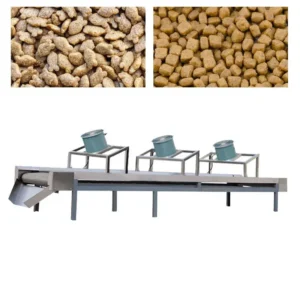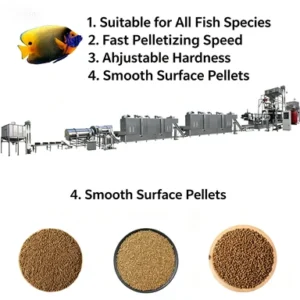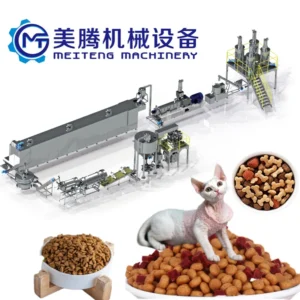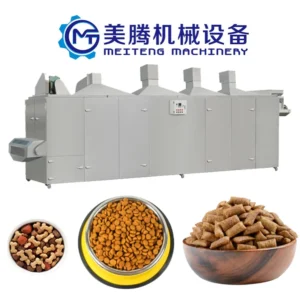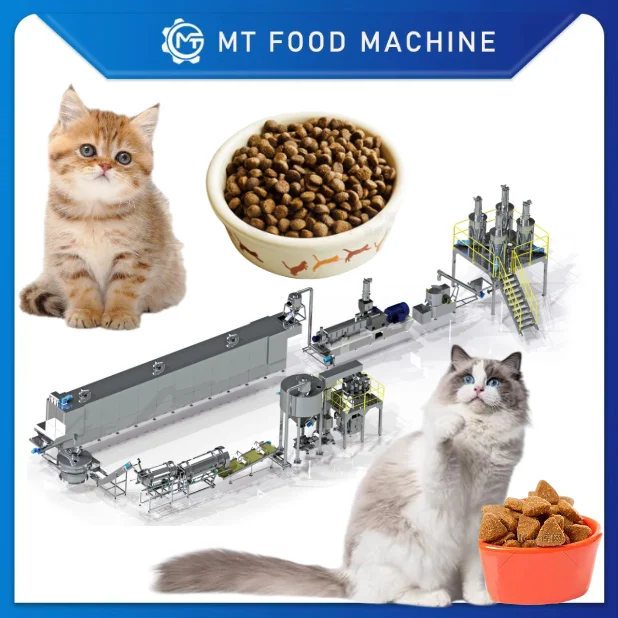
Full Range Synchronization — every supporting station from mixing to packing is capacity-matched to the extruder, preventing the bottlenecks that occur when a line is assembled from separate vendors without throughput verification.
Technical Specifications
| Parameter | Value |
|---|---|
| Product Type | Pet Food Making Machine |
| Application Range | Cat, dog, fish, bird, and cattle feed |
| Line Type | Complete Processing Line |
| Output Capacity | 450–550 kg/h (basis not stated in source — confirm raw material, moisture, and kibble size) |
| Control System | PLC Controlled |
| Operation Profile | Low labor requirement with easy-to-use design |
| Technical Support | Video technical support and online after-sales service |
| Standards | CE certified, ISO certified |
Application Suitability
| Application | Material or Output |
|---|---|
| Dry Kibble Production | Corn, wheat, rice, meat meal, and bone meal formulations for dog and cat diets |
| Aquatic Feed Processing | Fish meal, soy protein, and starch blends for floating and sinking pellets |
| Bird Feed Extrusion | Seed-based and grain-based mixes with vitamin fortification |
| Cattle Feed Pelleting | Roughage, grain, and protein concentrate blends for ruminant nutrition |
What a "Complete Pet Food Making Machine Range" Actually Means for Your Output
A line only runs as fast as its slowest station, and matching throughput across every piece of equipment is the difference between a rated capacity and a real one.
I have seen buyers focus entirely on the extruder barrel size and motor power, then discover after installation that the dryer cannot handle the moisture load coming off the die plate, or the coating drum is too small for the volume of kibble the extruder pushes out. The pet food making machine full equipment range exists to prevent that exact mismatch. When stations are sourced from different vendors, nobody takes responsibility for the handoff points — the moisture content entering the dryer, the temperature window at the coater, the cooling time before packing [NEED_CITE: throughput matching between extrusion and downstream drying stations]. A complete catalogue lets you survey every station and confirm that the conveying speed, drying residence time, and flavouring drum volume all align with the extruder’s actual output on your specific formulation.
Surveying Every Station Before You Specify the Line
When a buyer comes to us for a pet food making machine full equipment range, the first question should not be about the extruder model — it should be about the product specification the market expects. Kibble density, size range, and surface coating requirements dictate what happens at every station downstream. A floating fish feed pellet needs a different drying profile than a dense dog kibble, and the cooling conveyor length must match both the product temperature leaving the dryer and the ambient conditions in your facility.
Why the Dryer and Coater Define Your Final Product Quality
The extruder shapes the product and controls gelatinisation, but the dryer determines final moisture content and shelf stability, while the coater applies the fat and flavour layers that drive palatability. If the dryer is undersized, you either slow the extruder down or ship product with residual moisture that causes mould in the bag. If the coating drum lacks the volume or rotation speed for your throughput, the fat distribution becomes uneven and the pet rejects the feed [NEED_CITE: fat coating uniformity requirements in dry pet food production]. Every station in this range is specified to work together so that the capacity you see on paper is the capacity you get on the floor.
Reading the Specifications That Actually Matter
The PLC control system governs barrel temperature profiles, screw speed, and feed rate across the extruder, which directly affects starch gelatinisation and expansion at the die. For a multi-species line producing both floating aquatic feed and dense kibble, the screw configuration must be changeable, and the control system must store separate recipes for each product. The application range covering cat, dog, fish, bird, and cattle feed means the line is designed for formulation flexibility, but the actual output at 450–550 kg/h depends entirely on the raw material mix and target kibble dimensions. Voltage and frequency must be confirmed against your facility’s supply before production begins — a mismatch here delays commissioning by weeks, not hours.
The Hidden Cost of Mismatched Station Capacity
An extruder running at full output into an undersized dryer means product backs up on the conveyor, cools unevenly, and enters the coating drum at the wrong temperature. Fat applied to warm kibble absorbs differently than fat applied at the target cooling point, and the result is inconsistent palatability batch after batch. Buyers who skip the full equipment survey often discover these problems during the first production week, when the line cannot hold its rated output without constant intervention [NEED_CITE: post-installation commissioning issues from mismatched line stations]. The rework cost — new dryer, extended conveyor, larger coating drum — always exceeds what a matched line would have cost from the start.
Why Buyers Source the Full Range Here
Complete lines from batching to packing under one supplier mean throughput is matched across every station rather than assembled from separate vendors with no single point of accountability. Screw configuration and die design are specified to the buyer’s raw material and target product, not copied from a generic build. The in-house testing workshop runs your actual formulation before shipment, so product development does not start only after installation. Twin-screw expertise spans pet food, aquatic feed, snacks, cereals, starch, and protein applications, meaning the same engineering team understands how different formulations behave through the extruder. Pre-sales consultation carries through to on-site installation, commissioning, and ongoing maintenance support.
Documentation & Verification
- Line layout drawing showing station spacing and throughput match across the pet food making machine range
- Machine specification sheet detailing extruder barrel sections, motor rating, and control architecture
- Screw and die configuration record matched to your raw material and target kibble geometry
- Electrical schematic with voltage and frequency confirmation for your facility before production starts
- In-house trial run report on your actual raw material documenting output rate and product density
- CE declaration of conformity and ISO certificate for export market compliance
Installation, Commissioning & Support
- Foundation and floor space plan sized to the complete line footprint including dryer and cooling conveyor length
- Dedicated power circuit specification matching the PLC-controlled extruder motor and dryer heating elements
- Station-by-station assembly sequence with mechanical and electrical handoff points between extruder, dryer, and coater
- First-run parameter logging across barrel temperatures, screw speed, and dryer zones to establish baseline recipes
- Operator training covering recipe changeover on the PLC for switching between dog, cat, fish, bird, and cattle feed formulations
- Wear parts list identifying screws, dies, and dryer belt sections with recommended replacement intervals
What to Include in Your Inquiry
To specify the right configuration from the pet food making machine full equipment range, provide your target product type and kibble dimensions, the raw material formulation you intend to run including fresh meat or slurry percentages, your facility voltage and frequency, and the control language your operators require. If you have existing upstream or downstream equipment that must integrate, share those specifications so the line layout accounts for the connection points.
Frequently Asked Questions
Q: How do I verify the 450–550 kg/h capacity against my specific raw material?
A: Capacity depends on your formulation, moisture content, and target kibble size. We run your actual raw material in our testing workshop and document the output rate, expansion ratio, and product density in a trial report before you commit to the line.
Q: Which supporting stations are required to avoid line bottlenecks?
A: The extruder must be matched to a dryer with sufficient residence time, a coating drum sized for your throughput, a cooling conveyor long enough to reach ambient temperature, and a packing station rated for your bag weight and speed.
Q: What voltage and frequency options are available for my market?
A: Voltage and frequency are confirmed during the specification stage before production begins. The PLC control system and all motor drives are configured to your facility’s electrical supply to prevent commissioning delays.
Q: How are screw and die configurations matched to different feed types?
A: Each feed type — dog, cat, fish, bird, cattle — requires different screw profiles and die geometries to achieve the correct density and expansion. We configure and document the screw combination based on your target product specification.
Q: What is involved in the in-house trial run before shipment?
A: You supply your raw material or formulation details, and we run the complete line in our testing workshop. The trial report records output rate, product appearance, density, and moisture content so you know the line performs on your ingredients.