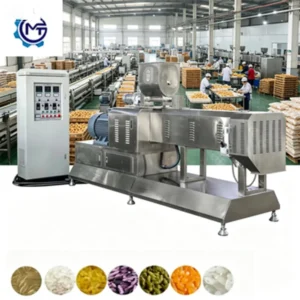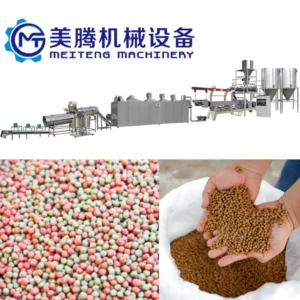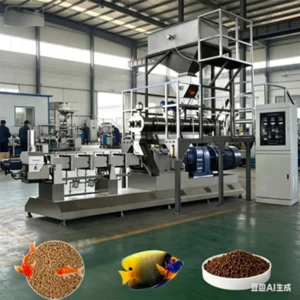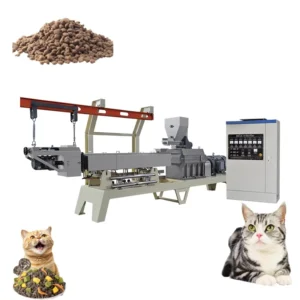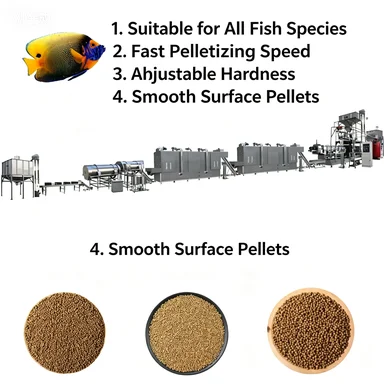
Matched Auxiliary Stations — Every dryer, coater and cooler is sized to the extruder’s actual throughput rather than quoted as a standalone catalog item, eliminating the bottlenecks that arise when supporting equipment is sourced from separate vendors.
Technical Specifications
| Parameter | Value |
|---|---|
| Product Type | Wet Twin Screw Extruder Floating Sinking Aquatic Fish Feed Pellet Production Line |
| Screw Configuration | Twin-screw, segmented barrel sections |
| Control System | Available with PLC or MCC control |
| Voltage | Configurable to buyer’s site requirement (50/60 Hz) |
| Barrel Material | Food-grade stainless steel contact surfaces |
| Die Assembly | Interchangeable die plates for pellet diameter selection |
| Conditioning | Pre-conditioner with steam injection for wet extrusion |
| Line Stations | Mixing, extrusion, drying, coating, cooling, packing |
| Testing | In-house trial run on buyer’s raw material before shipment |
Application Suitability
| Application | Material or Output |
|---|---|
| Floating fish feed pellets | Soybean meal, fish meal, rice bran, wheat flour blends |
| Sinking aquaculture feed | High-protein formulations with controlled density |
| Catfish pellet production | Grain and protein mixes at varying moisture levels |
| Tilapia feed pellets | Plant-based and marine-based raw material ratios |
| Shrimp feed extrusion | Fine-grind formulations requiring uniform gelatinisation |
Why "Rated Capacity" Means Nothing Without Your Actual Formula
A capacity figure tied to a generic test material will not predict output on your specific aquatic feed formulation.
I have watched buyers receive an aquatic feed line that performed well during factory acceptance on standard corn-based material, only to discover on-site that their actual formula — higher fat, different starch source, adjusted moisture — pushed real throughput well below expectation. The extruder was not wrong; the expectation was. That is why I ask for the buyer’s real recipe before any line configuration begins, so screw speed, barrel temperature profile and die selection are matched to what will actually run through the machine [NEED_CITE: twin-screw extrusion behaviour across varying fat and starch ratios].
How Wet Extrusion Changes Pellet Density Control
The pre-conditioner introduces steam into the raw material blend before it enters the twin-screw barrel, raising moisture and temperature ahead of the main extrusion zone. This early hydration step gives the starch more residence time to gelatinise, which directly influences whether the pellet floats or sinks in water. A wet twin screw extruder for floating sinking aquatic fish feed relies on this conditioning stage to hold consistent density across long production runs.
Barrel Sections, Screw Pitch and Shear Energy
Segmented barrel sections allow operators to set independent temperature zones along the screw length. Combined with variable screw pitch elements, this controls the shear energy applied at each stage — gentle mixing early on, intense cooking and compression toward the die face. Adjusting these zones is how a process engineer shifts a formulation from producing a buoyant floating pellet to a dense sinking variant without changing hardware [NEED_CITE: barrel zone temperature profiling in twin-screw food extrusion].
Reading the Specifications That Actually Matter
The twin-screw configuration matters because aquaculture formulations often contain high fat and fine protein fractions that a single screw cannot convey uniformly. The segmented barrel with independent heating zones lets the operator fine-tune gelatinisation degree — critical when floating and sinking pellets are both produced on the same line. Steam conditioning capacity in the pre-conditioner must match the extruder’s throughput; undersized conditioning leads to incomplete starch cooking and inconsistent pellet buoyancy. The PLC or MCC control option determines whether recipe changes are stored digitally with repeatable parameter recall or managed through manual relay logic, which affects batch-to-batch consistency during shift changes.
The Downstream Bottleneck Nobody Quoted For
An extruder running at full output is worthless if the dryer cannot remove moisture fast enough or the coating drum cannot apply fat evenly at that rate. I have seen lines where the extruder was correctly sized but the dryer was one model too small, forcing the entire line to throttle back and run below the purchased capacity. Selecting the dryer, cooler and coating station from the same equipment range ensures every station handles the same throughput without creating a choke point downstream [NEED_CITE: throughput matching between extrusion and drying stages in feed production].
What This Equipment Range Covers Under One Supplier
The full line — from batching and mixing through extrusion, drying, flavouring, cooling and packing — comes from a single equipment range, so throughput calculations are matched station by station before the layout is finalised. Screw configuration and die selection are specified against the buyer’s actual raw material, not copied from a generic build. The in-house testing workshop runs the buyer’s formula before the machine ships, so adjustments happen at the factory rather than during commissioning on the buyer’s floor. CE-certified construction and food-grade contact materials are standard across the range. Documentation includes line layout, electrical schematics with confirmed voltage, trial run reports and wear parts lists so the buyer’s maintenance team is prepared from day one.
Documentation & Verification
- Line layout drawing showing station-by-station throughput match for your target pellet output
- Screw and die configuration record matched to your aquatic feed formulation
- Electrical schematic with voltage and frequency confirmed for your site before production
- Trial run report on your raw material documenting pellet density and gelatinisation results
- CE declaration of conformity and ISO certificate for the complete line
- Wear parts list with screw element and die specifications for reorder planning
Installation, Commissioning & Support
- Foundation and utility plan sized to the twin-screw extruder’s motor power and steam demand
- Dedicated circuit requirements confirmed against local voltage and frequency before wiring begins
- Pre-conditioner and barrel sections arrive assembled; line stations connected and aligned on-site
- First-run parameter tuning with your actual feed formula to verify float and sink pellet density
- Operator training covering barrel zone temperature adjustment and die changeover procedure
- Spare screw elements and die plates identified and available for your first scheduled replacement
What We Need to Configure Your Line
Send your raw material formula with protein, fat and starch percentages, along with the target pellet diameter and whether the product must float, sink or both. Include your site voltage and frequency, preferred control language, and available workshop floor space with ceiling height. If you have existing upstream grinding or downstream packing equipment, share those specifications so the line can integrate without redundant stations. A sample of your raw material shipped to our testing workshop allows a full trial run before any production commitment.
Frequently Asked Questions
Q: Can the same line produce both floating and sinking pellets?
A: Yes. Switching between floating and sinking pellets on a wet twin screw extruder for floating sinking aquatic fish feed involves adjusting the pre-conditioner steam level, barrel zone temperatures and screw speed to change starch gelatinisation degree and final pellet density. The die plate may also be swapped if pellet diameter differs between products.
Q: What happens if my raw material formula changes after installation?
A: The segmented barrel and interchangeable screw elements allow reconfiguration for new formulations. The PLC control option stores multiple recipes with distinct temperature, speed and conditioning parameters, so operators can recall settings without manual trial and error each time a formula is adjusted.
Q: How is the dryer capacity matched to the extruder?
A: Dryer length and airflow are calculated based on the extruder’s output rate and the moisture content of pellets leaving the die. Undersized drying leaves pellets too wet for storage, while oversized drying wastes energy. The equipment range allows station-by-station matching so no single point restricts the line.
Q: Is a trial run really necessary before shipment?
A: Running your actual raw material in the testing workshop reveals how your specific starch source, fat level and particle size behave under extrusion conditions. Adjustments to screw pitch, die geometry and conditioning parameters are made at the factory, reducing the commissioning time and material waste at your site [NEED_CITE: pre-shipment trial runs reducing on-site commissioning duration].