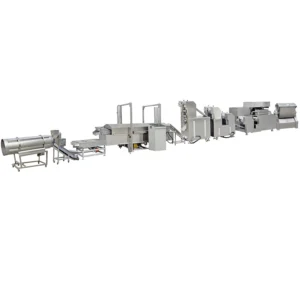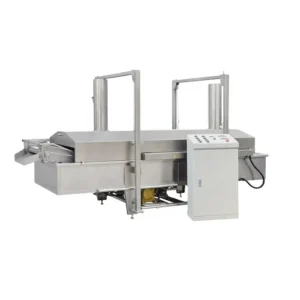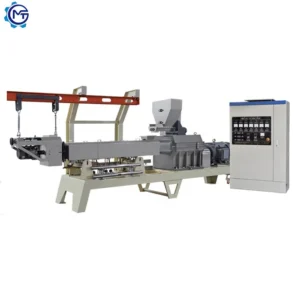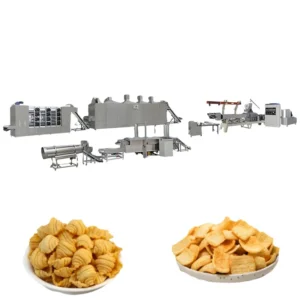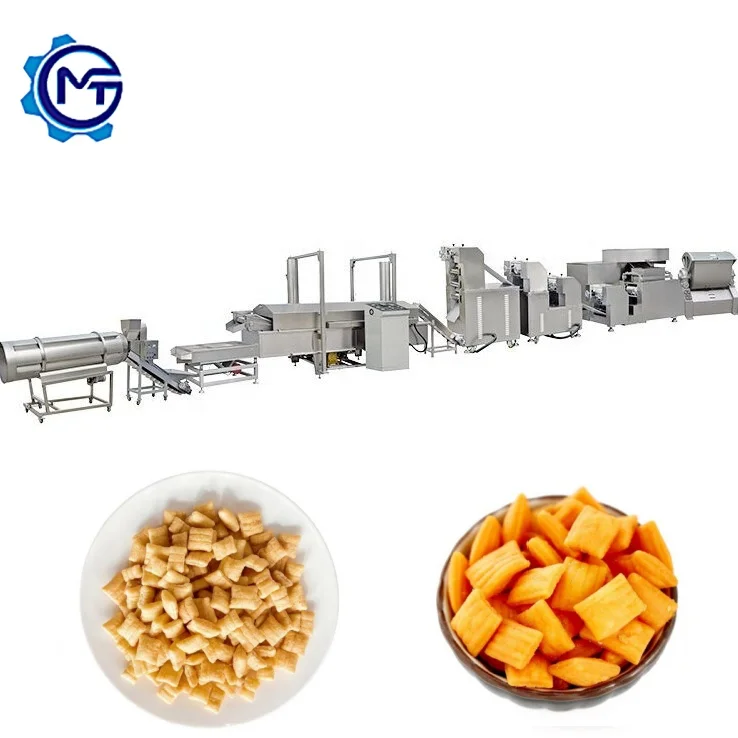
Integrated Frying Support — MT continuous deep frying machines are configured as matched stations within extruded snack lines, with throughput calculated against upstream extruder output and downstream coating capacity rather than quoted as isolated capacity figures.
Technical Specifications
| Parameter | Value |
|---|---|
| Product Type | Continuous Deep Frying Machine |
| Rated Power | 2.6 kW (drive and control systems) |
| Heating Tube Power | 60 kW |
| Voltage & Frequency | 380V / 50Hz (configurable for target market) |
| Control System | PLC |
| Overall Dimensions (L×W×H) | 6700 × 2200 × 1200 mm |
| Net Weight | 2000 kg |
| Capacity Range | 100–1000 kg/h (basis not stated in source — confirm product type, moisture, and frying time) |
| Oil Capacity | 320 L |
| Heating Method | Electric / Gas (optional) |
| Belt Type | Upper and lower double-layer mesh belt with frequency conversion stepless speed regulation |
| Oil Filtration | Continuous circulation filtration system |
| Slag Discharge | Bottom slag discharge system |
| Lifting System | Automatic lifting for upper hood and mesh belt |
| Construction Material | Food-grade 304 stainless steel |
| Warranty | 1 Year (core component warranty includes PLC) |
| Assembly State | Fully assembled |
| Standards | CE |
Application Suitability
| Application | Material or Output |
|---|---|
| Fried puffed snacks (Bugles, triangle chips) | Wheat flour dough, corn-based extruded pellets |
| Fried snack pellets | 2D/3D pellet snacks from potato starch or corn starch blends |
| Continuous chip frying | Sliced potato, sweet potato, and root vegetable chips |
| Restaurant and food factory operations | Batch-to-continuous frying scale-up for snack producers |
| Integrated snack line station | Matched with upstream extruders and downstream flavouring drums |
Why the Frying Station Often Bottlenecks the Whole Snack Line
A continuous deep frying machine for sale quoted at a nominal throughput means little when the extruder upstream delivers product at a different rate or moisture level. The frying station must be spec’d against actual line throughput, not catalog capacity. I have seen extruded pellet lines where the fryer was chosen last, after the extruder and dryer were already locked in. The result was a frying bottleneck that forced the entire line to run below its designed output, or worse, product sitting in the oil too long and coming out over-browned and bitter. The mismatch is never obvious on a spec sheet — it only shows up when the line runs with real product on the floor [NEED_CITE: line throughput matching principles for food processing equipment].
How the Double-Layer Mesh Belt Controls Product Behaviour
Light extruded snacks like Bugles and wheat flour puffs tend to float the moment they hit hot oil. The upper and lower mesh belts on this continuous deep frying machine sandwich the product during transit, holding each piece submerged at a consistent depth. This prevents uneven colouration and ensures that every piece receives the same heat exposure across its full surface. The frequency conversion speed regulation lets operators adjust frying time without stopping the line, which is critical when switching between products with different moisture contents or densities.
Continuous Oil Filtration and Its Effect on Product Consistency
Frying oil degrades as fine particles from extruded dough accumulate and carbonise. The continuous circulation filtration system on this unit removes suspended solids during operation rather than waiting for scheduled oil changes. This keeps the acid value within acceptable bounds for longer production runs and reduces the frequency of full oil replacement. The bottom slag discharge works alongside the filtration loop, collecting heavier debris before it can recirculate through the heating zone [NEED_CITE: edible oil degradation and acid value management in industrial frying].
Reading the Specifications for Your Production Context
The 60 kW heating tube power determines how quickly the 320 L oil volume recovers temperature after cold product enters the fryer. A higher product load or higher incoming moisture demands more thermal recovery capacity, so this figure should be evaluated against your specific product rather than taken as a standalone rating. The PLC control system manages oil temperature, belt speed, and filtration cycles from a single interface — and the control language can be configured before shipment to match your operator team. The 6700 mm length reflects the fryer’s residence time chamber; shorter fryers may not provide adequate frying time for denser pellet snacks. Food-grade 304 stainless steel throughout the contact zones meets hygiene requirements for food export markets and simplifies washdown between product changeovers.
The Hidden Cost of an Undersized Frying Station
When the fryer cannot keep pace with the extruder, operators either slow the entire line or allow product to queue before the fryer inlet. Queued extruded snacks lose moisture and change texture before they even enter the oil, producing inconsistent final product. Over time, the oil degrades faster because operators run it at higher temperatures to compensate for throughput pressure, which shortens oil life and raises operating costs. I once visited a facility where the fryer was the third vendor on the line — nobody had confirmed that its belt width matched the extruder’s die output pattern [NEED_CITE: equipment mismatch consequences in snack processing lines].
Why Buyers Source the Frying Station from the Same Supplier
MT supplies the continuous deep frying machine as part of a complete snack line, which means throughput is calculated across every station from batching through extrusion to frying and packing. Screw configuration on the upstream extruder is matched to the same raw material that enters this fryer, so moisture and density assumptions stay consistent. The in-house testing workshop runs your actual raw material through the extruder and fryer together before shipment, catching mismatches that spec sheets cannot reveal. Electrical schematics confirm voltage, frequency, and PLC language for your market before production begins. Wear parts lists cover mesh belt sections, heating elements, and filtration components so replacements are available when first needed.
Documentation & Verification
- Line layout drawing showing fryer position and throughput match to extruder output
- Machine specification sheet with confirmed voltage, heating method, and PLC language
- Factory test record with video inspection on your raw material before dispatch
- Screw and die configuration record from upstream extruder linked to frying parameters
- CE declaration of conformity covering the frying station and integrated safety systems
- Wear parts list covering mesh belt, heating tubes, and filtration components
Installation, Commissioning & Support
- Floor space allocation for 6700 × 2200 mm footprint with clearance for hood lifting access
- Dedicated 380V circuit sized for 60 kW heating load plus 2.6 kW drive and control systems
- Fully assembled delivery — position, level, connect utilities, and fill oil to begin commissioning
- PLC parameter setting for oil temperature curve and belt speed matched to your product during on-site startup
- Operator training on automatic lifting system for safe hood and belt access during cleaning
- Scheduled filtration maintenance intervals and mesh belt inspection guidance included in manual
What to Include in Your Frying Station Inquiry
To configure the right continuous deep frying machine for sale within your snack line, share your product type and target output per hour, the raw material recipe and incoming moisture level after extrusion, and your local voltage and frequency. If you already have an extruder running, provide its die output pattern and current throughput so the fryer belt width and residence time can be matched. Let us know whether electric or gas heating fits your facility utility setup, and whether you need a trial run on your material in our testing workshop before finalising the configuration.
Frequently Asked Questions
Q: How is frying capacity verified and what assumptions does it depend on?
A: Capacity depends on product type, incoming moisture, and required frying time. We verify throughput by running your actual extruded product through the fryer in our testing workshop, measuring oil temperature recovery and belt speed against your target output. The quoted range assumes specific conditions that must be confirmed against your material before the machine is built.
Q: Electric versus gas heating — how should I choose?
A: Electric heating with 60 kW tubes offers precise temperature control through the PLC and suits markets with stable grid supply. Gas heating reduces electricity demand and can lower operating costs where natural gas is readily available. The choice depends on your local utility pricing, available gas infrastructure, and whether your facility already has gas lines routed to the production area.
Q: How does the continuous oil filtration system work in practice?
A: Oil circulates through a filtration loop during operation, removing fine particles and sediment before they carbonise and degrade oil quality. The bottom slag discharge collects heavier debris separately. Maintenance involves periodic filter element inspection and replacement according to the schedule in the operation manual, which varies with product type and production volume.
Q: Can the voltage, frequency, and PLC language be set for my market?
A: Yes. Voltage and frequency are confirmed during the specification stage before production begins, and the PLC interface language is set to match your operator team. Electrical schematics are provided for your local electrician to verify compatibility with your facility supply before the machine ships.
Q: How does this fryer integrate with upstream and downstream equipment?
A: The fryer is positioned between the extruder or pellet former and the downstream flavouring or cooling stations. Belt width, transfer height, and throughput are calculated so product flows continuously without queuing. When sourced as part of a complete MT line, every station is matched to the same capacity target from a single supplier.