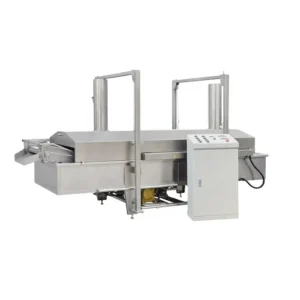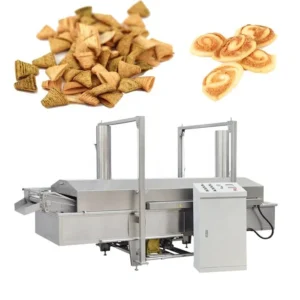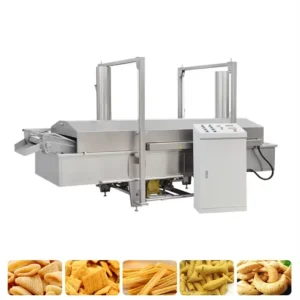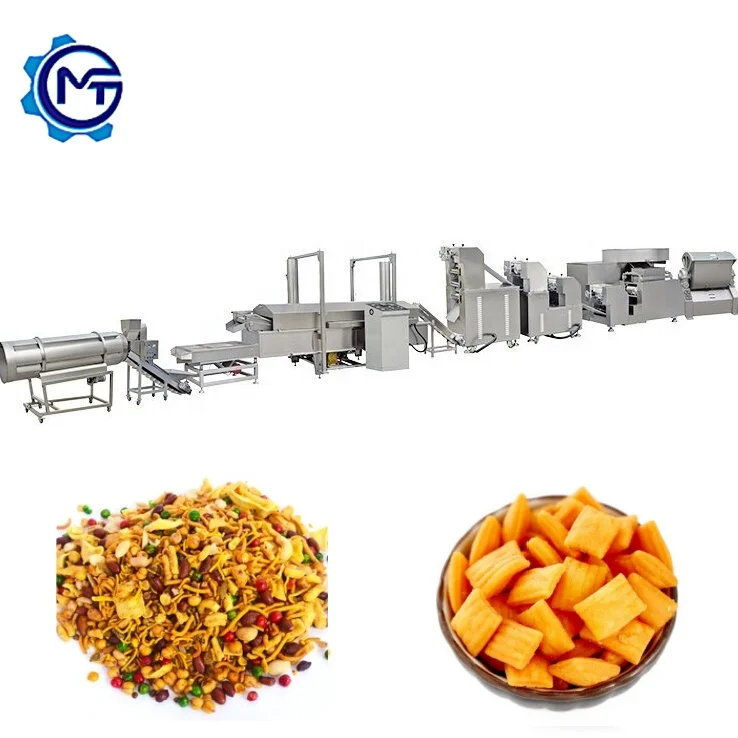
Integrated Line Throughput Matching — This continuous frying machine is configured to synchronize with upstream extrusion and downstream coating stations, preventing output loss at any single stage of snack processing lines.
Technical Specifications
| Parameter | Value |
|---|---|
| Product Type | Continuous Frying Machine |
| Power Source | Electric / Gas (configurable) |
| Heating Method | Electricity Heating / Gas Heating |
| Voltage | 380V/50HZ (other standards available) |
| Main Drive Power | 2.6 kW |
| Heating Tube Power | 60 kW |
| Oil Capacity | 320 L |
| Weight | 2000 kg |
| Overall Dimensions (L×W×H) | 6700 × 2200 × 1200 mm |
| Capacity | 100–1000 kg/h (basis to be confirmed by product type, moisture, and oil temperature) |
| Control System | PLC |
| Contact Material | Food-grade 304 Stainless Steel |
| Mesh Belt | Double-layer, frequency conversion stepless speed regulation |
| Oil Filtration | Oil circulation filtration system |
| Lifting System | Automatic lifting for hood and mesh belt |
| Slag Discharge | Bottom slag discharge system |
Application Suitability
| Application | Material or Output |
|---|---|
| Fried snack production | Corn curls, fried stick snacks, extruded pellets after frying |
| Instant noodle processing | Spix, Soba, Mie Sedap style fried noodle blocks |
| Breakfast snack lines | Puffed and extruded shapes requiring deep-frying before seasoning |
| Contract packaging lines | Any extruded snack shape passing through hot oil before flavouring drums |
What a Frying Machine Capacity Figure Actually Means
The throughput rating printed on the nameplate rarely matches what your line delivers on a specific product recipe.
A buyer I worked with years ago installed a fryer rated at a nominal hourly volume for corn curls, but their actual dough moisture ran noticeably higher than standard test material. The extruder pushed product through, yet the fryer couldn’t hold temperature recovery with that extra water load, and real output settled well below expectations. That mismatch is common when a Continuous Frying Machine manufacturer quotes capacity on one product while the buyer runs another [NEED_CITE: industrial frying temperature recovery rates relative to product moisture load]. The lesson is straightforward: a capacity number without stated product type, moisture content, and oil temperature is only a starting point, not a guarantee.
Where This Fryer Sits in the Full Equipment Sequence
On a typical snack extrusion line, the frying station receives formed product from the extruder and a short drying or cooling conveyor, then passes fried output into a de-oiling belt before the seasoning drum. Placing a Continuous Frying Machine manufacturer into this sequence requires that every adjacent station can keep pace. If the extruder produces more volume than the fryer can handle at the target oil temperature, product backs up, moisture migrates, and texture degrades before it ever reaches the oil.
Matching Heat Input to the Line’s Real Moisture Load
Each kilogram of raw product entering hot oil carries a fixed amount of water that must flash off before the crust sets. When upstream extrusion runs at higher moisture, the fryer’s heating tubes must supply substantially more energy just to maintain oil temperature. The 60 kW heating tube array on this unit is sized to handle moderate moisture differentials, but buyers running high-hydration recipes should confirm thermal recovery curves with actual samples [NEED_CITE: thermal balance calculations for continuous industrial deep fryers]. Gas-fired configurations are available where factory utility layouts favor burners over electric elements.
Reading the Specs That Govern Daily Operation
The double-layer mesh belt sandwiches product between upper and lower belts, which is necessary for low-density extruded snacks that would otherwise float and fry unevenly on one side. Stepless frequency conversion on the belt drive lets operators dial frying time continuously rather than switching between fixed gears, so a line changeover from corn curls to fried pellets only requires a belt-speed adjustment rather than mechanical sprocket changes. Food-grade 304 stainless steel contact surfaces meet the hygiene expectations of most export markets and withstand the daily caustic wash-downs typical in snack plants. The oil circulation filtration system continuously pulls sediment out of the bath during production, extending oil service life before a full change-out is required. Automatic hood and belt lifting means a single operator can raise the upper belt and canopy for end-of-shift cleaning without overhead crane support.
The Cost of Skipping Upstream-Downstream Matching
When a fryer is specified in isolation, the most common consequence is an oil temperature drop that no amount of heating power can recover in time, leaving product under-fried on the inside and over-browned on the surface. I have walked into plants where the extruder and fryer were sourced from different vendors, each quoting nominal capacity on different test products, and the gap between those two numbers became the owner’s daily problem [NEED_CITE: line integration failures caused by mismatched station throughput]. Seasoning adhesion suffers too, because oil film thickness on under-fried surfaces is inconsistent, and coating drums cannot compensate for that variance.
Why Source This Station from a Full-Line Builder
Throughput calculations across mixing, extrusion, drying, frying, and coating are done on one set of line-layout drawings, so every station is sized against the same product recipe and target output. Screw and die configurations upstream are chosen with the fryer’s oil load in mind, preventing the moisture mismatch that causes most post-installation disputes. An in-house testing workshop allows trial runs on the buyer’s actual raw material before the fryer ships, so capacity claims are verified rather than assumed. PLC programming and control-panel language are confirmed against the destination market during the specification stage, not discovered on commissioning day. Wear parts lists for mesh belts, heating tubes, and filter elements ship with the machine so first replacements are on hand.
Documentation & Verification
- Line layout showing fryer position and throughput balance with extruder and seasoning drum
- Machine specification sheet with confirmed voltage, frequency, and heating method
- Electrical schematic matching destination market wiring standards and PLC language
- Factory test record on buyer-supplied raw material before dispatch
- Packing photographs and customs documentation for export clearance
Installation, Commissioning & Support
- Foundation must support 2000 kg static weight plus dynamic load of 320 L oil and product
- Dedicated 380 V circuit rated for the 60 kW heating load plus main drive motor
- Machine ships as a single assembly; hood and belt lift for first inspection on arrival
- PLC parameters preset during factory trial; on-site commissioning verifies oil temperature recovery
- Operator training covers mesh belt speed adjustment, filter cleaning, and slag discharge routine
- Wear parts kit includes replacement heating tubes and filter cartridges for initial service interval
Before You Send the Inquiry
To size this frying station correctly within your line, share the extruded product type, typical moisture content after drying, and the hourly output your upstream extruder actually delivers. Confirm your factory voltage, frequency, and whether electric or gas heating fits your utility layout. If you already run a coating or packing station downstream, include its rated speed so throughput balance can be checked across every point.
Frequently Asked Questions
Q: How is fryer throughput matched to my upstream extruder output?
A: We calculate line throughput based on your specific product recipe, moisture content after drying, and target oil temperature, then size the fryer belt speed and heating capacity to hold that rate. Trial runs on your actual raw material in our testing workshop confirm the match before shipment.
Q: What voltage and control language options are available?
A: The standard configuration is 380 V/50 Hz, but other voltage and frequency combinations can be built to match local utility standards. PLC interface language is confirmed during the specification stage so operators read menus in their working language from first start-up.
Q: Where does the fryer fit between other stations?
A: On a typical snack line, the fryer receives product after extrusion and a short drying or cooling conveyor, then discharges onto a de-oiling belt before the flavouring drum. Layout drawings show every station’s position and the throughput balance between them.
Q: Which spare wear parts ship with the machine?
A: The initial wear parts list covers heating tubes, filter elements, and mesh belt sections so the first replacements are available on site. A full wear parts catalogue with part numbers is included in the documentation package for future orders.
Q: Can I specify gas heating instead of electric?
A: Yes, gas-fired burners are available as an alternative to the 60 kW electric heating tubes. The choice depends on your factory utility setup and local energy costs. We confirm the heating method during specification so the correct burner or element array is installed before shipping.