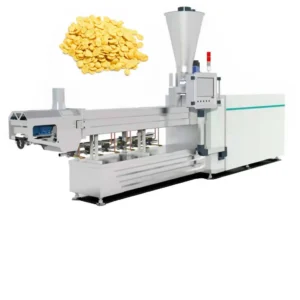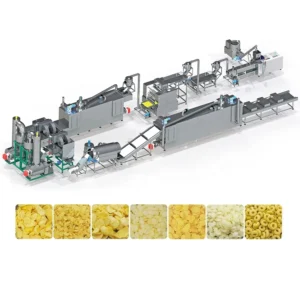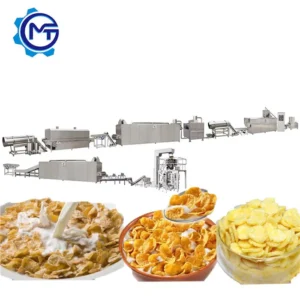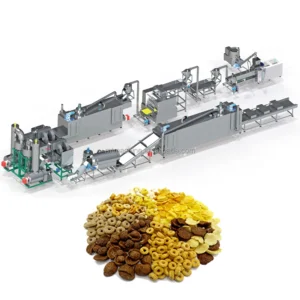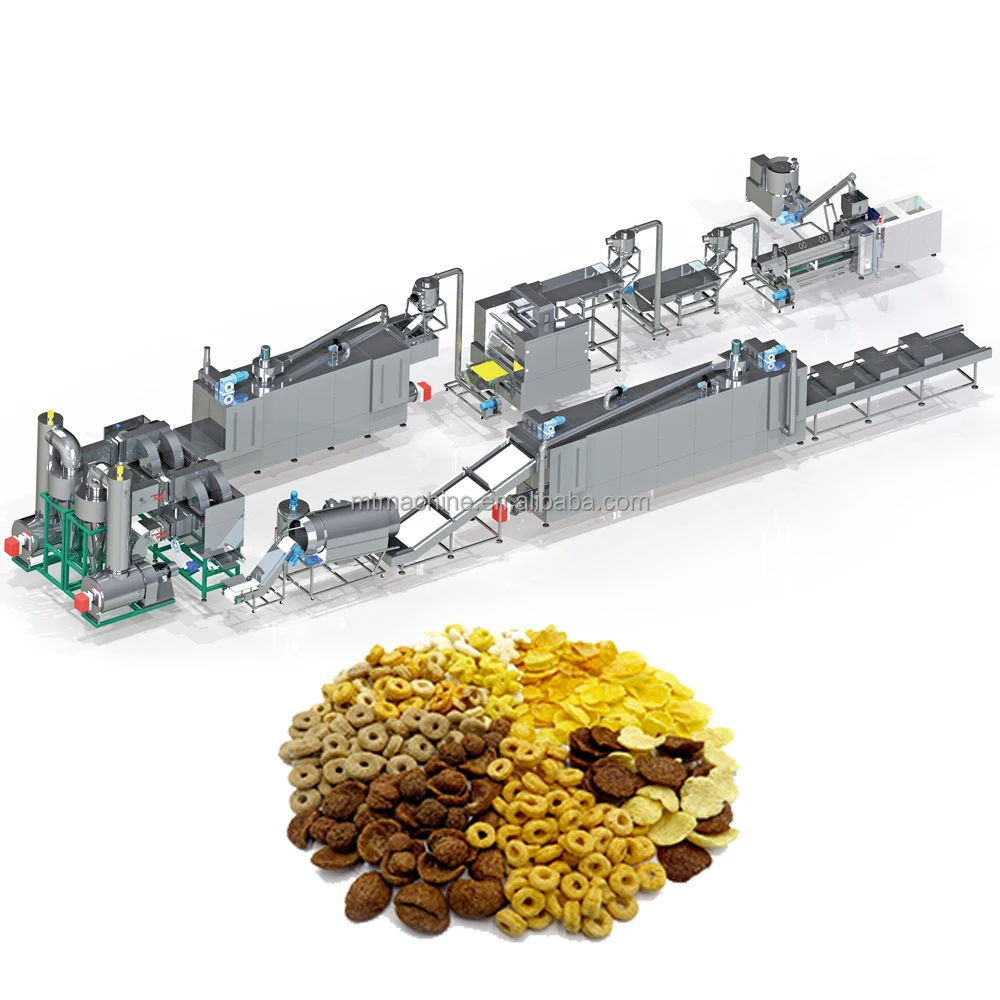
Integrated Line Matching — Every station from mixing to packing is sized against the extruder’s actual output so that no single unit chokes throughput downstream.
Technical Specifications
| Parameter | Value |
|---|---|
| Product Type | Twin Screw Corn Flakes Breakfast Cereal Extrusion Line |
| Screw Type | Twin Screw |
| Output Capacity | 200–300 kg/hr (basis not stated in source — confirm raw material, moisture level, and product format) |
| Voltage Options | 220V / 380V, 50Hz / 60Hz to be confirmed before production |
| Rated Power | 3 kW (verify against full line load; value may reflect flaking unit only) |
| Control System | PLC control with MCC integration across line stations |
| Flaking Machinery Dimensions | 1330 × 440 × 960 mm (source value — verify whether flaking unit only or full footprint) |
| Flaking Machinery Net Weight | 50 kg (source value — verify against manufacturer catalog) |
| Extruder Sub-Systems | Feeding, extruding, cutting, heating, gearing, controlling |
| Extruder Lubrication | Automatic lubricating and cooling function |
| Flaking Roller Drive | Hydraulic double rollers with independent dual-motor drive |
| Flaking Temperature Control | Infrared sensor regulation |
| Dryer Heating Source | Gas or Electric (configurable) |
| Hot Air Roasting Oven | Vibrating pan, reconciliation burner, dual circulating fans, cyclone dust removal |
| Coating System | Double tumble melter, elevator, coating drum, spraying nozzle |
| Raw Materials Processed | Corn, rice, wheat, oat, barley |
| Core Components | Gearbox |
| Warranty | 1 Year (core components: 1 Year) |
| Machinery Test Report | Provided |
| Video Outgoing-Inspection | Provided |
| Certification | CE, ISO |
Application Suitability
| Application | Material or Output |
|---|---|
| Natural corn flakes for retail breakfast cereal | Corn grits or whole corn meal, toasted without sugar |
| Sugar-coated corn flakes | Corn-based extrudate with sugar syrup spray and tumble coating |
| Wheat flakes for health-oriented cereal lines | Cracked wheat or blended wheat flour formulations |
| Rice and oat flakes for infant or fortified cereal | Rice flour, oat flour, or multi-grain blends |
| Puffed extruded snacks from the same platform | Corn, rice, or multi-grain dough with die-shape changes |
What "200–300 kg/hr" Actually Requires Downstream
A quoted extruder capacity means nothing if the dryer and flaking mill were never engineered to keep pace.
I watched a corn flakes line stall out in its first week because the buyer sourced the extruder from one vendor and the dryer from another. The extruder pushed dough at its rated rate, but the dryer could only handle a fraction of that volume. Product piled up, moisture climbed, and flake texture went soft within hours. The buyer blamed the extruder, but the real fault sat in the mismatched stations. When a corn flakes breakfast cereal machine full equipment range arrives as one matched set, this kind of bottleneck is designed out before the first bolt is tightened [NEED_CITE: throughput balancing methodology across sequential food processing stations].
How Screw and Barrel Design Shape the Flake
The twin-screw configuration in the MT-75 handles corn, rice, wheat, oat, and barley across a wide moisture range. Screw elements are arranged to control shear, residence time, and starch gelatinisation so that the dough leaves the barrel at the exact viscosity the flaking rollers expect. Change the grain or the target flake thickness and the screw combination shifts accordingly — a setup that generic builds often skip, leaving operators to guess at configurations after installation.
From Dough to Crisp: Matching Every Station in Sequence
A corn flakes breakfast cereal machine full equipment range must move product through mixing, extruding, flaking, drying, hot air roasting, cooling, and packing without any single station forcing the others to idle. The hydraulic flaking machinery here uses independent dual-motor drive with infrared sensor temperature control, keeping roller gap and surface heat steady so flake thickness holds within tolerance. Downstream, the hot air roasting oven runs a reconciliation burner with dual circulating fans and a cyclone dust removal device, delivering the surface blistering and internal crispness the market expects [NEED_CITE: roasting oven airflow design for uniform cereal blistering].
Reading the Specs That Matter Most
The gearbox at the heart of the extruder determines how much torque reaches the screws under full load; a gearbox sized too small will slip or overheat when running high-moisture oat formulations. Automatic lubricating and cooling inside the extruder extends screw service life during continuous shifts, cutting unplanned stops. On the flaking side, the hydraulic double-roller system holds pressure constant even as roller surfaces wear, so operators do not chase thickness drift every few hours. Dryer heating can be set to gas or electric depending on the buyer’s local utility cost, a decision that affects both running expense and temperature ramp-up speed. PLC control integrated with MCC across all stations means a single operator interface covers the entire line, reducing the chance of a mis-set parameter upstream causing waste downstream.
The Hidden Cost of a Mismatched Flaking Mill
Buyers sometimes focus on extruder output and treat the flaking mill as an afterthought. When the rollers cannot compress the extrudate fast enough, dough backs up in the conveyor, cools unevenly, and arrives at the dryer with inconsistent moisture. The dryer then over-dries some flakes and under-dries others. By the time the batch reaches the roasting oven, texture variation is already baked in, and no amount of oven tuning can fix it [NEED_CITE: sequential moisture control failure modes in cereal flaking lines].
Why Source the Full Range Under One Roof
Every station is capacity-matched during the layout phase, so the extruder, dryer, flaking mill, roaster, and coating drum are all specified against the same throughput target rather than assembled from separate catalogs. Screw configuration and die design are set after reviewing the buyer’s actual grain formula, not copied from a generic build. The in-house testing workshop runs the buyer’s raw material before shipment, producing a documented trial report so product development starts on day one of installation, not after weeks of trial and error. Electrical schematics are confirmed for the buyer’s local voltage, frequency, and control language before the cabinet is wired. CE and ISO documentation ships with every line, easing customs clearance and local regulatory filing.
Documentation & Verification
- Line layout drawing with station-by-station capacity confirmation for your grain formula
- Screw and die configuration record matched to your corn, rice, wheat, or oat blend
- Trial run report on your actual raw material executed in the testing workshop
- Electrical schematic with voltage, frequency, and PLC language locked to your market
- CE declaration of conformity and ISO certificate included in shipping documents
- Wear parts list with screw, die, roller surface, and nozzle part numbers
Installation, Commissioning & Support
- Foundation pad leveled to flaking machinery footprint of 1330 × 440 × 960 mm tolerance
- Dedicated circuit sized for confirmed voltage (220V or 380V) and full line amperage draw
- Extruder and dryer shipped partially assembled; final roller alignment done on site
- PLC parameter library loaded with trial-run profiles from your grain formula before arrival
- Operator training covers screw changeover, hydraulic roller adjustment, and roasting oven fan balance
- First-shipment spare set includes screws, die inserts, and spraying nozzles
What We Need to Quote Accurately
Share the grain or multi-grain formula you plan to run, including moisture content and any added ingredients. Let us know the target flake format — natural, sugar-coated, or both — along with the daily output you need to hit. Confirm your workshop’s available floor space, ceiling height, and local power supply voltage and frequency so the line arrives ready to wire [NEED_CITE: export machinery voltage and frequency confirmation standards].
Frequently Asked Questions
Q: How is the 200–300 kg/hr capacity verified, and on which raw material does it hold?
A: The capacity range depends on the grain type, moisture level, and whether the output is natural or sugar-coated flakes. We run your actual raw material in our testing workshop before shipment and document the sustainable throughput in a trial report, so the figure you see is tied to your formula, not a generic benchmark.
Q: What voltage, frequency, and control language are confirmed before shipment?
A: Before the cabinet is wired, we lock in your site’s voltage (220V or 380V), frequency (50Hz or 60Hz), and the PLC interface language. The electrical schematic ships with the line so your local electrician can verify every circuit matches the drawing on day one of installation.
Q: How are screw configuration and die design matched to my grain formula?
A: Each grain — corn, rice, wheat, oat, or barley — behaves differently under shear and heat. We select screw elements and die geometry based on your formula’s starch content, fiber level, and target flake density, then validate the combination during the in-house trial run before the extruder leaves the factory.
Q: How is throughput balanced so no single station becomes a bottleneck?
A: During the layout phase, we calculate mass flow at every station — extruder, flaking mill, dryer, roasting oven, and coating drum — against the same target output. Equipment is sized or adjusted so that no station forces the upstream or downstream unit to idle, which is verified again during the workshop trial.
Q: What spare wear parts are included at shipment and how are replacements sourced?
A: A first-set of screws, die inserts, roller surfaces, and spraying nozzles ships with the line. The wear parts list in your documentation includes part numbers and material specifications, so you can reorder directly from us or have local machine shops fabricate non-proprietary items to the same tolerances.