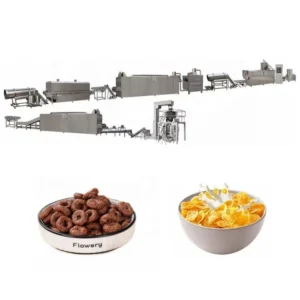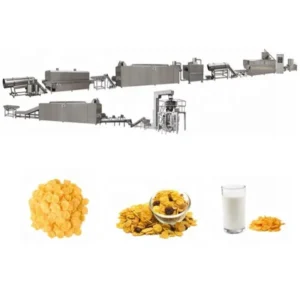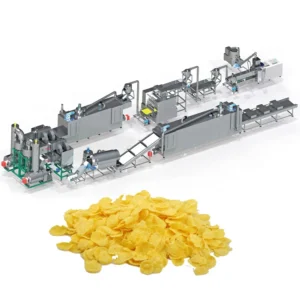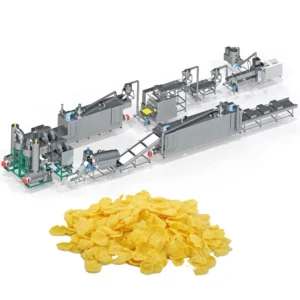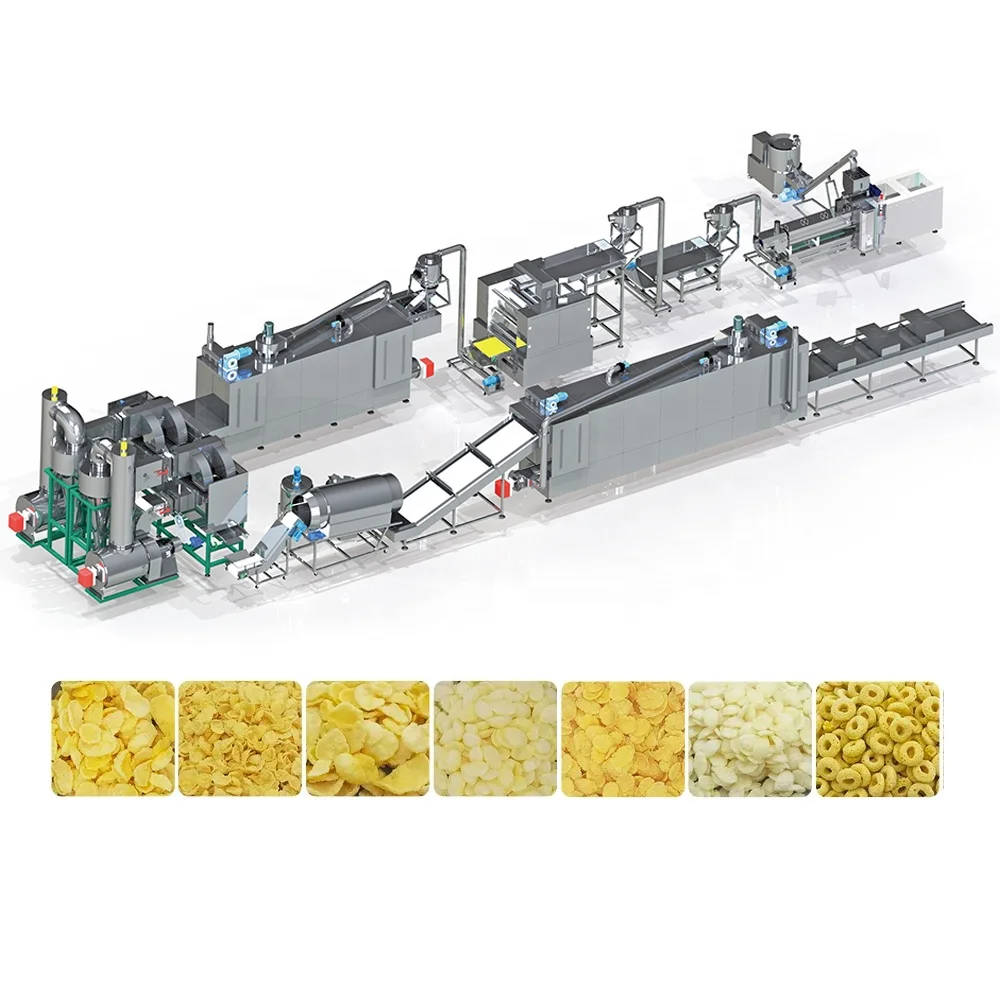
Integrated Throughput Matching — every station from the MT-75 extruder through the flake press and coating drum is sized against your actual grain blend so no single machine chokes the line.
Technical Specifications
| Parameter | Value |
|---|---|
| Product Type | Twin Screw Breakfast Cereal Extruder Line |
| Model | MT-75 |
| Screw Type | Twin screw, co-rotating |
| Mixer Output | 10–30 kg/load |
| Mixer Power | 4 kW |
| Mixer Tank Size | Ø600 × 500 mm |
| Mixer Dimensions | 1000 × 800 × 1200 mm |
| Screw Conveyor Power | 0.75 kW |
| Screw Conveyor Dimensions | 2700 × 500 × 2400 mm |
| Corn Flakes Press Power | 16.12 kW |
| Corn Flakes Press Roller Size | 510 × 310 × 1050 mm |
| Corn Flakes Press Dimensions | 1550 × 1300 × 2000 mm |
| Corn Flakes Press Features | Big roller, integrated cooling system, adjustable roller gap for flake thickness control |
| High-Temperature Oven Dimensions | 4.5 × 1.4 × 1.8 m |
| High-Temperature Oven Power | 3.75 kW |
| High-Temperature Oven Heating | Gas baking, both-side baking system |
| Sugar Spraying System Total Power | 28.75 kW |
| Sugar Spraying System Dimensions | 4000 × 1900 × 1880 mm |
| Sugar Spraying System Roller Size | Ø600 × 2700 mm |
| Line Configuration | Flour Mixer → Screw Elevator → Double-screw Extruder → Elevator → Dryer → Elevator → Coating Line → Vibrating Spreader → Elevator → Dryer → Cooling Conveyor → Packing Machine |
| Assembly State | Complete production line |
| Contact Material | Stainless steel on all food-contact parts |
| Control System | Separate controller box for press machine (basis not stated in source — confirm PLC/MCC scope for full line) |
| Voltage & Frequency | Customizable (e.g., 3ph 380V 50Hz, 3ph 415V 60Hz, 3ph 220V 60Hz; default basis to be confirmed) |
| Output Capacity | Basis to be confirmed per grain type and moisture content |
| Certification | CE |
Application Suitability
| Application | Material or Output |
|---|---|
| Corn flake production | Corn grits, corn flour blended with vitamins |
| Choco hoops and grain rings | Rice flour, oat flour, wheat flour blends |
| Fruit loops and multigrain hoops | Mixed grain powders with fruit-based additives |
| Sugar- or honey-coated cereal | Extruded pellets finished through sugar spraying drum |
| Fortified breakfast cereals | Grain base supplemented with nutritional premix |
Why Nominal Capacity Figures Mislead Breakfast Cereal Buyers
A breakfast cereals corn flakes machine for sale is only as productive as the slowest station in the chain.
I once sized a cereal line for a South American buyer using the extruder’s published throughput. The buyer ran a whole-wheat blend with higher fiber content than the test grain, and expansion dropped sharply. The extruder pushed material faster than the dryer could handle, and the flake press could not keep pace with the wetter, denser pellets. The whole line settled at roughly half the quoted rate. That taught me to verify every station against the buyer’s actual formulation before locking the layout [NEED_CITE: grain formulation impact on extrusion throughput].
How Co-Rotating Twin-Screw Geometry Shapes Your Cereal
The MT-75 uses co-rotating twin screws with sectional modules that handle transport, mixing, de-gassing, cooking, and forming in a single continuous barrel. Each module can be rearranged so the shear profile matches your grain blend — high-shear sections for starch gelatinisation in corn, gentler kneading blocks when oats or rice dominate the recipe. This modularity is what separates a breakfast cereals corn flakes machine for sale that adapts to your formulation from one that forces you to reformulate around the hardware.
Flake Press and Oven Balance: Where Lines Succeed or Fail
After extrusion, pellets pass through the dedicated corn flake press, where the adjustable roller gap and integrated cooling system control flake thickness and prevent surface sticking. The press roller measures 510 × 310 mm, giving enough contact width to flatten pellets uniformly before they enter the high-temperature oven. Gas-fired dual-side baking then toasts the flakes evenly across the bed depth. If the press delivers flakes faster than the 4.5-meter oven can crisp them, moisture traps inside and the product ships soft. Matching these two stations is where most turnkey breakfast cereal projects either hold their rate or lose it [NEED_CITE: thermal balance in cereal drying ovens].
Reading the Specs That Actually Matter
The mixer tank at Ø600 × 500 mm and 10–30 kg per load sets the batch rhythm upstream. If your recipe calls for short hydration windows — common with fine corn flour — the 4 kW mixer must clear a batch before the extruder starves. The screw conveyor at 0.75 kW feeds material steadily into the extruder hopper, and its 2700 mm length provides enough residence to prevent surge feeding. Downstream, the sugar spraying system draws 28.75 kW across its melting tank and temperature-holding roller (Ø600 × 2700 mm), keeping syrup viscosity stable so coating weight stays consistent across shifts. Stainless steel contact parts throughout the line meet food-grade requirements and simplify wash-down between product changeovers.
The Hidden Cost of Skipping a Pre-Shipment Trial Run
When an extruder ships without a trial on the buyer’s own grain blend, screw configuration and die selection default to a generic build. The first production run then becomes a costly experiment — adjusting moisture levels, swapping screw elements, and discarding off-spec product while the line sits idle. I have watched commissioning stretch into weeks because the screw combination optimized for plain corn grits could not develop enough expansion on a high-fiber wheat blend. A factory trial before shipment collapses that risk [NEED_CITE: extrusion screw configuration for whole grain blends].
What Sets This Equipment Range Apart
The complete station lineup — mixer, elevator, extruder, dryer, flake press, coating drum, cooler, and packing — comes from one supplier, so throughput is balanced across every hand-off point rather than stitched together from mismatched vendors. The screw configuration and die design are specified to your raw material and target flake density, not copied from a standard template. An in-house testing workshop runs your actual grain blend before the line ships, locking parameters in advance. The twin-screw platform covers corn flakes, grain rings, and fortified cereal formats on the same extruder base. Pre-sales engineering, on-site installation, commissioning, and operator training are included in the project scope.
Documentation & Verification
- Line layout and capacity calculation matched to your grain blend and target output
- Machine specification sheet confirming voltage, frequency, and control language
- Screw and die configuration record specific to your cereal formulation
- Trial run report produced on your raw material before shipment
- CE declaration of conformity and ISO certificate included
- Complete wear parts list covering screws, dies, and press roller surfaces
Installation, Commissioning & Support
- Foundation plan accounts for the 4.5 m oven length and full-line footprint
- Dedicated circuit sizing based on the sugar spraying system’s 28.75 kW total draw
- Equipment ships in sectional modules for container loading and on-site assembly
- First-run parameter tuning uses your trial run report as the baseline
- Operator training covers screw module swaps and roller gap adjustment
- Wear parts stock plan for screws, dies, and press roller surfaces
What to Share When Requesting a Line Proposal
To configure a breakfast cereals corn flakes machine for sale that holds its rate on your product, provide your grain blend composition and moisture targets, the daily output you need to hit, and your facility’s voltage and frequency standard. Include ceiling height and available floor length so the layout fits without compromise. If you run existing upstream milling or downstream packing equipment, share the interface specifications so the line integrates cleanly.
Frequently Asked Questions
Q: How is the line capacity verified against my specific grain formulation and moisture content?
A: Before shipment, your actual grain blend runs through the MT-75 extruder in the testing workshop. Screw modules, die geometry, and moisture levels are adjusted until the target flake density and expansion rate are achieved. The trial run report documents these parameters and becomes the commissioning baseline, so the line does not start from scratch on your factory floor.
Q: What voltage and frequency options are available for my target market’s power supply?
A: The line is configurable for common industrial supplies including 3-phase 380V 50Hz, 415V 60Hz, and 220V 60Hz configurations. Voltage and frequency must be confirmed before production begins so that motors, heating elements, and the separate press controller box are all built to match your site’s electrical standard [NEED_CITE: industrial voltage standards by export market].
Q: How is throughput balanced between the extruder, flake press, dryer, and coating stations?
A: Each station is sized against the extruder’s actual output on your grain blend, not its nominal rating. The flake press roller width, the 4.5-meter oven belt length, and the sugar spraying drum diameter are all selected so that no single station accumulates a backlog or starves the next one downstream.
Q: What control system is used across the line, and can the interface language be configured?
A: The corn flake press has a separate controller box, and the full-line control scope — including PLC or MCC options — is confirmed during the specification stage. Interface language, alarm text, and HMI labels are set to your preference before the electrical panels are wired, avoiding reprogramming during commissioning.
Q: Which spare wear parts are included at delivery, and what is the lead time for replacements?
A: The initial spare package covers high-wear items including twin-screw elements, die plates, and press roller surfaces. A detailed wear parts list ships with the line. Replacement lead times are confirmed in the quotation so you can plan inventory around your production schedule rather than waiting for emergency shipments.