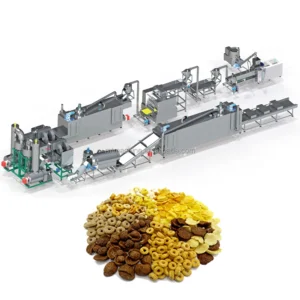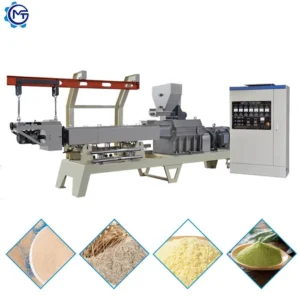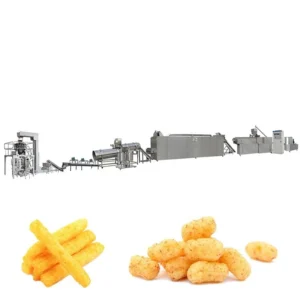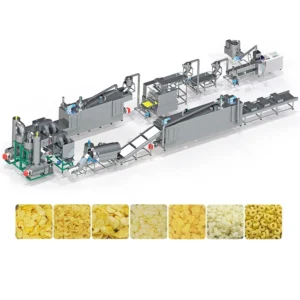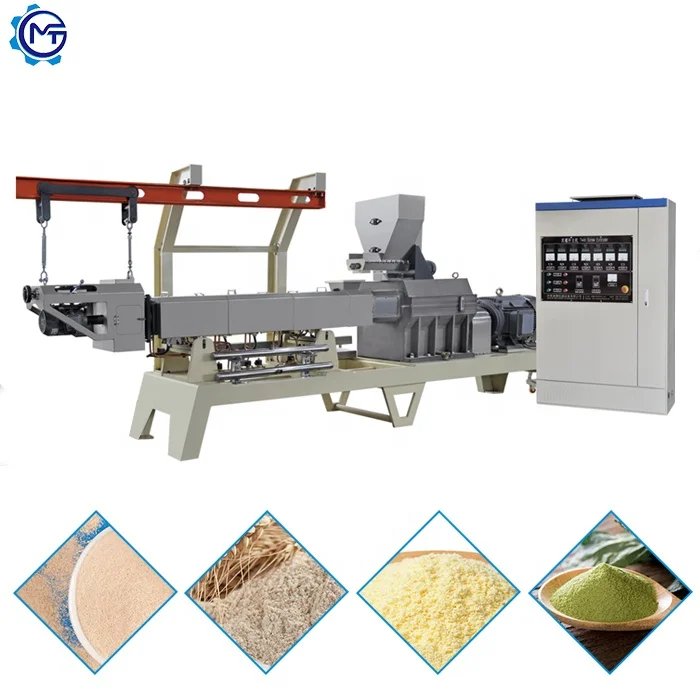
Screw Configuration Matched to Your Raw Material — we design extruder screw profiles and die geometry against the specific corn or grain blend you plan to run, then prove it in a trial run before shipment.
Technical Specifications
| Parameter | Value |
|---|---|
| Model | MT75 (also available: MT70, MT85) |
| Product Type | Twin Screw Extruder Breakfast Cereal Production Line |
| Screw Type | Twin-screw |
| Installed Power | 210 kW (MT75) / 160 kW (MT70) / 190 kW (MT85) |
| Power Consumption | 150 kW (MT75) / 120 kW (MT70) / 140 kW (MT85) |
| Output Capacity | 300–500 kg/h (MT75, basis not stated in source — confirm raw material and moisture content) / 150–200 kg/h (MT70) / 300–400 kg/h (MT85) |
| Overall Dimensions (L×W×H) | 45 × 1.5 × 3.5 m (MT75) / 41 × 1.5 × 2.2 m (MT70) / 43 × 1.5 × 3.2 m (MT85) |
| Control System | PLC control system with MCC integration for full line |
| Flaking Roller System | Hydraulic double-roller with independent dual motors; infrared temperature sensing |
| Dryer Heating Source | Gas or Electric (configurable) |
| Roasting Oven | Hot air roasting with conciliation burner, dual circulating fans, cyclone dust removal, vibrating pan with high-temperature spraying tubes |
| Coating System | Double tumble for sugar melting, elevator, coating drum, spraying nozzle |
| Automation Features | Automatic lubricating and cooling function on extruder |
| Voltage & Frequency | Customizable (commonly 415V/50Hz, 440V/50Hz, 220V/60Hz) |
| Certifications | CE, ISO |
Application Suitability
| Application | Material or Output |
|---|---|
| Natural corn flakes production | Corn grits and corn flour |
| Sugar-coated corn flakes | Corn base with sugar syrup coating |
| Shaped breakfast cereals (balls, tubes, rings, stars, fruit loops, wheels, flowers, hearts) | Corn, rice, wheat, oat, and barley powder blends via die adjustment |
| Instant porridge and nutritional cereal powder | Multi-grain formulations |
Why the Dryer Matters More Than the Extruder Rating
A breakfast cereal corn flakes machine full equipment range is only as reliable as its weakest downstream station. Every station must hold the same throughput on your actual raw material, or the line bottlenecks within the first week of production.
I once stood in a plant outside Monterrey watching freshly extruded corn flakes pile up on a cooling conveyor because the dryer could not keep pace with the extruder output. The flakes clumped, stuck together, and went straight to waste. The extruder nameplate promised a certain capacity; the dryer told a different story. That mismatch cost the operator days of lost production while we reconfigured the thermal profile and airflow on site. [NEED_CITE: matching extruder output to dryer and cooler capacity in cereal lines]
How Each Station in the Line Fits Together
The sequence starts with mixing and batching, where raw grain powders are blended to a precise moisture ratio before entering the MT75 twin-screw extruder. The extruder cooks and shapes the dough through controlled shear, barrel temperature zones, and moisture management. From there, the extrudate moves to the hydraulic flaking roller system, where independent dual motors drive each roller to maintain consistent flake thickness under infrared-monitored temperature conditions.
Downstream, the dryer — available with gas or electric heating — removes surface moisture before the hot air roasting oven develops the crispness and color buyers expect in a finished corn flake. The roasting oven uses dual circulating fans and a cyclone dust removal device to keep the product clean and uniformly toasted. A vibrating pan with high-temperature spraying tubes ensures even heat distribution. For sugar-coated variants, the dedicated coating system adds a sugar melting tumble, elevator feed, coating drum, and precision spraying nozzles to deliver even surface coverage before the final drying stage.
What the Flaking and Roasting Stations Actually Do to Your Product
The hydraulic double-roller system on the flaking machinery is where sheet thickness gets locked in. Independent motor drives on each roller prevent the drift you get when a single motor struggles with varying dough viscosity across a production shift. [NEED_CITE: hydraulic roller pressure control in cereal flaking operations] The infrared sensor monitors roller surface temperature in real time, which matters because corn dough behaves differently at 60 °C versus 75 °C — too cool and the flakes crack at the edges, too hot and they stick and tear.
The hot air roasting oven is where the final texture is decided. Two separate circulating fans create cross-flow air patterns that prevent the hot spots common in single-fan designs. The conciliation burner modulates flame output to hold a steady roasting temperature, and the cyclone dust removal device pulls fine particulate out of the airstream so it does not settle back onto the flakes as burnt specks.
Reading the Extruder Specifications That Actually Matter
The twin-screw design in the MT75 handles a wider range of grain formulations than a single-screw unit because the intermeshing screws create a self-wiping action that prevents sticky corn dough from building up inside the barrel. The 210 kW installed power and 150 kW working consumption give you headroom for high-moisture formulations that demand more torque to push through the die plate. Screw configuration is matched to your specific grain blend — corn alone behaves very differently from a corn-rice-oat mix in terms of starch gelatinisation temperature and expansion ratio. The automatic lubricating and cooling function reduces barrel wear during extended production runs and helps maintain the thermal profile across shifts. Voltage and frequency are confirmed before production — 415V/50Hz, 440V/50Hz, or 220V/60Hz — so the motor starters and PLC communicate correctly with your facility’s electrical supply.
The Hidden Cost of an Unmatched Line
When the extruder capacity exceeds what the dryer or cooling conveyor can handle, the problem does not show up during a one-hour factory test. It appears on day three of a continuous production run when the backlog forces the extruder to idle, the dough cools inside the barrel, and restarts produce off-spec product for the first several minutes. [NEED_CITE: downstream bottleneck effects on extruder consistency in food processing lines] I have seen operators blame the extruder for texture problems that were actually caused by a coating drum turning too slowly or a roasting oven that could not recover temperature fast enough between batches.
Why Source the Full Range from One Supplier
Every station in this breakfast cereal corn flakes machine full equipment range is sized together, so throughput numbers match from the mixer through to the packing end. The screw and die configuration is specified to your grain formulation and target cereal shape, not copied from a generic build. Trial runs on your actual raw material happen in the testing workshop before shipment, so you see the product before you accept the line. The PLC and MCC control system is wired for your confirmed voltage and control language, avoiding commissioning delays on site. Spare wear parts — screws, dies, roller surfaces — are documented and available when your first replacement cycle comes due.
Documentation & Verification
- Line layout and capacity calculation showing throughput matching across every station
- Screw and die configuration record specified to your grain blend and target cereal shape
- Trial run report on your raw material from the in-house testing workshop
- Electrical schematic with voltage and frequency confirmed to your facility supply
- CE declaration of conformity and ISO certificate for customs and import compliance
Installation, Commissioning & Support
- Overall line footprint of 45 × 1.5 × 3.5 m (MT75) mapped to your floor plan before dispatch
- 210 kW installed power requirement confirmed against your facility’s dedicated circuit capacity
- PLC and MCC control panel set to your confirmed voltage, frequency, and operator language
- First-run parameter setting on your grain formulation during on-site commissioning
- Operator training covering extruder auto-lubrication, flaking roller gap adjustment, and roasting oven fan balance
- Wear parts list with screw, die, and roller replacements identified for your first maintenance cycle
What to Share When You Request a Quote
To size the breakfast cereal corn flakes machine full equipment range correctly, we need to know the grain types and blends you plan to run, your target output per shift, and whether you want natural flakes, sugar-coated variants, or both from the same line. Your workshop dimensions and ceiling height determine whether the standard 45-meter line layout fits or needs reconfiguration. Confirming your local voltage and frequency up front prevents control system rework after delivery.
Frequently Asked Questions
Q: How is the capacity rating verified on my specific raw material and recipe?
A: We run a trial in the testing workshop using your actual grain blend at your target moisture content. The output is measured over a sustained period, not a short burst, and documented in a trial run report. This is how we confirm whether the rated capacity holds on your specific formulation before the line ships.
Q: Can the flaking roller gap be adjusted for different flake thickness specifications?
A: Yes. The hydraulic double-roller system allows gap adjustment to produce flakes at different thickness targets. Independent dual motors on each roller maintain consistent pressure even when dough viscosity shifts during a production run, and the infrared sensor monitors roller temperature to prevent sticking or cracking at the flake edges.
Q: How are the dryer and roasting oven capacities matched to the extruder output?
A: Each downstream station is calculated against the extruder’s sustained output on your raw material, not just the nameplate rating. The dryer evaporation rate and the roasting oven residence time are both sized so that product flows continuously without queuing or idling at any point in the sequence.
Q: What voltage and control language options are confirmed before production?
A: Common configurations include 415V/50Hz, 440V/50Hz, and 220V/60Hz, but we confirm your facility’s exact supply before building the MCC panel. The PLC interface language is also set to your operator preference so that commissioning does not stall over translated error messages.
Q: Which die and screw configurations produce different cereal shapes?
A: Die plates are interchangeable to produce shapes including rings, balls, tubes, stars, fruit loops, wheels, flowers, and hearts. Screw configuration is adjusted to match your grain blend and the expansion ratio each shape requires, and this setup is recorded in your configuration document for future reorder consistency.