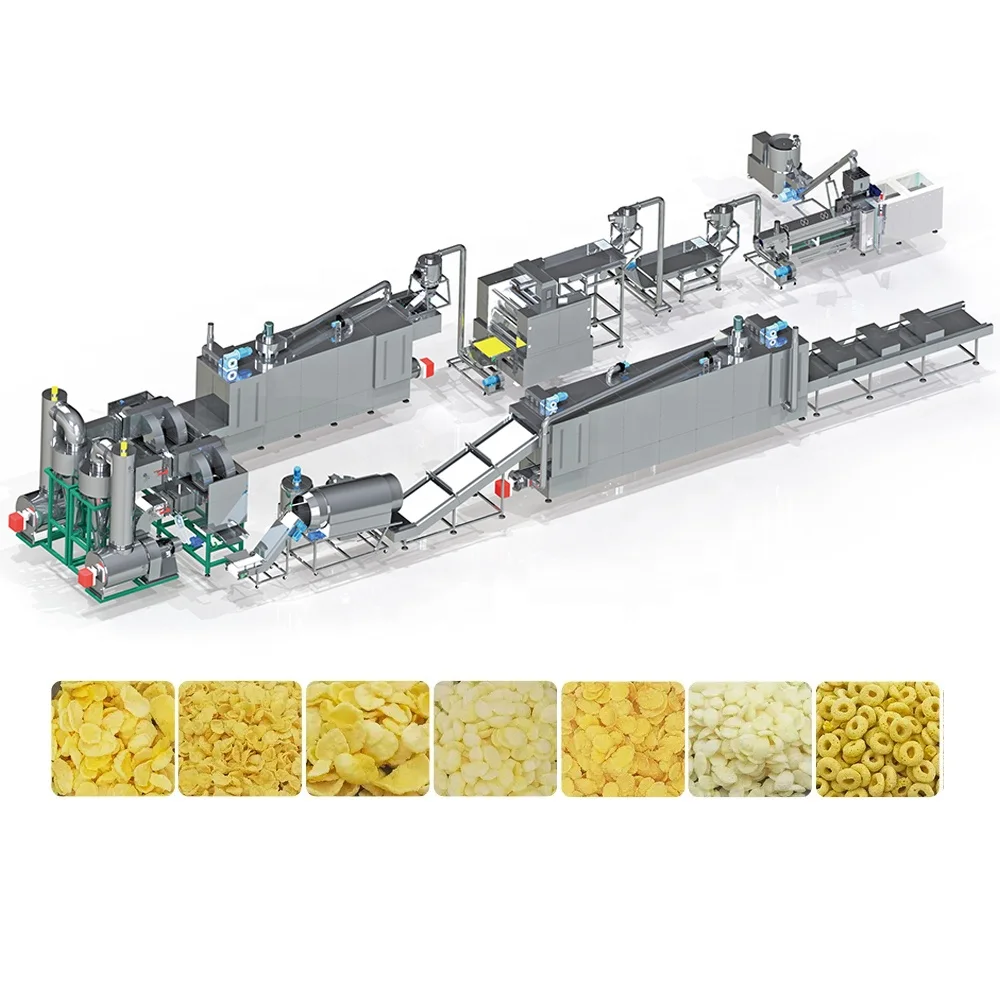
Hydraulic Flaking Precision — uniform flake thickness maintained by dual-roller hydraulic pressure and infrared temperature sensing, ensuring every batch meets the crispness standard your retail market expects.
Technical Specifications
| Parameter | Value |
|---|---|
| Model | MT70 / MT85 / MT75 |
| Product Type | Corn Flakes Breakfast Cereal Production Line |
| Installed Power | MT70 — 160 kW; MT85 — 190 kW; MT75 — 210 kW |
| Power Consumption | MT70 — 120 kW; MT85 — 140 kW; MT75 — 150 kW |
| Output Capacity | MT70 — 150–200 kg/h (basis not stated in source); MT85 — 300–400 kg/h (basis not stated in source); MT75 — 300–500 kg/h (basis not stated in source) |
| Overall Dimensions (L×W×H) | MT70 — 41×1.5×2.2 m; MT85 — 43×1.5×3.2 m; MT75 — 45×1.5×3.5 m |
| Extruder Type | Twin Screw |
| Control System | PLC with MCC available for full line |
| Dryer Heating Source | Gas or Electric |
| Flaking Machinery | Hydraulic double-roller system, dual-motor separate drive, infrared sensor temperature control |
| Hot Air Roasting Oven | Conciliation burner, dual circulating fans, cyclone dust removal |
| Coating System | Double tumble sugar melting, elevator, coating drum, spraying nozzle |
| Screw Feature | Wear-resistant manufacturing, automatic lubricating and cooling function |
| Assembly State | Complete production line |
| Certification | CE, ISO |
Application Suitability
| Application | Material or Output |
|---|---|
| Natural corn flakes production | Corn powder dough extruded, flaked, roasted |
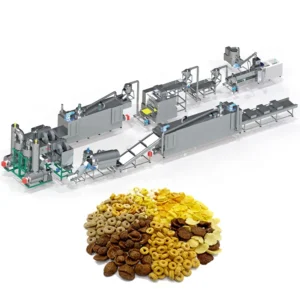
| Sugar-coated corn flakes | Finished flakes passed through sugar spraying and coating drum |
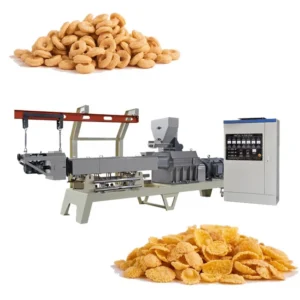
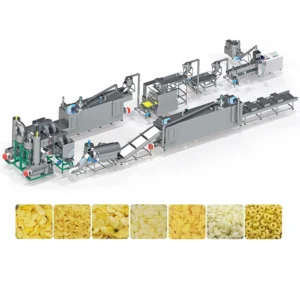
| Multi-grain cereal shapes | Rice, wheat, oat, barley powder with die changes for rings, stars, fruit loops |
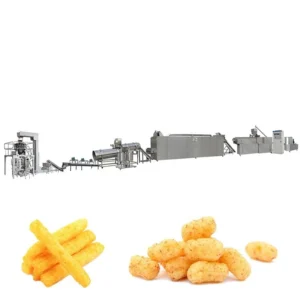
| Expanded snack variants | Same extruder platform producing ball, tube, stick, wheel, flower, heart shapes |
What "300 kg/h" Leaves Out About Your Corn Flakes Line
The capacity number on a quotation is meaningless without stating the raw material, moisture content, and flake thickness it was measured against.
I spent years walking factory floors across Southeast Asia and the Pearl River Delta, and the most common failure on breakfast cereal lines is not a broken motor or a faulty PLC — it is a throughput claim that was never validated on the buyer’s actual corn flour. A mill in Thailand once signed for a line rated at a nominal output figure, only to discover their locally sourced corn had higher starch content than the supplier assumed. The extrudate expanded too little, the flakes went soggy in milk within minutes, and a major supermarket chain returned an entire shipment. That mismatch is exactly what a properly surveyed corn flakes breakfast cereal production line full equipment package should prevent [NEED_CITE: raw material variability impact on extrusion output].
Extrusion Stability Across Long Production Shifts
The MT-75 twin-screw extruder at the heart of this corn flakes breakfast cereal production line full equipment range uses an automatic lubricating and cooling system to maintain barrel temperature consistency over extended runs. Cereal dough is unforgiving — even a slight thermal drift changes gelatinisation behaviour and produces flakes that shatter during roasting instead of developing the signature surface blisters. The screw elements are manufactured with wear-resistant technology and serviced by the integrated cooling circuit, reducing the chance of mid-shift texture deviation.
From Flaking to Final Crispness
The flaking station uses a hydraulic double-roller system driven by two independent motors, with an infrared sensor monitoring roller surface temperature in real time. This matters because uneven flake thickness leads to uneven roasting: thin edges burn before thick centres dry. Downstream, the hot air roasting oven employs a conciliation burner and two separate circulating fans inside the chamber, with a cyclone dust removal device keeping the airflow clean. The result is a controlled Maillard reaction across every flake, producing the colour and crunch that breakfast cereal buyers judge within seconds of opening the bag [NEED_CITE: cereal roasting temperature uniformity standards].
Reading the Spec Sheet Against Your Production Target
Three model tiers — MT70, MT85, and MT75 — span different installed power levels and physical footprints, so matching machine size to your factory space and output target is a matter of selecting the right row, not compromising. The twin-screw configuration handles corn, rice, wheat, oat, and barley powders, with die swaps enabling shape changes from flat flakes to rings or fruit loops on the same extruder barrel. The PLC-controlled flaking machinery and the MCC panel governing the full line keep every station synchronised, which matters when the extruder output must feed the dryer and roaster without buffer inventory piling up on the conveyor. The overall line length stretches beyond 40 metres across all three models, so floor planning and utility routing need to account for the full footprint before foundations are poured.
The Hidden Cost of Mismatched Station Sizing
When a corn flakes line is assembled from separate vendors, the coating drum often ends up undersized for the flaking rate. Sugar syrup piles up, flakes stick together, and operators spend half their shift clearing blockages instead of monitoring quality. The same happens when the dryer cannot keep pace with the extruder — wet flakes queue on the belt, moisture migrates, and the roasting oven receives inconsistent input. These are not defects in any single machine; they are the consequence of a line that was never throughput-matched as one system. The downtime accumulates quietly, shift after shift, until someone finally counts the lost hours [NEED_CITE: throughput mismatch consequences in multi-stage food processing lines].
Why Source the Full Range from One Equipment Catalogue
Every station in this corn flakes breakfast cereal production line full equipment range — mixer, extruder, flaker, dryer, roaster, coater, cooler, packer — is sized against the extruder’s verified output on your specific raw material, so no single machine bottlenecks the next. The screw and die configuration is specified to your target flake density and expansion ratio, not copied from a generic build that assumes a standard corn flour. Before the line ships, a trial run on your actual raw material takes place in the testing workshop, generating a report that confirms texture, density, and throughput before you commit to installation. The electrical schematic and voltage confirmation are locked to your local grid before production begins, avoiding the weeks of commissioning delay that happen when a 60 Hz motor arrives in a 50 Hz market. The line layout is designed around your factory dimensions rather than forcing your building to fit a standard drawing.
Documentation & Verification
- Line layout and capacity calculation mapping every station to your extruder output
- Screw and die configuration record matched to your target flake density
- Trial run report on your actual corn flour before shipment
- Electrical schematic with voltage and frequency confirmed for your grid
- Machine specification sheet covering all stations from mixer to packer
- CE declaration of conformity and ISO certificate included with shipment
Installation, Commissioning & Support
- Foundation plan accounts for the 41–45 metre line length and utility routing for gas or electric dryer options
- Power distribution sized to the 160–210 kW installed capacity with dedicated circuits for each station
- On-site assembly supervised by engineers familiar with the twin-screw extruder and hydraulic flaking station
- PLC and MCC panels configured with your preferred control language before the first test run
- Operator training covers screw configuration adjustments, flake thickness calibration, and roasting temperature profiles
- Wear parts list for screws, dies, and flaking rollers provided with reorder part numbers
Preparing Your Inquiry
To specify the right configuration from this corn flakes breakfast cereal production line full equipment range, share your target cereal type — natural flakes, sugar-coated, or multi-grain shapes — along with the raw material composition and moisture content of your local corn or grain flour. Provide your workshop floor dimensions including ceiling height, your local voltage and frequency, and the daily output target you need to hit. If you have upstream milling or downstream packaging equipment already installed, include those details so the line can be integrated without gaps.
Frequently Asked Questions
Q: How is the capacity figure verified before the line ships?
A: The capacity number is confirmed through a trial run in the testing workshop using your actual raw material at your specified moisture content and target flake thickness. The resulting report documents real output, texture, and density so you know what to expect before installation begins, rather than discovering mismatches during commissioning.
Q: What voltage, frequency, and control language are confirmed before production?
A: Your local grid specifications and preferred PLC language are locked in the electrical schematic before the line enters production. This prevents the common scenario where a motor wound for the wrong frequency arrives on site and delays commissioning by weeks while a replacement is sourced.
Q: How are the dryer and coating drum matched to the extruder output?
A: Each station’s throughput is calculated against the extruder’s verified output on your raw material, so the dryer residence time, roaster belt speed, and coating drum volume all align. No station accumulates buffer inventory or starves the next, keeping the line running continuously without operator intervention.
Q: Can the same line produce shapes beyond flat corn flakes?
A: Yes. By swapping the extruder die, the twin-screw platform produces rings, stars, fruit loops, balls, tubes, and other cereal shapes on the same line. The flaking station is bypassed for puffed shapes, while the dryer and roaster continue to handle moisture reduction and texture development.
Q: What spare wear parts ship with the first order?
A: The initial shipment includes a wear parts list covering screws, dies, and flaking roller elements identified by reorder part numbers. This ensures replacement components are available when the first changeover is due, rather than forcing an unplanned line stop while parts are manufactured and shipped internationally.