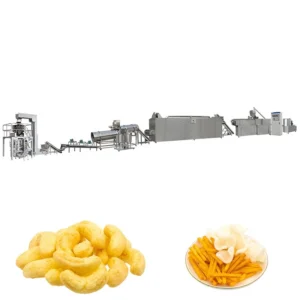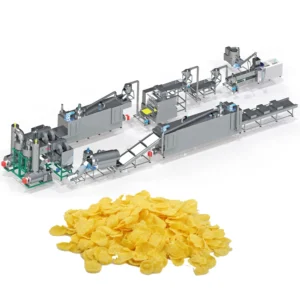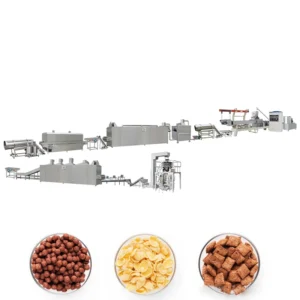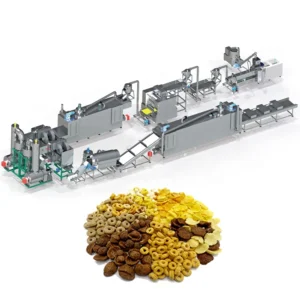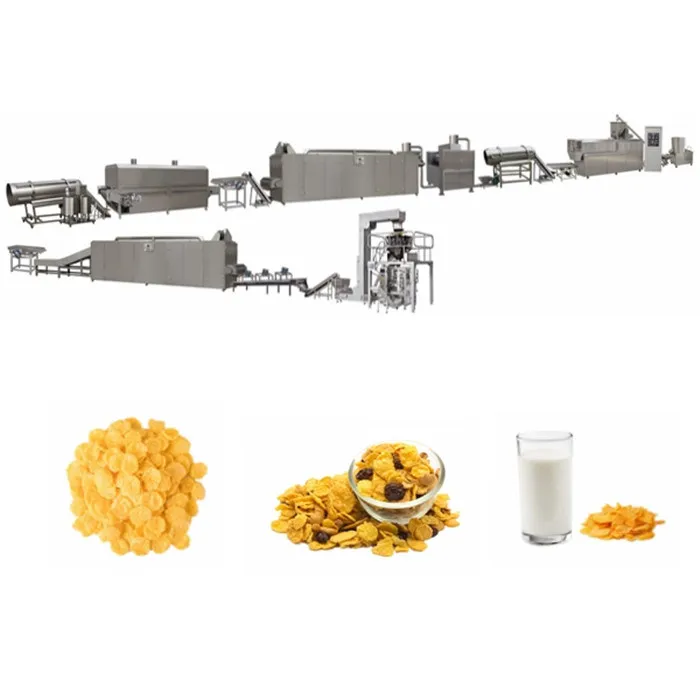
Line-Wide Throughput Matching — Every station from the mixer to the sugar coater is specified against the extruder’s actual output on your grain formula, preventing downstream bottlenecks that generic builds create.
Technical Specifications
| Parameter | Value |
|---|---|
| Model | MT70 |
| Product Type | Corn Flakes Extrusion Production Line |
| Extruder Type | Twin-screw |
| Installed Power | 160 kW (MT70) |
| Power Consumption | 120 kW (MT70) |
| Output Capacity | 150–200 kg/h (MT70, basis not stated in source — confirm raw material and moisture content) |
| Overall Dimensions (L×W×H) | 41 × 1.5 × 2.2 m (MT70) |
| Available Line Configurations | MT70 / MT85 / MT75 |
| MT85 Installed Power | 190 kW |
| MT75 Installed Power | 210 kW |
| Flaking Machinery Drive | Double motors with separate roller driving; hydraulic system |
| Flaking Temperature Control | Infrared sensor for even temperature pipe control |
| Dryer Heating Source | Gas or Electric (configurable) |
| Roasting Oven | Hot air with conciliation burner, dual circulating fans, cyclone dust removal |
| Coating System | Double tumble for sugar melting, elevator, coating drum, spraying nozzle |
| Control System | PLC and MCC |
| Die Shapes Available | Ball, tube, stick, ring, fruit loop, star, wheel, flower, heart |
| Basic Raw Materials | Corn, rice, wheat, oat, barley powder |
| Standards | CE, ISO |
Application Suitability
| Application | Material or Output |
|---|---|
| Natural corn flakes production | Corn grits and corn flour blends through extrusion, flaking, drying and roasting |
| Sugar-coated breakfast cereal | Corn or multi-grain base with sugar syrup spraying and tumble coating |
| Shaped cereal formats | Rings, balls, loops and stars via interchangeable die plates on the twin-screw extruder |
| Multi-grain breakfast cereal | Blends of rice, wheat, oat and barley powder processed through the same line stations |
| Puffed snack front-end | Same extrusion section with die changes for snack pellet or direct-expanded formats |
Why "Nominal Capacity" Fails on Real Cereal Grain Blends
A breakfast cereal corn flakes production line equipment package must be rated against the buyer’s actual grain formula, not a generic test flour.
I remember configuring a corn flakes line for a South Asian buyer who sent a sample that ran well on our standard corn flour. When the machine arrived and they loaded their locally milled grits — noticeably coarser — the extruder could not achieve the gelatinisation needed for proper flake expansion. Output dropped to roughly half the quoted figure [NEED_CITE: raw material particle size effects on twin-screw extrusion throughput]. The dryer and roaster were then oversized for the actual feed rate, wasting energy on every shift. That experience changed how I approach every cereal line inquiry: capacity means nothing until the screw configuration and die geometry match the specific grain blend and moisture level the buyer will actually run.
Screw Geometry and Die Design for Flake Texture
The twin-screw extruder at the heart of this breakfast cereal corn flakes production line equipment uses a screw configuration selected for the buyer’s grain type and target flake density. Barrel zones are profiled to manage moisture and shear so the starch reaches full gelatinisation before the material exits the die. Different cereal grains demand different compression ratios and residence times — corn requires a longer conditioning section than rice, for instance. The die plate determines the pellet shape that the flaking rolls will later press into the final flake.
Flaking, Roasting and Coating Matched to Extruder Output
Downstream stations are where many cereal lines lose their balance. The hydraulic double-roller flaking machinery on this line uses independent dual-motor drive and infrared temperature sensing to hold uniform flake thickness across the full roller width. If the flaker cannot keep pace with the extruder, material backs up; if it runs faster than necessary, flake consistency suffers. The hot air roasting oven uses a conciliation burner with two circulating fans and a cyclone dust removal device to deliver even surface blistering [NEED_CITE: hot air roasting uniformity requirements for breakfast cereal]. The sugar coating system — melting tumble, elevator, spraying nozzles and coating drum — is sized so that syrup application rate tracks the roasted flake flow without pooling or starvation.
Reading the Specs That Actually Matter
Installed power of 160 kW on the MT70 configuration reflects the combined motor and heating load across extruder, dryer and roaster, but actual power consumption sits around 120 kW during steady-state operation. The distinction matters for electrical planning at the buyer’s facility. Overall line length of 41 m for the MT70 dictates the minimum workshop bay, and the 1.5 m width leaves room for operator access on both sides. The PLC control system manages the flaking roller gap and temperature profile, which directly governs final flake thickness and crunch — parameters that a manual system struggles to hold across long production runs [NEED_CITE: PLC control impact on cereal flake consistency]. Die interchangeability across nine shapes lets a single extruder front-end serve multiple product SKUs without additional capital equipment.
The Hidden Cost of a Mismatched Line Configuration
When the extruder, flaker, dryer and coater come from separate vendors, nobody guarantees that each station handles the same mass flow. The extruder may push out material faster than the dryer can reduce moisture to the target range, forcing the operator to slow the entire line. Voltage and frequency differences between the buyer’s grid and the motor ratings cause overheating and premature bearing wear. Spare wear parts — screws, die plates, flaking rollers — may not be available from the original supplier when the first replacement cycle arrives, leaving the line idle for weeks [NEED_CITE: spare parts availability impact on cereal line uptime].
Why Source the Complete Cereal Line Here
Every station from batching through packing comes from a single equipment source, so throughput calculations are reconciled across the full line before fabrication begins. The screw configuration and die geometry are documented against the buyer’s raw material formula rather than copied from a standard build. An in-house testing workshop runs the buyer’s actual grain blend before shipment, generating a trial report that confirms capacity and flake quality. Electrical schematics are prepared with the target market’s voltage, frequency and control language confirmed in advance. Twin-screw expertise across breakfast cereals, pet food, snacks and starch applications means the engineering team understands how different raw materials behave under extrusion conditions.
Documentation & Verification
- Line layout drawing with capacity calculation for each station matched to your grain formula
- Screw and die configuration record specifying compression ratio and die geometry for your raw material
- Trial run report from in-house testing workshop on your cereal grain blend before shipment
- Electrical schematic with confirmed voltage, frequency and PLC language for your facility
- CE declaration of conformity and ISO certificate for customs and regulatory clearance
- Wear parts list identifying screws, dies and flaking rollers with replacement intervals
Installation, Commissioning & Support
- Foundation plan based on the 41 m line length and 160 kW total installed power for the MT70 configuration
- Dedicated electrical circuit sized for 120 kW steady-state draw with voltage and frequency matched to your grid
- Sequential station assembly starting from the extruder and extending through dryer, roaster and coater
- First-run parameter setting for barrel temperature profile, flaking roller gap and roasting oven airflow
- Operator training covering PLC interface navigation, die changeover and sugar coating drum adjustment
- Spare screw elements, die plates and flaking roller shells supplied with initial shipment
What to Include in Your Inquiry
To configure the right breakfast cereal corn flakes production line equipment for your facility, share your primary grain type and any blend ratios, your target hourly output on that specific formula, and the available workshop length and ceiling height. Confirm your local voltage, frequency and preferred control language so the electrical package is built correctly from the start. If you have existing upstream milling or downstream packing equipment, note the interface points so the line layout accounts for them.
Frequently Asked Questions
Q: How is line capacity verified on the buyer’s actual cereal grain blend?
A: Before shipment, the buyer’s raw material is run through the extruder and downstream stations in the in-house testing workshop. The trial report records actual throughput, flake thickness, moisture after drying and surface quality after roasting, confirming that every station handles the target output on that specific grain formula.
Q: How are extruder, dryer and coater capacities matched across the line?
A: Each station is calculated against the mass flow leaving the extruder on the buyer’s raw material. Dryer residence time, roaster conveyor speed and sugar coating drum volume are all set so that no single station forces the operator to throttle the extruder below its rated output.
Q: What voltage, frequency and control language options are confirmed before production?
A: The electrical schematic is prepared after the buyer confirms local grid specifications. Motor ratings, heating elements and PLC interface language are all set to match the destination facility, preventing commissioning delays caused by mismatched power supplies or untranslated screens.
Q: Is a trial run performed on the buyer’s raw material before shipment?
A: Yes. The in-house testing workshop processes the buyer’s actual grain blend through the configured extruder and flaking machinery. The resulting trial report covers throughput, gelatinisation quality, flake dimensions and any adjustments made to screw configuration or die selection before the line is packed.
Q: What spare wear parts are included and how are replacements supplied?
A: The initial shipment includes spare screw elements, die plates and flaking roller components identified in the wear parts list. Replacement specifications are documented so that subsequent orders match the original configuration without requiring a new engineering review.