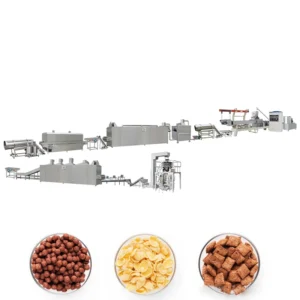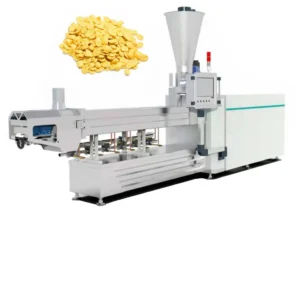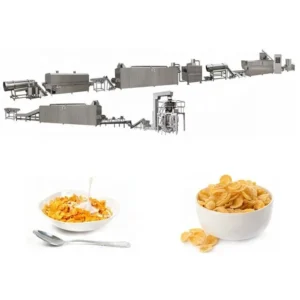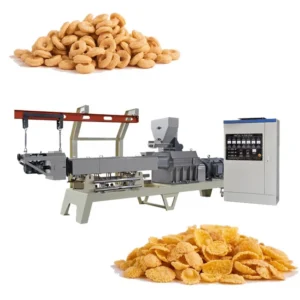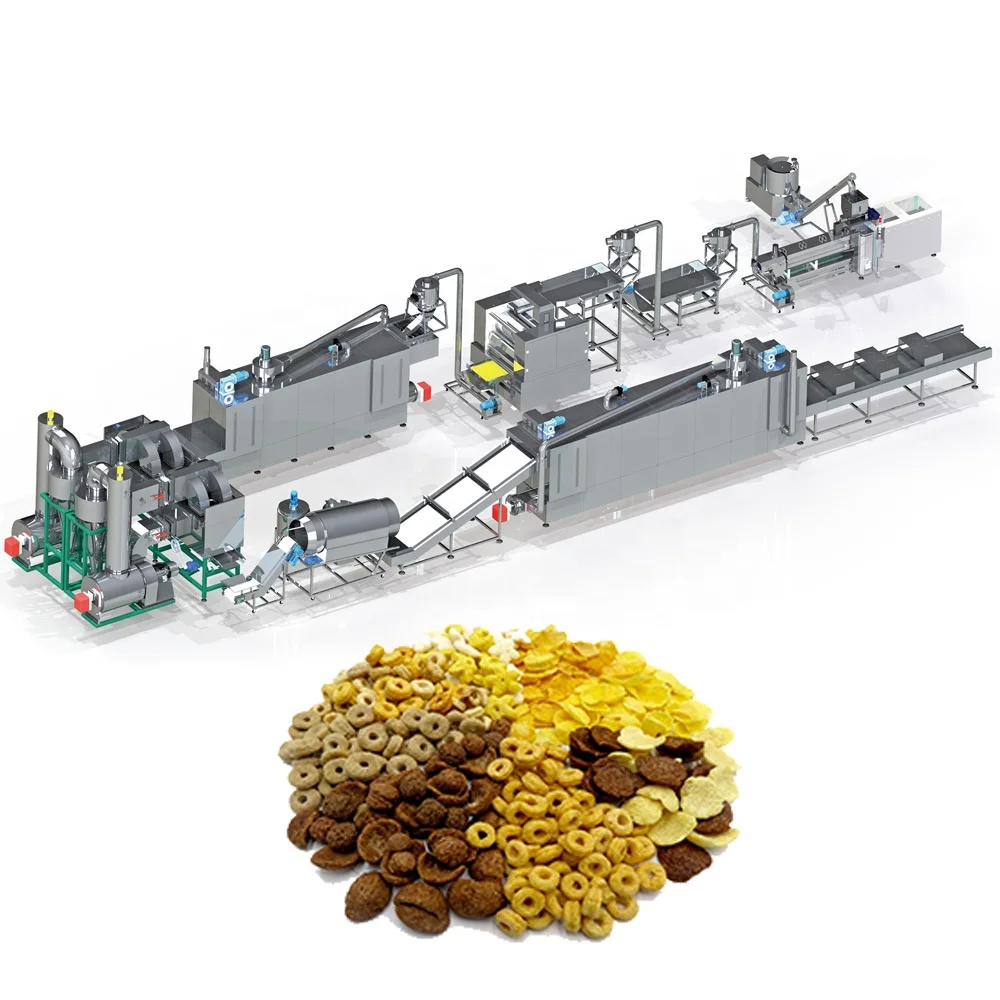
Line throughput integrity — every station from batching to packing is sized against the extruder output, so the breakfast cereal corn flakes machine full equipment range avoids bottlenecking any single process step.
Technical Specifications
| Parameter | Value |
|---|---|
| Product Type | Corn Flakes Production Line |
| Models Available | MT70 / MT85 / MT75 |
| Installed Power | 160 kW (MT70); 190 kW (MT85); 210 kW (MT75) |
| Power Consumption | 120 kW (MT70); 140 kW (MT85); 150 kW (MT75) |
| Output Capacity | 150–200 kg/h (MT70); 300–400 kg/h (MT85); 300–500 kg/h (MT75) (basis to be confirmed — depends on raw material and moisture) |
| Overall Dimensions | 41 × 1.5 × 2.2 m (MT70); 43 × 1.5 × 3.2 m (MT85); 45 × 1.5 × 3.5 m (MT75) |
| Extruder Type | Twin screw |
| Control System | PLC and MCC control |
| Flaking Machine Drive | Double motors for separate roller driving; hydraulic system |
| Flaking Temperature Control | Infrared sensor for even temperature pipe control |
| Dryer Heating Source | Gas or Electric (configurable) |
| Roasting Oven | Hot air roasting with conciliation burner, dual circulating fans, cyclone dust removal |
| Coating System | Double tumble sugar melter, elevator, coating drum, spraying nozzle |
| Lubrication | Automatic lubricating and cooling function on extruder |
| Certification | CE; ISO |
Application Suitability
| Application | Material or Output |
|---|---|
| Natural corn flakes production | Corn, rice, wheat, oat, barley powder |
| Sugar-coated breakfast cereals | Corn grits with sugar syrup coating |
| Shaped cereal formats | Ball, tube, stick, ring, fruit loop, star, wheel, flower, heart (by adjusting extruder die) |
| Multi-grain cereal processing | Blended grain powders including corn, rice, wheat, oat, barley |
Why Matching Dryer and Coater Capacity to Extruder Output Matters Early
A breakfast cereal corn flakes machine full equipment range only delivers its rated output when every downstream station handles what the extruder produces.
Buyers frequently compare extruder capacity figures and assume the rest of the line will keep up. In practice, a dryer that cannot evaporate moisture fast enough, or a coating drum undersized for the sugar-spraying step, forces the extruder to idle. The whole line then runs at the slowest station’s pace. I have walked into commissioning jobs where the extruder was ready but the roaster could not hold temperature across the full bed depth, leaving half the batch under-toasted. Specifying throughput at every station before the line is built removes that class of problem entirely. [NEED_CITE: throughput matching across food extrusion line stations]
Station-by-Station Equipment Survey
The catalogue covers every machine between raw material intake and final packing. Mixing and batching systems feed the twin-screw extruder, which cooks and shapes the cereal dough. The extrudate then passes through a hydraulic flaking machine where double-motor separate roller drive and infrared-sensor temperature control produce uniform flake thickness. Downstream, the dryer removes surface moisture using gas or electric heating, and the hot air roasting oven with its conciliation burner and dual circulating fans develops the final toast colour and crunch. For sugar-coated variants, the coating system — double tumble sugar melter, spray nozzle, and coating drum — applies syrup before a second drying pass and cooling.
How the Full Equipment Range Prevents Line Imbalance
Each station in the breakfast cereal corn flakes machine full equipment range is selected so its capacity aligns with the extruder output rather than being specified independently. The flaker’s hydraulic roller pressure and the roaster’s fan volume are both calculated against the extruder’s kg/h figure. When a buyer surveys this catalogue, they see where every machine fits and can verify that no single unit constrains the others. This approach matters especially for multi-grain recipes where corn, oat and barley behave differently through the dryer — the residence time and air volume must account for the slowest-drying ingredient in the blend. [NEED_CITE: grain moisture behaviour in breakfast cereal drying stages]
Reading the Specification Sheet Against Your Production Target
The twin-screw extruder relies on automatic lubricating and cooling to sustain continuous runs and extend screw service life, which directly affects how long the line can operate between maintenance stops. Installed power ranges across three models, and the actual power consumption figures are lower than installed totals, reflecting duty-cycle variation across mixing, heating and drive loads. The flaking machine’s hydraulic system with separate roller motors allows independent speed adjustment on each roller, reducing flake breakage when processing brittle corn grits versus more elastic oat-based dough. Infrared-sensor temperature control on the flaker keeps the roller surface within a narrow band, preventing the flakes from sticking or shattering. The roasting oven’s cyclone dust removal device captures fine particulate generated during toasting, maintaining sanitary conditions inside the oven chamber and reducing cleaning intervals between product changeovers.
The Cost of Underspecifying Downstream Stations
When a buyer sources the extruder from one vendor and the dryer or coater from another without verifying capacity alignment, the line often runs below expectations from day one. The extruder produces at its rated output but flakes pile up ahead of the roaster because the oven cannot toast the full volume in the required residence time. Sugar coating becomes uneven if the drum rotation speed and spray rate were sized for a smaller batch. These mismatches do not show up on individual machine spec sheets — they only appear during commissioning, when rework and downtime consume the project schedule. [NEED_CITE: downstream capacity mismatch in cereal extrusion lines]
Why Procurement Through a Single Equipment Catalogue Works
Throughput matching across every station is calculated by one engineering team rather than negotiated between separate vendors, so the dryer air volume and roaster fan capacity are set against the extruder’s actual output on your recipe. Screw configuration and die design are specified to your raw material and target flake shape before the line is built. An in-house machine testing workshop runs trial production on your corn, oat or barley blend before shipment, generating a report that confirms flake thickness, toast colour and coating coverage. Twin-screw expertise across breakfast cereal, snack and grain applications means the extruder parameters are set from prior production data rather than generic defaults. Pre-sales consultation through layout design, on-site installation, commissioning and operator training covers the full project timeline under one supplier relationship.
Documentation & Verification
- Line layout and capacity calculation showing throughput match across mixer, extruder, flaker, dryer, roaster and coater
- Machine specification sheet per selected model with installed power, consumption and overall dimensions
- Electrical schematic and voltage confirmation document matched to your facility supply before production
- Trial run report produced on your specific grain blend and moisture level before dispatch
- CE declaration of conformity and ISO certificate included in shipment documentation package
- Wear parts list covering screws, dies and roller surfaces with recommended replacement intervals
Installation, Commissioning & Support
- Foundation must support line dimensions up to 45 × 1.5 × 3.5 m with level concrete floor and adequate overhead clearance for the roaster exhaust duct
- Electrical supply must match confirmed voltage and frequency for PLC and MCC control panels; dedicated circuit required for extruder motor starting current
- Equipment ships in modular sections; flaker, dryer and roaster are assembled and aligned on site with roller gap and belt tension set during commissioning
- First production run validates flake thickness, roaster temperature profile and sugar coating uniformity using your raw material under engineer supervision
- Operator training covers PLC interface navigation, recipe parameter recall, flaker hydraulic pressure adjustment and roaster fan speed control
- Automatic lubricating and cooling system on the twin-screw extruder reduces daily maintenance to visual inspection and filter checks
- Wear parts stock includes replacement screw elements, die plates and flaker roller surfaces available for first scheduled changeover
Preparing Your Equipment Enquiry
To specify the right configuration from the breakfast cereal corn flakes machine full equipment range, share your target cereal type — natural or sugar-coated — along with the grain or grain blend you plan to process and the moisture content at the mixing stage. Indicate your intended hourly output and the floor space available, including ceiling height for the roaster exhaust. Confirm your local voltage, frequency and preferred control language so the PLC and MCC panels are wired correctly before shipment. If you have existing upstream milling or downstream packing equipment, provide those interface details so the conveyor and transfer points align.
Frequently Asked Questions
Q: How is output capacity verified against my specific raw material and moisture content?
A: Each model’s published output range depends on the grain type, particle size and moisture at the extruder inlet. We run a trial in our testing workshop using your actual corn, oat or barley sample, measure the flake yield and moisture reduction at each station, and report the confirmed throughput before the line ships.
Q: Which stations are included in the catalogue and how is throughput matched?
A: The full equipment range covers mixing, twin-screw extrusion, flaking, drying, hot air roasting, sugar coating, cooling and packing. Dryer residence time, roaster fan volume and coater drum speed are all calculated against the extruder output so no station bottlenecks the line.
Q: What voltage, frequency and control language options are confirmed before production?
A: Voltage and frequency are confirmed against your facility supply during the specification stage. The PLC and MCC control panels are wired and labelled accordingly, and the HMI language is set to your operator preference before the electrical schematic is finalised and production begins.
Q: Can individual machines be ordered separately or only as a complete line?
A: Individual stations such as the twin-screw extruder, hydraulic flaker or hot air roaster can be specified separately for integration into an existing line. When ordered as part of the full range, throughput matching and conveyor layout are included in the engineering package.
Q: What spare wear parts are listed and available at first replacement?
A: The wear parts list provided with your line covers extruder screw elements, die plates, flaker roller surfaces and coating drum spray nozzles. Recommended replacement intervals are based on the trial run data, and initial spare sets can be included in the shipment to cover the first scheduled changeover.