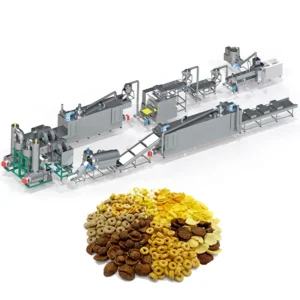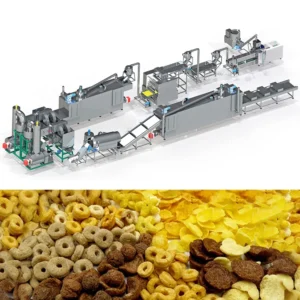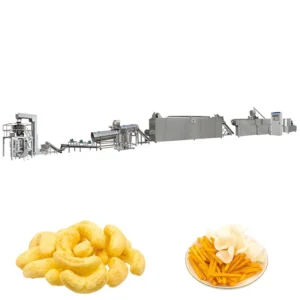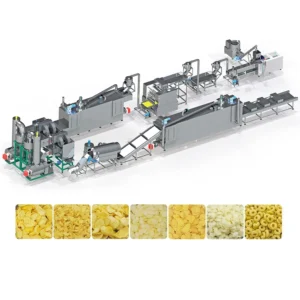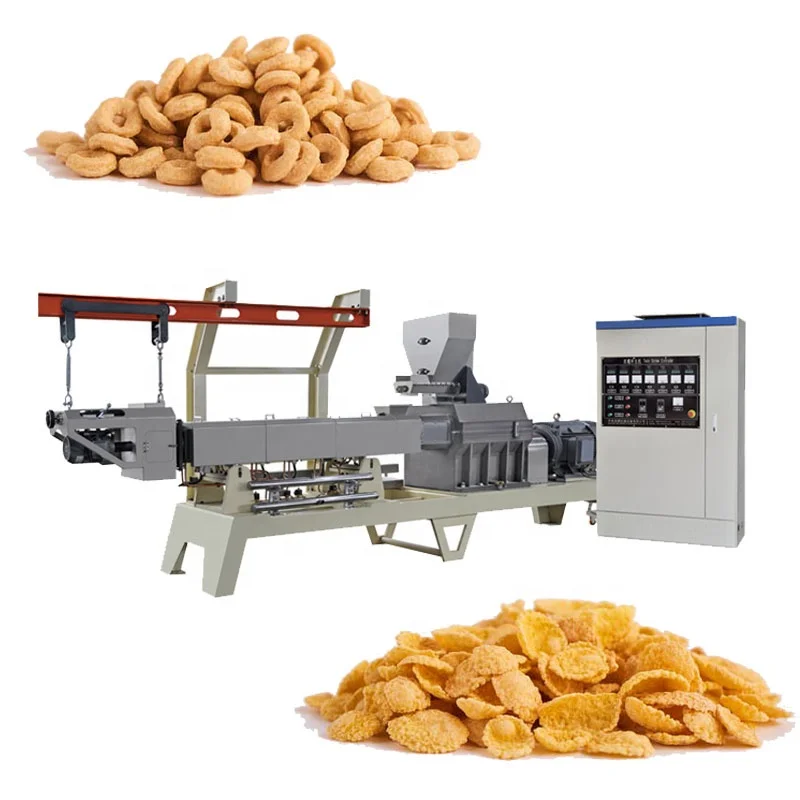
Throughput-Matched Station Design — every flaking, drying and coating unit is sized against the MT70 extruder output so the line runs at its rated pace without material queuing between stations.
Technical Specifications
| Parameter | Value |
|---|---|
| Model | MT70 |
| Product Type | Corn Flakes Processing Machine / Oatmeal Production Line |
| Screw Configuration | Twin-screw |
| Installed Power | 160 kW |
| Operating Power Consumption | 120 kW |
| Output Capacity | 150–200 kg/hr (basis not stated in source — confirm raw material type, moisture content and flake thickness) |
| Overall Dimensions (L × W × H) | 41 × 1.5 × 2.2 m |
| Control System | PLC and MCC |
| Basic Raw Materials | Corn, rice, wheat, oat, barley powder |
| Final Product Shapes | Ball, tube, stick, ring, fruit loop, star, wheel, flower, heart (via die adjustment) |
| Flaking Machine Drive | Hydraulic double-roller system with separate dual-motor drive and infrared sensor temperature control |
| Dryer Heating Source | Gas or Electric (configurable) |
| Hot Air Roasting Oven | Vibrating pan, conciliation burner, dual circulating fans, cyclone dust removal |
| Sugar Coating System | Double tumble melter, elevator, coating drum, spraying nozzles |
| Assembly State | Complete turnkey line from mixing to packing |
| Certification | CE, ISO |
Application Suitability
| Application | Material or Output |
|---|---|
| Natural corn flakes production | Corn grits or corn flour, toasted without sugar coating |
| Sugar-coated corn flakes | Corn or rice base with syrup application in coating drum |
| Oatmeal and multigrain flakes | Oat, barley or blended grain powder |
| Extruded snack shapes for breakfast cereals | Rice, wheat or corn powder formed into rings, balls, stars or fruit loops via die change |
| Fortified breakfast cereal lines | Grain base blended with vitamin and mineral premix before extrusion |
Why "Rated Capacity" Means Nothing Without Station Alignment
A line is only as fast as its slowest station, and the bottleneck is almost never the extruder.
When I was setting up a corn flakes line in Malaysia a few months back, the flaking rollers could not keep pace with the extruder discharge. Half-cooked dough sat on the conveyor cooling down and losing the moisture window needed for proper flake compression. The oven downstream was oversized for what actually reached it, burning gas while waiting for product. This is the reality behind a corn flakes machine full equipment range specification — the number on the extruder nameplate is irrelevant if the flaking, drying or roasting station cannot absorb its output [NEED_CITE: throughput matching principles in continuous food processing lines].
Sizing Every Station to the Extruder Discharge Rate
The MT70 twin-screw extruder sits at the centre of this line with 160 kW installed power and 120 kW running consumption. Every downstream unit — the hydraulic flaking press, the gas or electric dryer, the hot air roasting oven, the double-tumble sugar coating system — is specified so that its maximum throughput meets or slightly exceeds the extruder discharge. This is the core logic of surveying a corn flakes machine full equipment range before committing to individual units: you see the entire chain at once rather than discovering a mismatch after installation.
How the Flaking Station Controls Final Texture
Flake thickness is determined at the double-roller press, which runs on a PLC-controlled hydraulic system with independent motors for each roller. Infrared sensors monitor roller surface temperature in real time. If one roller runs hotter than the other, the dough sheet sticks unevenly and flakes emerge with asymmetric blister patterns after roasting. The separate motor drives allow each roller speed to be tuned independently, giving operators fine control over compression ratio and final flake density — critical when switching between natural corn flakes and sugar-coated variants that demand different base textures.
Specifying the Roasting and Coating Sequence
The hot air roasting oven uses a vibrating pan with high-temperature spraying tubes and a conciliation burner, supported by two separate circulating fans and a cyclone dust removal device. This combination delivers even surface blistering — the characteristic micro-bubbles on a corn flake that signal proper toasting. Downstream, the sugar coating system pairs a double tumble melter with an elevator-fed coating drum and precision spraying nozzles. The tumble melter maintains syrup at a stable viscosity so that coating weight stays consistent across shifts, avoiding the sticky clumping that occurs when syrup temperature fluctuates [NEED_CITE: sugar coating uniformity in breakfast cereal production].
Reading the Power and Footprint Data
The 160 kW installed power on the MT70 reflects the full motor, heater and control load; the 120 kW operating figure is what you will actually meter during steady-state production. The 41-metre line length at 1.5 metres wide and 2.2 metres high tells you the minimum bay size needed, but you must also allow clearance for the elevator infeed on the coating drum, maintenance access panels on the roasting oven and the cooling conveyor run before packing. Gas-heated dryers demand a dedicated supply line and combustion exhaust routing, while electric dryers need a high-amperage circuit separate from the extruder and flaking press feeds. The PLC and MCC control architecture keeps motor protection, variable-frequency drives and temperature loops on a centralised panel so that operators manage the entire sequence from one interface rather than walking between standalone panels.
What Happens When One Station Is Underspecified
I have seen coating drums specified for a lower throughput than the extruder upstream. Syrup application becomes a rush job — flakes pass through the drum too quickly and exit with patchy coverage, while the operator slows the entire line to compensate. The roasting oven then runs below its designed load, cycling its burners on and off, which creates hot spots and scorched flakes. These are not equipment defects; they are sizing errors that compound across every shift [NEED_CITE: consequences of throughput mismatch in continuous cereal processing].
Why Sourcing the Full Range From One Supplier Matters
Complete line supply from a single manufacturer means the flaking press motor ratings, dryer belt speed and coating drum diameter are all calculated against the same extruder output figure rather than assembled from independent vendor datasheets. The screw configuration and die design are recorded against your specific corn, oat or blended grain formulation so that flake geometry matches what the downstream stations expect. An in-house testing workshop runs your raw material through the extruder and flaking press before the line ships, catching moisture or gelatinisation issues early. Pre-sales engineering covers layout drawings with utility connection points for every station, and the PLC programme is written to coordinate start-up and shutdown sequences across all units. Post-installation support includes operator training on the centralised MCC panel and a documented wear-parts list covering screws, dies, roller shells and spraying nozzles.
Documentation & Verification
- Line layout with capacity calculation showing throughput matching between every station from mixer to packer
- Machine specification sheet for each unit listing motor power, utility requirements and footprint
- Screw and die configuration record matched to buyer’s raw material and target flake or snack shape
- Electrical schematic with voltage and frequency confirmation for destination market
- Trial run report on customer-supplied raw material before line dispatch
- CE declaration of conformity and ISO certificate covering manufacturing process
Installation, Commissioning & Support
- Floor plan must accommodate 41 m line length with additional clearance for elevator infeed and cooling conveyor
- Dedicated high-amperage electrical circuit for dryer and roasting oven separate from the 120 kW extruder feed
- Hydraulic system on flaking press requires filtered oil supply and level check before first start-up
- PLC programme commissioned on-site with operator language set to destination market preference
- Wear-parts list issued at handover covering twin-screw barrels, die plates, flaking roller shells and spray nozzles
- Gas-heated dryer option requires certified combustion exhaust routing to workshop exterior
Preparing Your Enquiry
To match the right station sizes to your production target, share the raw material formulation you plan to run, the target flake thickness or snack shape, and the daily output you need. Include your workshop length, ceiling height and available voltage and frequency so the layout and electrical schematic can be prepared before quotation. If you are adding this line alongside existing mixers or packing stations, note their capacity so the corn flakes machine full equipment range can be aligned at the infeed and discharge points.
Frequently Asked Questions
Q: What stations are included in a complete corn flakes line and how is throughput matched between them?
A: The line runs from mixing through twin-screw extrusion, flaking, drying, hot air roasting, sugar coating, cooling and packing. Each station’s motor rating, belt speed and processing volume are calculated against the extruder’s steady-state output so that material flows continuously without queuing. The line layout document shows the matched capacity figure for every unit.
Q: Can the same extruder produce both natural and sugar-coated corn flakes?
A: Yes. The MT70 extruder and flaking press produce the base flake for both variants. Natural flakes pass directly from the roasting oven to cooling and packing. Sugar-coated flakes are routed through the double tumble melter and coating drum after roasting, then cooled to set the syrup before packing.
Q: What raw materials can this line handle and how does material choice affect configuration?
A: Corn, rice, wheat, oat and barley powder are all processed on this line. Material choice affects screw configuration, barrel temperature profile and die selection. Higher-fat formulations like oat may need adjusted screw pitch and flaking roller pressure. A trial run on your specific raw material confirms the setup before the line ships.
Q: What utility requirements should I plan for each station?
A: The extruder draws 120 kW operating power from a dedicated circuit. Gas-heated dryers need a supply line and combustion exhaust; electric dryers require a separate high-amperage feed. Compressed air is used for pneumatic valves on the flaking press and coating nozzles. The PLC panel needs a stable control-voltage supply with surge protection.
Q: How are different breakfast cereal shapes achieved on this line?
A: Shape changes happen at the extruder die — swapping die plates produces balls, tubes, rings, stars, fruit loops or other profiles. The flaking press is bypassed for puffed shapes, which go straight from extrusion to drying and roasting. Downstream stations remain the same regardless of shape selected.