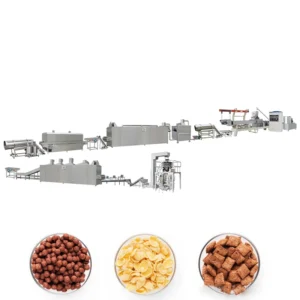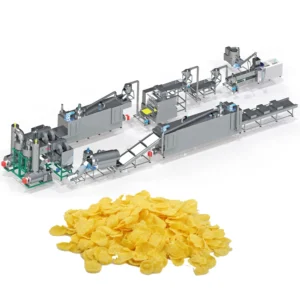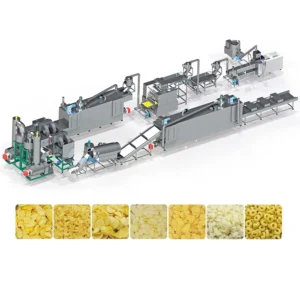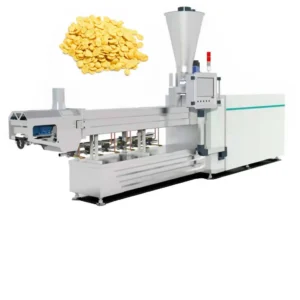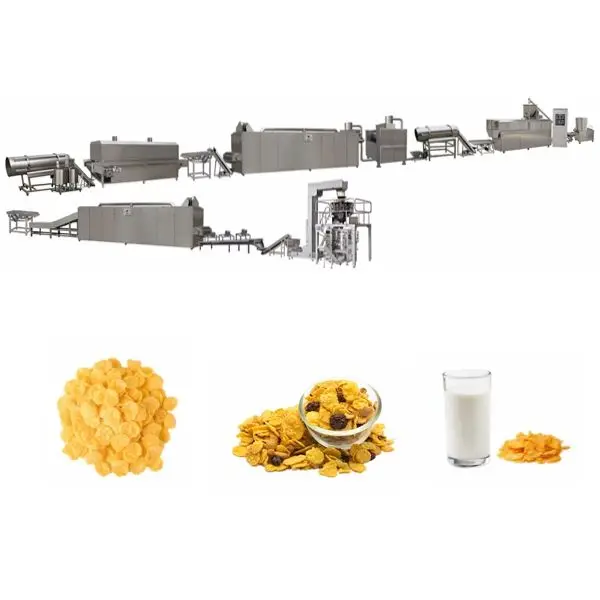
Matched Extruder-to-Packing Throughput — every station from the MT70/MT85/MT75 extruder through the flaker, dryer, roaster and coating drum is sized so one step never starves or floods the next.
Technical Specifications
| Parameter | Value |
|---|---|
| Product Type | Corn Flakes Production Line (Twin-Screw Extruder Line for Breakfast Cereals) |
| Model Options | MT70 / MT85 / MT75 |
| Screw Type | Twin Screw |
| Installed Power | 160 kW (MT70) / 190 kW (MT85) / 210 kW (MT75) |
| Power Consumption | 120 kW (MT70) / 140 kW (MT85) / 150 kW (MT75) |
| Output Capacity | 150–200 kg/hr (MT70), 300–400 kg/hr (MT85), 300–500 kg/hr (MT75) (basis not stated in source) |
| Overall Dimensions | 41 × 1.5 × 2.2 m (MT70) / 43 × 1.5 × 3.2 m (MT85) / 45 × 1.5 × 3.5 m (MT75) |
| Control System | PLC |
| Dryer Heating Source | Gas or Electric (configurable) |
| Flaking System | Hydraulic double-roller, double motors, infrared sensor temperature control |
| Roasting Oven | Vibrating pan, high-temperature spray tubes, dual circulating fans, cyclone dust removal |
| Coating System | Double tumble for sugar melting, elevator, coating drum, spraying nozzle |
| Extruder Features | Automatic lubricating and cooling function; wear-resistant screw technology |
| Certifications | CE, ISO |
Application Suitability
| Application | Material or Output |
|---|---|
| Natural Corn Flakes | Corn, rice, wheat, oat, barley powder |
| Sugar-Coated Corn Flakes | Corn base with sugar or honey glaze |
| Shaped Breakfast Cereals | Rings, stars, fruit loops, balls, tubes, sticks, flowers, hearts (via die change) |
| Snack Food Variants | Puffed and extruded snack formats using alternative die configurations |
Why "Rated Capacity" Means Nothing Without the Raw Material Recipe
The throughput figure on a breakfast cereal corn flakes machine full equipment range only holds if your flour blend, moisture content and fat ratio match the test conditions. I once spent five days on-site rewiring screw elements and barrel temperatures because a client’s oat-and-bran formula generated torque spikes the standard corn-grit trial never predicted. When the dryer or roaster is spec’d against a clean-corn benchmark, adding fibre or protein shifts the gelatinisation window, and the whole line either backs up at the extruder or runs too wet through the roasting oven [NEED_CITE: starch gelatinisation behaviour across different cereal blends]. Matching every station to your actual recipe before the machines are built avoids that expensive on-site re-engineering.
How the Full Station Catalogue Fits Together
A buyer surveying the complete breakfast cereal corn flakes machine full equipment range needs to see where each piece sits in the sequence. The natural corn flakes workflow runs Mixing → Extruding → Flaking → Drying → Hot Air Roasting → Cooling → Packing. The sugar-coated variant inserts a Sugar Spraying and Coating stage between the roaster and the final dryer. Knowing this lets a contractor or technical buyer verify that the flaking mill throughput and the coating drum volume both align with whichever extruder model is chosen.
Throughput Matching Across Every Station
The extruder is only as productive as the dryer and roaster that follow it. If an MT85 pushes dough at the upper end of its range but the hot air roasting oven lacks sufficient residence time, surface bubbling stays incomplete and the flakes taste raw. This breakfast cereal corn flakes machine full equipment range lists the roaster with dual circulating fans and a vibrating pan, which together control how long each flake spends under the high-temperature spray tubes [NEED_CITE: residence time requirements for cereal roasting ovens]. Specifying the roaster length and fan speed against the extruder output keeps crispness consistent across the batch.
Reading the Specification Sheet Like a Process Engineer
Twin-screw extrusion generates shear and heat internally, so barrel temperature profiles must shift when the raw material changes from pure corn grits to an oat-heavy blend. The MT70 at 160 kW installed power suits pilot-scale or specialty cereal runs, while the MT75 at 210 kW supports larger-volume commodity flakes. The hydraulic double-roller flaking system uses infrared sensor temperature control to keep roll surface heat stable, which directly affects flake thickness uniformity. PLC control across the line means recipe parameters — screw speed, barrel zone temperatures, roller gap and pressure — can be stored and recalled, reducing batch-to-batch drift. Automatic lubricating and cooling functions inside the extruder gearbox cut unplanned stops during long production shifts.
What Happens When Stations Are Sourced Separately
I have walked into plants where the extruder was European, the dryer was local fabrication and the coating drum was a repurposed cement mixer. The extruder ran fine, but the dryer could not keep up, so wet flakes piled into the roaster and the cyclone dust removal choked within hours [NEED_CITE: dust collection failure from upstream moisture overload]. Sourcing the breakfast cereal corn flakes machine full equipment range from one catalogue means the dryer capacity, roaster airflow and coating drum volume are all calculated against the same extruder output, eliminating these hidden bottlenecks.
Why Buyers Source the Entire Range Here
The screw configuration and die design are specified to your raw material and target flake density before production starts, not copied from a generic template. An in-house testing workshop runs trial batches on your actual flour blend so gelatinisation and expansion are confirmed before the machines ship. Every station — extruder, flaker, dryer, roaster, coater, cooler — comes with a matching specification sheet so throughput alignment is documented, not assumed. Line layout and capacity calculations show how each machine connects, which simplifies utility planning and phased installation for contractors. Pre-sales consultation continues through on-site commissioning, operator training and wear parts supply.
Documentation & Verification
- Line layout and capacity calculation matching extruder output to flaker, dryer and roaster
- Machine specification sheet for each station confirming installed power and footprint
- Screw and die configuration record matched to your cereal flour blend
- Electrical schematic with voltage and frequency confirmed for your market
- Factory test record from trial run on your raw material before dispatch
- CE declaration of conformity and ISO certificate for import documentation
Installation, Commissioning & Support
- Floor plan review confirming the 41–45 m line length fits your facility with maintenance clearance
- Dedicated power circuit sized for 160–210 kW extruder plus dryer and roaster loads
- Sequential assembly from extruder through packing with utility hook-up guidance
- First-run parameter tuning on your flour blend, adjusting barrel zones and roller gap
- Operator training covering PLC recipe storage, screw lubrication intervals and safety locks
- Wear parts list including screws, dies and flaking roller shells with reorder lead times
What to Prepare Before Requesting a Quote
Share your cereal flour formulation — corn, oat, barley ratios and target moisture — so the extruder screw profile and die selection start from your actual material. Confirm your daily output target and shift pattern so the right model (MT70, MT85 or MT75) and downstream dryer size are proposed. Provide your workshop dimensions, ceiling height and local voltage and frequency so the layout and electrical package arrive site-ready. If you want to validate flake texture before committing, request a trial run using your raw material in the testing workshop.
Frequently Asked Questions
Q: What machines are included in the full corn flakes line, and where does each station fit?
A: The natural line runs mixing, twin-screw extrusion, hydraulic flaking, drying, hot air roasting, cooling and packing. The sugar-coated variant adds sugar spraying and a coating drum between the roaster and final dryer. Each station is matched in throughput to the extruder model selected.
Q: How do I match dryer and coating drum capacity to the extruder model I choose?
A: The line layout and capacity calculation document aligns dryer residence time and coating drum volume against the output of the MT70, MT85 or MT75 extruder. This prevents wet flakes backing up or coating capacity sitting idle between batches.
Q: Can the same extruder produce shaped breakfast cereals beyond flat corn flakes?
A: Yes. By swapping the die plate, the twin-screw extruder can produce rings, stars, fruit loops, balls, tubes and other shapes. The flaking mill is bypassed for these formats, and the downstream dryer and roaster settings are adjusted accordingly.
Q: What is the difference between the natural corn flakes line and the sugar-coated line in terms of equipment?
A: The sugar-coated line inserts a sugar spraying station and a double-tumble coating drum after the hot air roaster, followed by an additional drying stage to set the glaze. All other stations — mixer, extruder, flaker, primary dryer, roaster, cooler and packing — remain the same.
Q: What heating sources are available for the dryer and roasting oven?
A: Both the dryer and the hot air roasting oven can be configured for gas or electric heating. The choice depends on your local utility cost and available gas supply, and is confirmed during the electrical schematic and voltage verification stage.