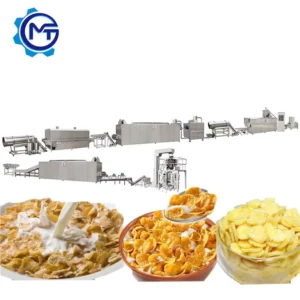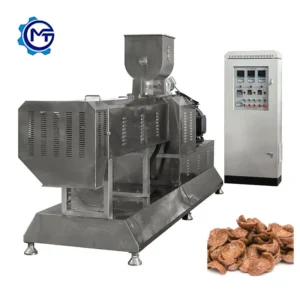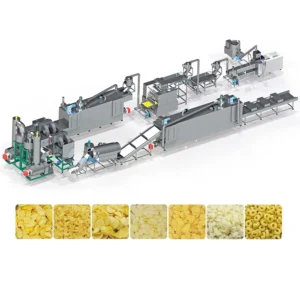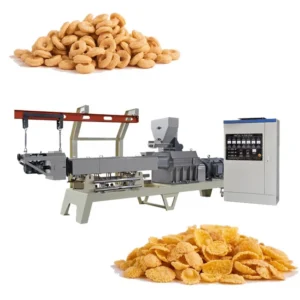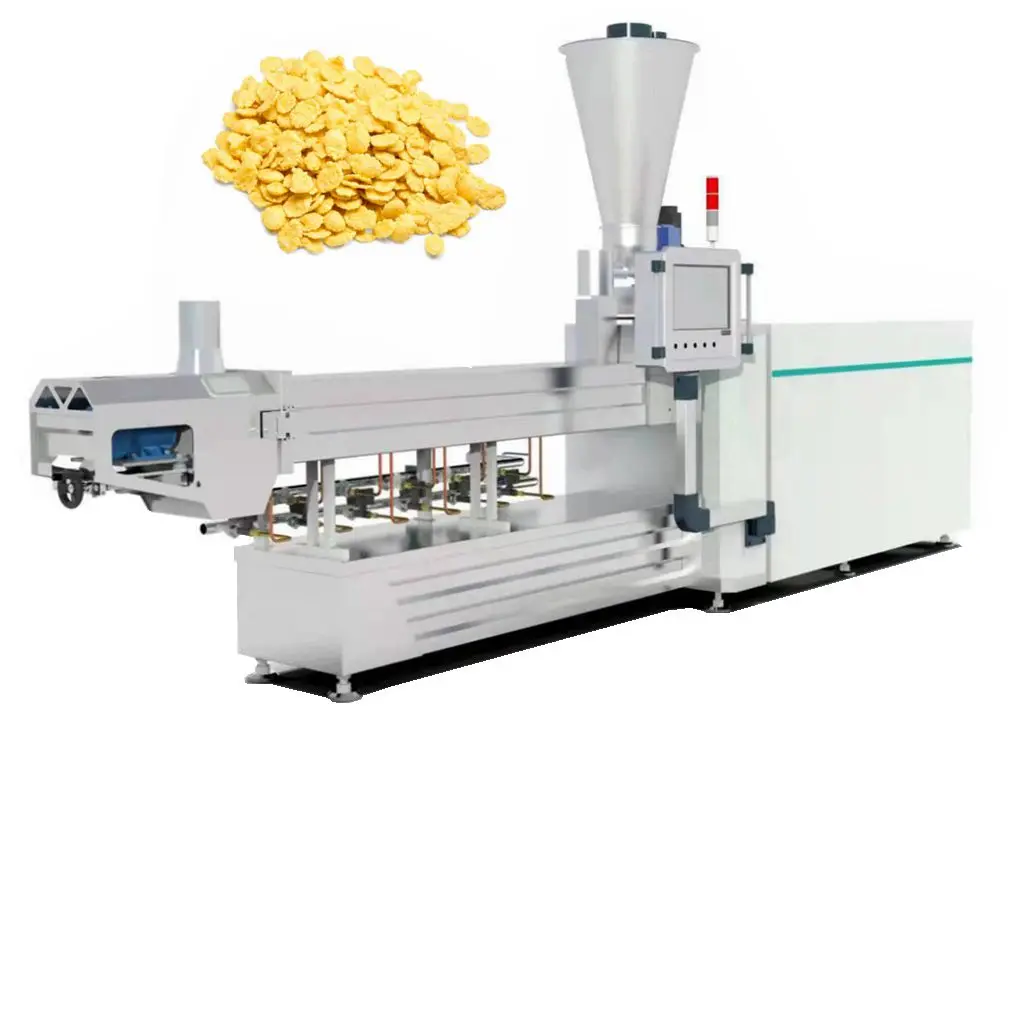
Screw and Die Specificity — Every extruder in this breakfast cereal corn flakes machine full equipment range ships with screw configuration and die design matched to your raw material, preventing density and texture failures caused by generic builds.
Technical Specifications
| Parameter | Value |
|---|---|
| Product Type | Breakfast Cereal Corn Flakes Production Line |
| Model Options | MT70 / MT85 / MT75 |
| Installed Power | MT70 — 160 kW; MT85 — 190 kW; MT75 — 210 kW |
| Power Consumption | MT70 — 120 kW; MT85 — 140 kW; MT75 — 150 kW |
| Output Capacity | MT70 — 150–200 kg/h (basis to be confirmed); MT85 — 300–400 kg/h (basis to be confirmed); MT75 — 300–500 kg/h (basis to be confirmed) |
| Overall Dimensions (L×W×H) | MT70 — 41 × 1.5 × 2.2 m; MT85 — 43 × 1.5 × 3.2 m; MT75 — 45 × 1.5 × 3.5 m |
| Extruder Screw Type | Twin Screw |
| Flaking Machinery | Hydraulic double-roller system; dual independent motors; infrared sensor temperature control |
| Dryer Heating Source | Gas / Electric (configurable) |
| Roasting Oven | Hot air roasting with vibrating pan, high-temperature spraying tubes, conciliation burner, two circulating fans, cyclone dust removal |
| Coating System | Double tumble sugar melting, elevator, coating drum, spraying nozzle |
| Control System | PLC control (MCC available per line configuration) |
| Lubrication | Automatic lubricating and cooling function on extruder |
| Standards | CE, ISO |
Application Suitability
| Application | Material or Output |
|---|---|
| Natural corn flakes production | Corn, rice, wheat, oat, barley powder |
| Sugar-coated breakfast cereal | Corn or multi-grain base with sugar spray and tumble coating |
| Shaped cereal snacks | Ball, tube, stick, ring, fruit loop, star, wheel, flower, heart (by adjusting mould) |
| Fortified breakfast cereal lines | Grain powder blends with added nutritional premix |
What "Rated Capacity" Means When the Raw Material Changes
Your actual grain composition determines real output, not the brochure figure.
I spent years on the workshop floor in Shandong watching lines perform flawlessly during factory tests, only to stall once installed overseas because the buyer’s corn grits had a different fat or starch profile than the standard test material. A breakfast cereal corn flakes machine full equipment range quoted at a nominal throughput can drop noticeably when moisture content or particle size shifts. That gap between spec sheet and production floor is where most commissioning disputes start [NEED_CITE: raw material variability impact on extrusion throughput].
How Each Station in the Corn Flakes Line Holds Its Rated Output
A corn flakes line is only as fast as its slowest station. The mixing system must feed the extruder at a consistent rate, the flaking rollers must handle the full extrudate volume without backlog, and the dryer must remove moisture at a pace that matches upstream output. This breakfast cereal corn flakes machine full equipment range is configured so that every station — from batching through extrusion, flaking, drying, hot air roasting, sugar coating, cooling, and packing — is throughput-matched to the extruder model selected. Mismatched standalone equipment from different vendors is a frequent source of bottleneck complaints in cereal production [NEED_CITE: production line bottleneck causes in food extrusion].
Twin-Screw Extrusion for Cereal Grain Processing
The twin-screw extruder at the heart of this line provides the shear and residence time needed to fully gelatinise starch from corn, wheat, oat, or barley. Screw configuration is specified to the buyer’s grain blend — higher fat content requires different screw element spacing and compression ratios than lean corn grits. The automatic lubricating and cooling system maintains barrel temperature consistency across long production runs, reducing batch-to-batch variation in flake density and surface blister. Screw elements are produced through a proprietary wear-resistant process to extend service life before the first replacement set is needed.
Reading the Power and Dimension Specs
Installed power across the MT70, MT85, and MT75 models ranges from 160 kW to 210 kW, reflecting the larger motor and heating elements required for higher throughputs. Power consumption sits at roughly 70–75% of installed capacity under normal operating load. The line footprint stretches from 41 to 45 metres in length, which means buyers need to confirm workshop length and ceiling height before ordering — the MT85 and MT75 models reach 3.2 and 3.5 metres tall respectively, requiring clearance for dryer and roaster exhaust ducting. The hydraulic flaking station uses dual independent motors for separate roller driving, giving operators fine control over flake thickness independent of line speed.
The Cost of Skipping the Raw Material Trial
I remember a customer who sent a sample bag of corn flour that looked standard on paper. During our trial run the extrudate came out dense and refused to flake properly — fat content was higher than typical, collapsing the cell structure before it reached the rollers. Had that line shipped without the trial, the buyer would have spent weeks adjusting parameters on-site with raw material already sitting in their silo. Skipping pre-shipment testing on your actual grain blend risks flake density outside market specification, surface blister inconsistency, and sugar coating adhesion failures that only appear after the roasting stage [NEED_CITE: pre-shipment trial testing importance in food machinery procurement].
What This Line Delivers Beyond the Extruder
Every station is sourced and matched under one supplier, so throughput calculations are done against the full line rather than individual machine brochures. Screw and die configuration records are documented against your specific raw material before the extruder leaves the workshop. The roasting oven uses a vibrating pan and cyclone dust removal to maintain even heat distribution and prevent fine particle buildup that scorches flake surfaces. Electrical schematics and voltage confirmation are completed before production begins — not discovered during commissioning when the local power grid does not match an assumed standard. Factory test runs on customer raw material generate a written report that travels with the shipment.
Documentation & Verification
- Line layout and capacity calculation confirming throughput match across every station
- Screw and die configuration record matched to your grain blend and target flake density
- Electrical schematic with voltage, frequency, and control language confirmation for your market
- Factory test record and trial run report on your actual raw material before dispatch
- CE declaration of conformity and ISO certificate included with shipment documentation
- Wear parts list specifying screw elements, die plates, and roller surfaces with replacement intervals
Installation, Commissioning & Support
- Confirm workshop length of 41–45 m and ceiling clearance up to 3.5 m before delivery
- Verify three-phase power supply matches confirmed voltage and frequency on the electrical schematic
- Line ships in modular sections; flaking and roasting stations require on-site assembly and alignment
- PLC control system language set per operator requirement before first production run
- Initial screw and die configuration parameters documented and handed over during commissioning
- Automatic lubrication system checked and refill schedule set during operator training
What We Need to Configure Your Line
To size the right extruder model and match every downstream station, we need your grain type and typical moisture content, target hourly output on your actual recipe, workshop dimensions including ceiling height, and local voltage and frequency. If you run sugar-coated variants, let us know the coating percentage so the tumble drum and spraying system can be matched. We also need to confirm control panel language and whether you prefer gas or electric heating on the dryer before the line layout is finalised.
Frequently Asked Questions
Q: How is output capacity verified on my specific raw material and moisture content?
A: We run a trial in our testing workshop using your actual grain blend at the moisture level you specify. Extrudate density, flake thickness, and roasting behaviour are measured and documented in a trial run report. This report confirms which model — MT70, MT85, or MT75 — holds your required throughput before any production commitment.
Q: What voltage, frequency, and control language options are confirmed before shipment?
A: Electrical schematics are prepared after we confirm your site power supply. Voltage and frequency are locked in before production starts. PLC control panel language is set to your operator preference. This prevents commissioning delays that occur when assumptions about local grid standards turn out to be wrong.
Q: How are dryer and roaster capacities matched to the extruder to prevent line bottlenecks?
A: Each station is calculated against the extruder’s output on your raw material, not a generic brochure figure. Dryer residence time, roaster pan area, and coating drum volume are all specified to handle the full upstream flow without backlog or idle time between stations.
Q: Which stations can be supplied standalone versus as part of the complete line?
A: Individual stations such as the flaking machinery, roasting oven, or coating drum can be supplied for integration into existing lines. However, throughput matching and control system coordination are most effective when the full sequence from mixing through packing is configured as a single project.
Q: What spare wear parts are included and when is the first replacement due?
A: A wear parts list ships with every line, covering screw elements, die plates, and flaking roller surfaces. First replacement timing depends on your grain abrasiveness and production hours. We document expected intervals during commissioning so you can plan procurement before wear affects flake quality.