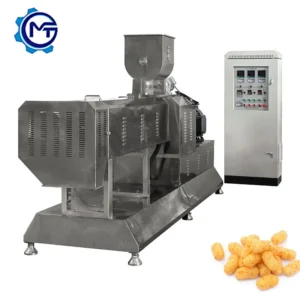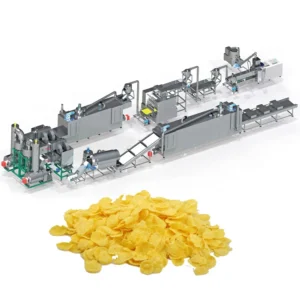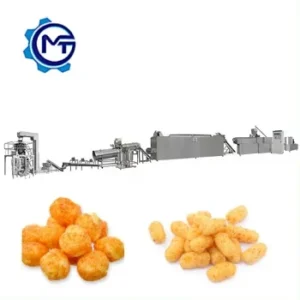
Complete Line Balance — Every station from batching to packing is mapped to the extruder’s real throughput, preventing the pile-ups I’ve seen when a dryer or flavoring drum can’t keep pace with the screw speed.
Technical Specifications
| Parameter | Value |
|---|---|
| Product Type | Twin Screw Corn Puff Snack Extrusion Processing Line |
| Model Options | MT65 / MT70 / MT85 / MT100 |
| Installed Power | 130 kW (MT65) / 180 kW (MT70) / 220 kW (MT85) / 240 kW (MT100) |
| Real Power Consumption | 95 kW (MT65) / 120 kW (MT70) / 130 kW (MT85) / 160 kW (MT100) |
| Output Capacity | 120–150 kg/h (MT65, basis not stated in source) / 200–300 kg/h (MT70, basis not stated in source) / 300–500 kg/h (MT85, basis not stated in source) / 600–800 kg/h (MT100, basis not stated in source) |
| Screw Type | Twin-screw |
| Speed Control | Frequency inverter speed controlling system |
| Lubrication & Cooling | Automatic lubricating and cooling system |
| Dryer Heating Source Options | Electric / Steam / Gas (configurable to local utility) |
| Die Configuration | Interchangeable dies for multiple shapes |
| Flavoring System | Double drum flavoring line with sugar melting and spraying nozzle |
| Packing Machine | Automatic weighing, sealing, marking, coding, bag filling |
| Core Filling Option | Available with addition of core filling machine and cutting machine |
| Raw Materials | Corn, rice, wheat, oat, barley flour, and similar grain-based materials |
| Warranty | 1 year |
Application Suitability
| Application | Material or Output |
|---|---|
| Puffed corn snack production | Corn flour, corn grits, rice flour blends |
| Cheese ball and cereal ring manufacturing | Grain-based dough with cheese or sugar coating |
| Core-filled extruded snacks | Grain shell with cream, chocolate, or fruit paste filling |
| Multi-shape snack runs (stick, tube, star, flower, heart, fruit loop) | Wheat, oat, barley flour and composite grain mixes |
| Snack food plant capacity expansion | Existing line integration or greenfield layout |
What "Nominal Capacity" Leaves Out When Stations Are Mismatched
A corn puff extrusion processing line only runs as fast as its slowest station — and that station is rarely the extruder.
I’ve walked into plants in Mexico and Colombia where a twin-screw extruder was pushing product onto a dryer belt that couldn’t carry the volume. The result wasn’t a small inefficiency — it was product stacking, moisture failing spec, and operators manually clearing the conveyor every forty minutes. The full equipment range twin screw snack extruder catalogue exists so buyers can see every station in context and match real throughput before a purchase order is signed [NEED_CITE: throughput matching across extrusion line stations]. When the mixer feeds faster than the extruder can accept, or the flavoring drum turns slower than the dryer discharges, the entire line stalls at the bottleneck.
Mapping the Full Equipment Sequence
A corn puff extrusion processing line moves through material preparation, batching, extruding, drying, coating or flavoring, cooling, and packing. Each station has its own cycle time and capacity ceiling. The twin-screw extruder sits at the center, but the double drum flavoring line with sugar melting and spray nozzle must receive product at the same rate the dryer delivers it. If the cooling conveyor is shorter than the packing machine’s infeed requirement, product backs up and moisture re-absorption begins.
Why Dryer Heating Source Matters Before You Order
The dryer is where most lines quietly lose throughput. Electric heating gives precise temperature control but draws significant amperage — a concern in regions where industrial power allocation is limited. Steam heating integrates well where a boiler already exists on-site. Gas-fired dryers are common in Latin American snack plants where natural gas infrastructure is reliable and electricity costs are high [NEED_CITE: industrial dryer heating source selection by utility availability]. Specifying the wrong heating source doesn’t just raise operating cost — it can cap the dryer’s effective throughput below the extruder’s output.
Reading the Specs That Actually Affect Your Output
The twin-screw design handles a wider range of grain-based raw materials than single-screw platforms, from fine corn flour to coarse oat blends, because the counter-rotating screws create a self-wiping action that prevents material buildup in the barrel. The frequency inverter speed controlling system lets operators adjust screw RPM to match different recipes without stopping the line, which directly affects residence time and expansion at the die. Interchangeable dies mean the same extruder base can produce cheese balls, tubes, sticks, rings, fruit loops, stars, and heart shapes — but each die geometry changes the back-pressure and therefore the expansion ratio. The automatic lubricating and cooling system maintains barrel temperature stability during long runs, which keeps product density consistent from the first hour to the tenth.
The Hidden Cost of Buying the Extruder Alone
I’ve seen buyers focus all their attention on the extruder specification and treat the dryer, flavoring drum, and cooler as afterthoughts. The consequence shows up during commissioning: the extruder reaches its rated output, but the single-drum flavoring system can’t coat product fast enough, forcing the operator to cut extruder speed to match. That’s a capacity loss you pay for every shift [NEED_CITE: flavoring drum throughput as bottleneck in snack extrusion lines]. A double drum flavoring line with sugar melting and spraying nozzle addresses this by splitting the coating load across two stages. Skipping proper line layout planning also means electrical panels and utility drops end up in the wrong positions, delaying startup by days while cable runs are re-routed.
Why Sourcing the Full Range from One Supplier Changes the Conversation
Every station in this corn puff extrusion processing line — from the batching system through the extruder, dryer, double drum flavoring line, cooler, and automatic packing machine — is documented in a single line layout and capacity calculation. Screw configuration and die design are specified to the buyer’s raw material and target shape, not copied from a generic build. An in-house testing workshop runs trial production on customer-supplied raw material before shipment, so product development doesn’t start blind after installation. Electrical schematics include voltage and frequency confirmation for the destination market, eliminating the commissioning delays I’ve watched cost plants entire launch windows. Wear parts lists cover screws, dies, and consumables so the first replacement cycle doesn’t turn into a sourcing emergency.
Documentation & Verification
- Line layout and capacity calculation showing throughput balance across every station
- Screw and die configuration record matched to your raw material and target snack shape
- Electrical schematic with voltage and frequency confirmed for destination market
- Trial run report on customer-supplied raw material before shipment
- Factory test record covering extruder, dryer, and flavoring drum under load
- Wear parts list with screw, die, and consumable specifications for first replacement
Installation, Commissioning & Support
- Foundation and utility drop layout provided per the MT65/MT70/MT85/MT100 footprint and real power consumption figures
- Dedicated circuit sizing based on installed power rating for each model variant
- Assembly sequence documentation for turnkey line stations from batching through packing
- First-run parameter setting on frequency inverter speed control and dryer temperature zones
- Operator training covering die changeover, double drum flavoring adjustment, and automatic lubrication checks
- Wear parts inventory review covering screws, dies, and spray nozzles for the initial production period
What to Include in Your Inquiry
To size a corn puff extrusion processing line correctly, share your primary raw material and its typical moisture content, your target daily output, and the snack shapes you plan to produce. Include your plant’s available voltage and frequency, the language preference for the control interface, and whether you need core filling capability on the same line. If you have existing upstream or downstream equipment that must integrate, note its throughput and connection type.
Frequently Asked Questions
Q: How is output capacity verified against my specific raw material and moisture content?
A: Capacity figures are based on specific raw material and moisture conditions. A trial run on your actual raw material is conducted in the testing workshop before shipment, generating a test report that documents real throughput, expansion ratio, and product density under your recipe conditions.
Q: Which dryer heating source fits my plant’s utility infrastructure?
A: The dryer is configurable for electric, steam, or gas heating. Electric suits plants with sufficient amperage allocation, steam integrates where a boiler already operates, and gas is preferred where natural gas supply is stable and electricity tariffs are high. Selection is confirmed during line layout planning.
Q: What die shapes are available, and how do I add core filling to the same line?
A: Interchangeable dies cover shapes including cheese ball, tube, stick, ring, fruit loop, star, wheel, flower, and heart. Core filling capability is added by incorporating a core filling machine and cutting station into the base line layout without changing the extruder platform.
Q: How do I confirm voltage, frequency, and control language before production?
A: Electrical schematics are prepared with your destination market’s voltage and frequency confirmed before production begins. Control system language is specified during the configuration stage so the HMI matches your operator requirements at commissioning.
Q: What documentation covers the full line layout, not just the extruder?
A: You receive a line layout and capacity calculation showing throughput matching across all stations, screw and die configuration records, electrical schematics, trial run reports, factory test records, operation manuals, and wear parts lists covering the complete sequence from batching to packing.