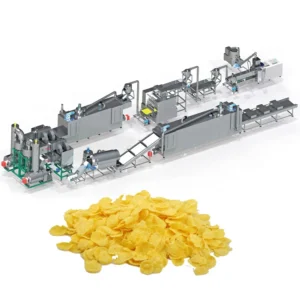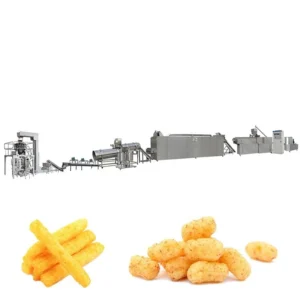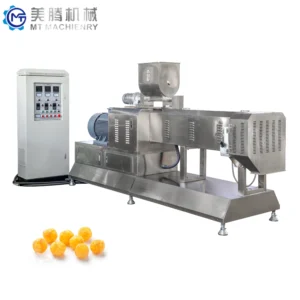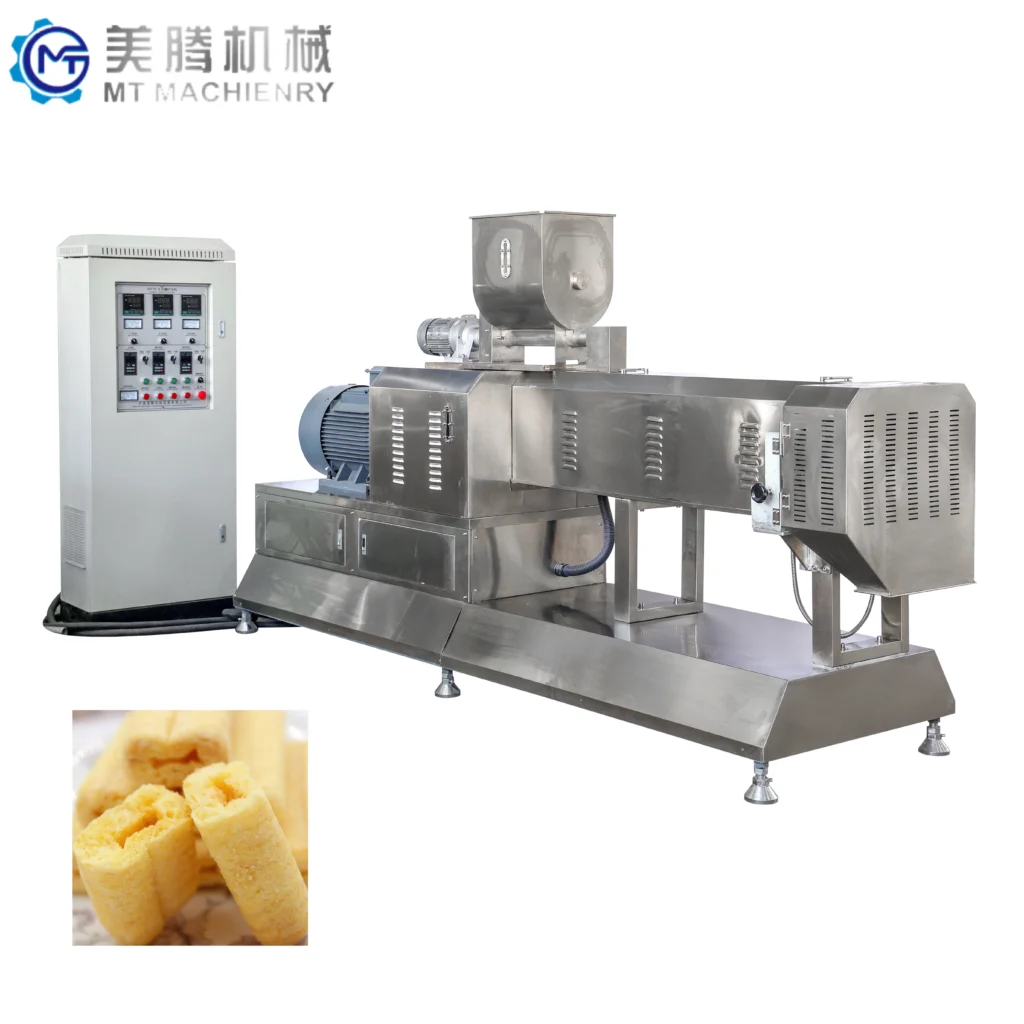
Throughput-Matched Stations — Every dryer, flavoring drum, and cooler in this twin screw corn puff snack extrusion line full equipment range is sized against the extruder output so no station sits idle waiting for upstream feed.
Technical Specifications
| Parameter | Value |
|---|---|
| Model | MT65 |
| Product Type | Twin Screw Corn Puff Snack Extrusion Line |
| Screw Type | Twin Screw |
| Installed Power | 130 kW |
| Real Consumption | 95 kW |
| Output Capacity | 120–150 kg/h (basis not stated in source — confirm raw material, moisture, die configuration) |
| Capacity Range (General) | 100–800 kg/h across model variants (basis to be confirmed) |
| Control System | Frequency speed controlling system |
| Line Stations | Material preparation → Batching → Extruding → Drying → Coating/Flavoring → Cooling → Packing → Stacking |
| Dryer Heating Source | Electric / Steam / Gas (configurable) |
| Flavoring System | Double drum with sugar melting and spraying nozzle |
| Assembly State | Complete turn-key line from material grinding to final packing |
| Warranty | 1 year |
| Delivery Time | 20 working days (extrusion line); approx. 35 working days with packing and stacking |
| Standards | CE, ISO |
| Model Variants | MT65, MT70, MT85, MT100 |
Application Suitability
| Application | Material or Output |
|---|---|
| Puffed corn snacks | Corn flour, rice flour, wheat flour, oat flour, barley flour |
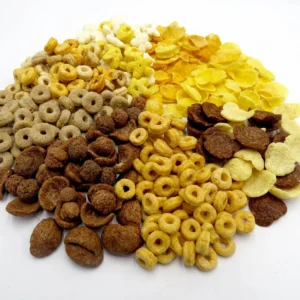
| Shaped extruded snacks | Cheese ball, tube, stick, ring, fruit loop, star, wheel, flower, heart shapes via interchangeable dies |
| Core-filled puffing snacks | Same grain base with addition of core filling and cutting station |
| Snack line capacity surveys | Equipment catalogue review before specifying full line layout |
| Station replacement or upgrade | Individual dryer, flavoring, cooling, or packing units for existing extrusion lines |
Why Nominal Capacity Means Nothing Without Raw Material Context
A line rated on one grain blend can lose half its throughput when the buyer’s actual corn grits arrive at higher moisture.
I remember a project in the Middle East where a corn puff line was signed off at sample-book capacity. When the customer’s local corn grits tested at higher moisture than the trial material, expansion dropped and the dryer ran empty while the extruder struggled to push product through. The whole Twin Screw Corn Puff Snack Extrusion Line full equipment range sat bottlenecked at one station [NEED_CITE: effect of raw material moisture on extrusion expansion rate]. That experience shifted how I approach every layout: confirm the raw material first, then size every downstream station to match what the extruder actually delivers on that specific feedstock — not what the brochure says.
Matching Every Station to the Extruder Output
The Twin Screw Corn Puff Snack Extrusion Line full equipment range is catalogued so buyers can see each station — batching, extruding, drying, coating, cooling, packing — as a matched set rather than a collection of standalone machines. When the dryer is undersized, wet product piles up on the belt; when the flavoring drum is oversized, the coating cycle finishes long before the next batch arrives. Both scenarios waste energy and shorten belt life. Sizing each station against real extruder throughput eliminates these gaps.
Configurable Heating and Coating for Local Conditions
The dryer is offered with electric, steam, or gas heating, allowing the line to align with whatever utility infrastructure the buyer’s factory already supports [NEED_CITE: industrial heating source selection criteria for food processing]. The double drum flavoring system includes a sugar melting unit and spraying nozzle, which handles oil-based, liquid, melted sugar, and flour-based coatings evenly across varying product bulk densities. This flexibility matters when a producer switches between savory cheese-dusted sticks and sweet-glazed rings on the same line.
How Screw Configuration and Die Design Shape the Final Snack
Twin screw geometry determines how long the material stays inside the barrel and how much shear it receives before reaching the die. Corn flour behaves differently from oat or barley flour — each has its own gelatinisation temperature and expansion profile. The frequency speed controlling system lets operators adjust screw speed to fine-tune shear and residence time without changing hardware. Meanwhile, die selection governs whether the output is a hollow tube, a dense cheese ball, or a thin ring [NEED_CITE: twin screw extrusion die geometry and product shape relationship]. Getting both right on the buyer’s actual material is what separates a line that runs at stated capacity from one that constantly needs manual adjustment.
What Happens When Stations Are Mismatched
When a flavoring drum cannot keep pace with the extruder, coated product exits unevenly — some pieces are over-glazed while others pass through almost bare. A dryer that is too short forces the operator to slow the extruder down, cutting effective output well below nameplate figures. And a packing station without vibration feeding struggles to weigh low-density puffed corn accurately, leading to giveaway or underfill complaints from retail buyers [NEED_CITE: volumetric vs gravimetric packing accuracy for puffed snacks]. These are not theoretical concerns; they show up in the first week of production.
Why Source the Full Range from One Supplier
The MT65 and its model variants (MT70, MT85, MT100) are designed so that throughput is matched across every station — extruder, dryer, flavoring, cooler, packing — under a single supplier, avoiding the finger-pointing that occurs when separate vendors blame each other for line bottlenecks. Screw and die configuration is specified to the buyer’s raw material and target shape before production begins. An in-house testing workshop allows trial runs on customer-supplied corn grits or flour blends before the line ships, catching moisture or expansion issues at the factory rather than on the buyer’s floor. Pre-sales consultation extends through layout design, utility planning, on-site installation, commissioning, and operator training.
Documentation & Verification
- Line layout and capacity calculation showing station-by-station throughput balance
- Machine specification sheet listing installed power and real consumption per model
- Screw and die configuration record matched to your corn flour or grain blend
- Electrical schematic with voltage and frequency confirmed for your target market
- Factory trial run report on your actual raw material before dispatch
- CE declaration of conformity for export compliance
Installation, Commissioning & Support
- Utility planning based on the 95 kW real consumption and configurable dryer heating source
- Voltage and frequency confirmation locked in before production to match local grid standards
- Assembly sequence from extruder through packing station with floor-level footprint guidance
- First-run parameter setting on your specific corn flour moisture and granulation
- Operator training covering screw speed adjustment and flavoring drum changeover
- Wear parts list including screws and dies with reorder lead times noted
Before You Request a Quote
To size the right model variant and configure each station accurately, share your raw material type and moisture content, your target product shape and daily output requirement, and your factory’s available voltage and frequency. If you already run upstream or downstream equipment, let us know the interface points so the line can be matched accordingly. A sample of your actual corn or grain flour for a workshop trial run is always welcome.
Frequently Asked Questions
Q: How are extruder, dryer, and flavoring stations matched in capacity to avoid line bottlenecks?
A: Each station in the Twin Screw Corn Puff Snack Extrusion Line full equipment range is sized against the extruder’s real output on the buyer’s confirmed raw material. Throughput calculations account for moisture loss in the dryer and dwell time in the flavoring drum, so no station sits idle or becomes a choke point.
Q: What supporting equipment is available beyond the extruder?
A: The catalogue covers material batching systems, conveying, dryers with electric, steam, or gas heating, double drum flavoring lines with sugar melting, coolers, vibration-fed packing machines with electronic pad weighing, and stacking units. Each can be ordered as part of the full line or as a standalone replacement.
Q: How do I choose between electric, steam, and gas heating for the dryer?
A: The choice depends on your factory’s existing utility infrastructure. Steam is typical where a boiler already serves other process lines; gas suits facilities with piped natural gas; electric is chosen where utility rates are favorable or boiler installation is impractical. Heating source selection affects both operating cost and dryer footprint.
Q: Can I order individual stations to upgrade an existing puffed snack line?
A: Yes. Each station — dryer, flavoring drum, cooler, packing machine — is available separately. You provide the current line throughput and interface dimensions, and the replacement station is configured to match your existing extruder output and conveyor layout.
Q: What are the model variants and how do their power and capacity differ?
A: The range includes MT65, MT70, MT85, and MT100 variants. The MT65 carries 130 kW installed power with 95 kW real consumption and a stated output of 120–150 kg/h on a basis to be confirmed. Larger variants scale power and barrel dimensions accordingly; exact figures depend on screw configuration and target product shape.