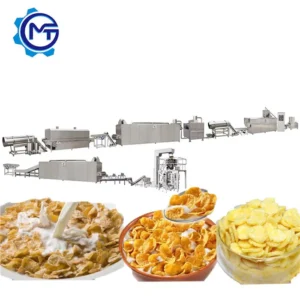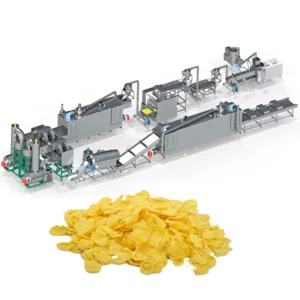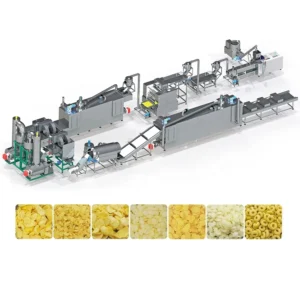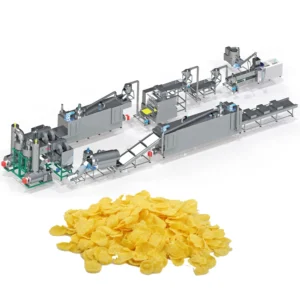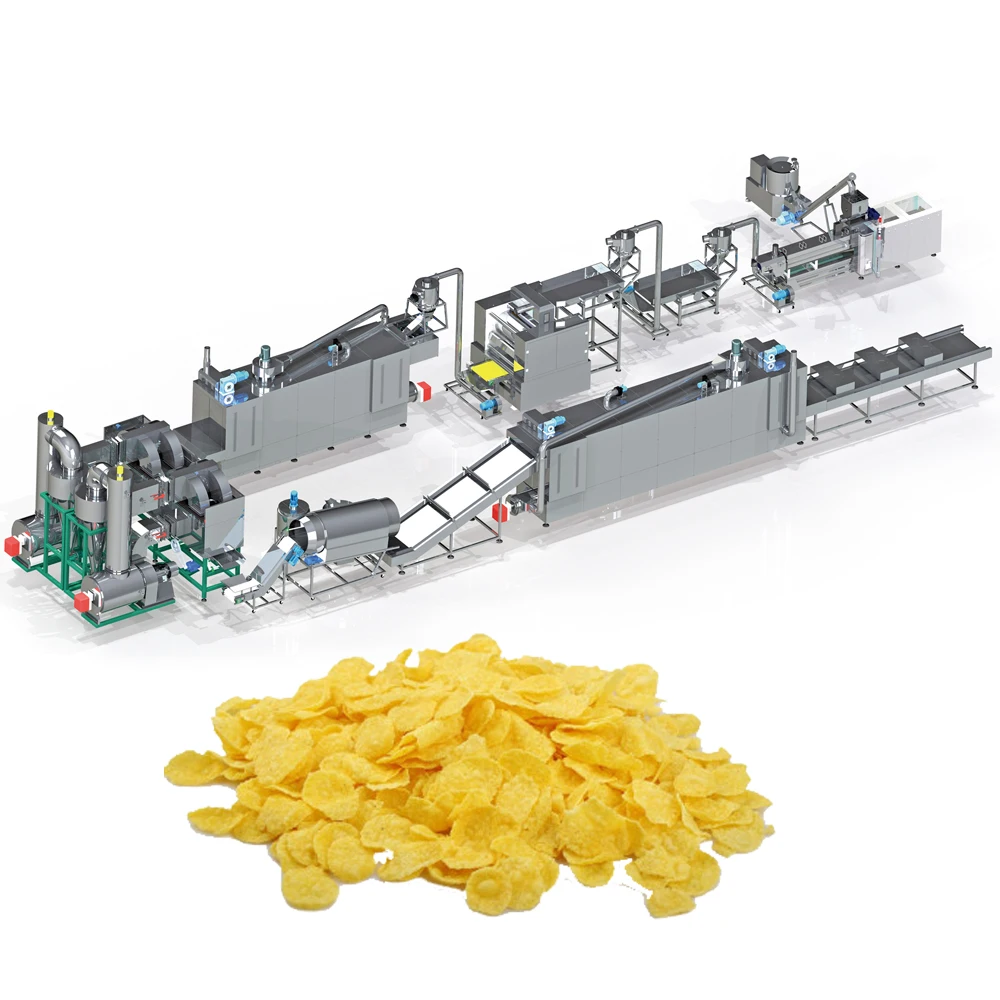
Screw Configuration Matched to Your Formula — Every corn flakes extruder in this series ships with screw elements and die geometry selected after a trial run on your actual grain blend, not a generic catalog build.
Technical Specifications
| Parameter | Value |
|---|---|
| Product Type | Corn Flakes Production Line |
| Available Models | MT-65 / MT-70 / MT-75 / MT-85 |
| Screw Type | Twin screw, co-rotating sectional modules |
| Output Capacity (MT-65) | 120–150 kg/h (basis not stated in source — confirm raw material and moisture) |
| Output Capacity (MT-70) | 200–250 kg/h (basis not stated in source — confirm raw material and moisture) |
| Output Capacity (MT-75) | 300–400 kg/h (basis not stated in source — confirm raw material and moisture) |
| Output Capacity (MT-85) | 400–500 kg/h (basis not stated in source — confirm raw material and moisture) |
| Installed Power | 84 kW (MT-65) / 132 kW (MT-70) / 186 kW (MT-75) / 239 kW (MT-85) |
| Real Power Consumption | 59 kW (MT-65) / 92 kW (MT-70) / 140 kW (MT-75) / 167 kW (MT-85) |
| Control System | PLC and MCC (verify against current catalog) |
| Mixer Power / Tank | 4 kW / φ600×500 mm |
| Screw Conveyor Power | 0.75 kW |
| Corn Flakes Press Power | 16.12 kW |
| Press Roller Size | 510×310×1050 mm |
| High-Temperature Oven | 4.5×1.4×1.8 m, 3.75 kW |
| Sugar Spraying System | 28.75 kW, Ø600×2700 mm roller |
| Overall Line Length | 12 m (MT-65) to 28 m (MT-85) |
| Extruder Features | Self-cleaning, forced gear box lubrication, non-stop cutting |
| Line Sequence | Mixer → Screw Conveyor → Twin Screw Extruder → Flaking Press → High-Temp Oven → Sugar Spraying |
| Standards | CE |
| Warranty | 1 year complete, lifetime maintenance |
Application Suitability
| Application | Material or Output |
|---|---|
| Corn flakes for breakfast cereal packaging | Corn grits, corn flour at controlled moisture |
| Oat-based snack flakes | Oat groans, rolled oat blends |
| Multi-grain breakfast cereals | Rice flour, wheat flour, soya bean blends |
| Sweetened cereal variants | Corn base with sugar coating in the spraying drum |
| Puffed cereal snack formats | Corn or rice flour with die-change on the twin-screw extruder |
| Core-filled snack pieces | Chocolate or sugar filling through co-extrusion die |
Why Matching Every Station Matters More Than Extruder Capacity Alone
A corn flakes production line equipment for sale only delivers its rated output when the press, oven, and coating drum are sized to keep pace with the extruder barrel.
I once stood in a cereal plant where the extruder was pushing product faster than the flaking press could flatten it. Half-cooked pellets piled up on the conveyor, the oven ran overloaded, and the sugar coating came out uneven because the drum was turning slower than the feed rate demanded. The buyer had selected the extruder by its nameplate capacity and treated the downstream stations as accessories. The entire corn flakes production line equipment for sale sat idle for three days while we swapped in a larger press roller and re-calibrated the oven belt speed [NEED_CITE: throughput matching across sequential food processing stations].
How the Twin-Screw Barrel Handles Variable Grain Blends
The co-rotating sectional screw modules inside each extruder can be rearranged along the barrel to create distinct zones for forward transport, mixing, de-gassing, cooking, and forming. When a buyer switches from pure corn grits to an oat-and-wheat blend, the starch gelatinisation temperature and moisture absorption rate shift. Reconfiguring the screw elements and adjusting barrel segment temperatures keeps the dough at the correct viscosity before it reaches the die plate, which is essential for consistent flake thickness downstream.
The Flaking Press and Oven as a Single Thermal Stage
The corn flakes press machine uses an adjustable roller gap to set flake thickness, and its integrated cooling system prevents the hot extrudate from sticking to the roller surface. Immediately after pressing, the flakes enter the high-temperature gas oven where dual-side baking removes residual moisture and develops the crispness consumers expect. If the oven belt speed does not match the press throughput, flakes either under-dry and clump together in the sugar drum, or over-dry and fracture into undersized pieces that fail packaging weight checks [NEED_CITE: moisture and temperature control in breakfast cereal drying].
Reading the Power and Dimension Data Correctly
The installed power figures (84 kW to 239 kW across the four models) represent the total connected load of every motor and heater on the line. The real power consumption values (59 kW to 167 kW) reflect what the corn flakes production line equipment for sale actually draws during steady-state operation with typical grain formulations. The difference matters for sizing your plant’s transformer and dedicated circuit. Overall line length stretches from 12 metres for the MT-65 to 28 metres for the MT-85, so workshop floor plans must account for material flow in a straight or L-shaped layout with clearance on both sides for maintenance access.
What Happens When Downstream Capacity Is Undersized
An extruder that runs ahead of its flaking press forces operators to reduce screw speed, which lowers cooking temperature and leaves raw starch in the pellet. Those under-processed pellets flatten unevenly, producing flakes with soft centres that turn soggy in milk. The sugar spraying system then coats a product that already fails the crunch test, and the buyer ends up scrapping entire batches while blaming the raw material supplier. This kind of mismatch is the single most common reason a newly installed cereal line cannot reach its expected throughput [NEED_CITE: bottleneck effects in sequential food extrusion lines].
Why Buyers Source the Full Sequence From One Equipment Range
Every station in this series — from the 4 kW mixer through the twin-screw extruder, the flaking press, the high-temperature oven, and the 28.75 kW sugar spraying system — is listed in a single catalog so that throughput, power draw, and physical footprint are cross-checked before the layout drawing is issued. The screw configuration and die design are specified against the buyer’s raw material formula rather than copied from a standard template. An in-house testing workshop runs the buyer’s actual grain blend through the extruder before shipment, generating a trial run report that documents moisture levels, barrel temperatures, and screw speed settings. This approach prevents the situation where a line arrives on site and the product development work has to start from zero after installation.
Documentation & Verification
- Machine specification sheet for each station confirming power, dimension, and capacity
- Line layout drawing showing throughput matching between extruder, press, oven, and coating drum
- Screw and die configuration record matched to your grain formula
- Factory test record and trial run report on your raw material before dispatch
- CE declaration of conformity covering the complete line
- Electrical schematic with voltage and frequency confirmed for your market
Installation, Commissioning & Support
- Floor plan must accommodate up to 28 m line length with side clearance for the MT-85 model
- Dedicated circuit sized for real power draw of up to 167 kW at confirmed local voltage and frequency
- Equipment ships in sectional modules; on-site assembly aligns conveyor heights between stations
- First-run commissioning includes barrel temperature profiling and press roller gap calibration
- Operator training covers screw element rearrangement for formula changes on the twin-screw extruder
- Wear parts list specifies replacement intervals for screw modules, die plates, and press roller bearings
What to Include in Your Inquiry
Provide the grain types and blend ratios you plan to run, along with target moisture content after the oven stage. Confirm your workshop length, ceiling height, and the local voltage and frequency standard so that motors and heaters are wound correctly before production begins. If you intend to run both flaked and puffed formats on the same extruder, note the die shapes required so that the screw configuration covers both product types without a full rebuild between changeovers.
Frequently Asked Questions
Q: How is output capacity verified for each model?
A: Each capacity figure in the specification table is listed with a note that the raw material type and moisture content must be confirmed. Before shipment, a trial run using your actual grain blend is conducted in the testing workshop, and the measured throughput is documented in a report that accompanies the machine.
Q: What voltage and frequency options are available?
A: Motors, heaters, and the PLC panel are configured after the buyer confirms the local electrical standard. This confirmation happens during the specification stage before production starts, preventing delays at commissioning caused by mismatched voltage or an incorrect control panel language.
Q: How do I choose between the MT-65, MT-70, MT-75, and MT-85?
A: Selection depends on your target hourly output and the raw material formula you intend to run. Because actual throughput varies with grain type and moisture, the decision is finalized after the trial run report confirms which model holds your required rate on your specific blend.
Q: Can I purchase individual stations instead of the full line?
A: Individual stations such as the flaking press or sugar spraying system are available separately. However, throughput matching across stations is only verified when the complete sequence is specified together, which reduces the risk of downstream bottlenecks.
Q: What spare wear parts ship with the line?
A: Each shipment includes a wear parts list identifying screw modules, die plates, and press roller components. The specific spare set included is confirmed during the quotation stage based on the screw configuration and die design selected for your product.