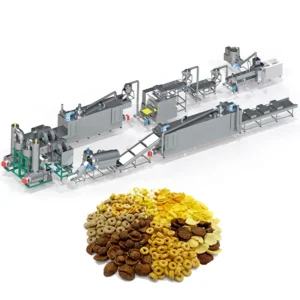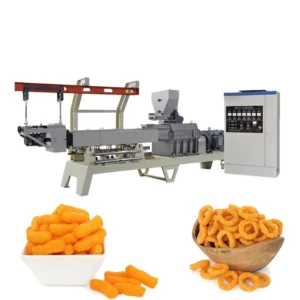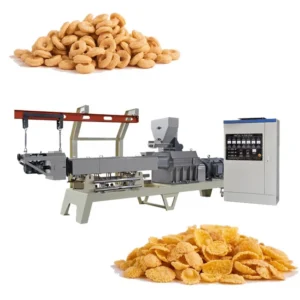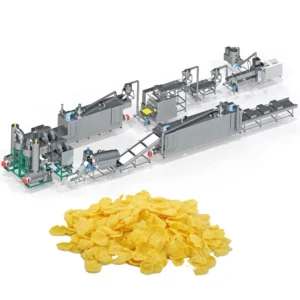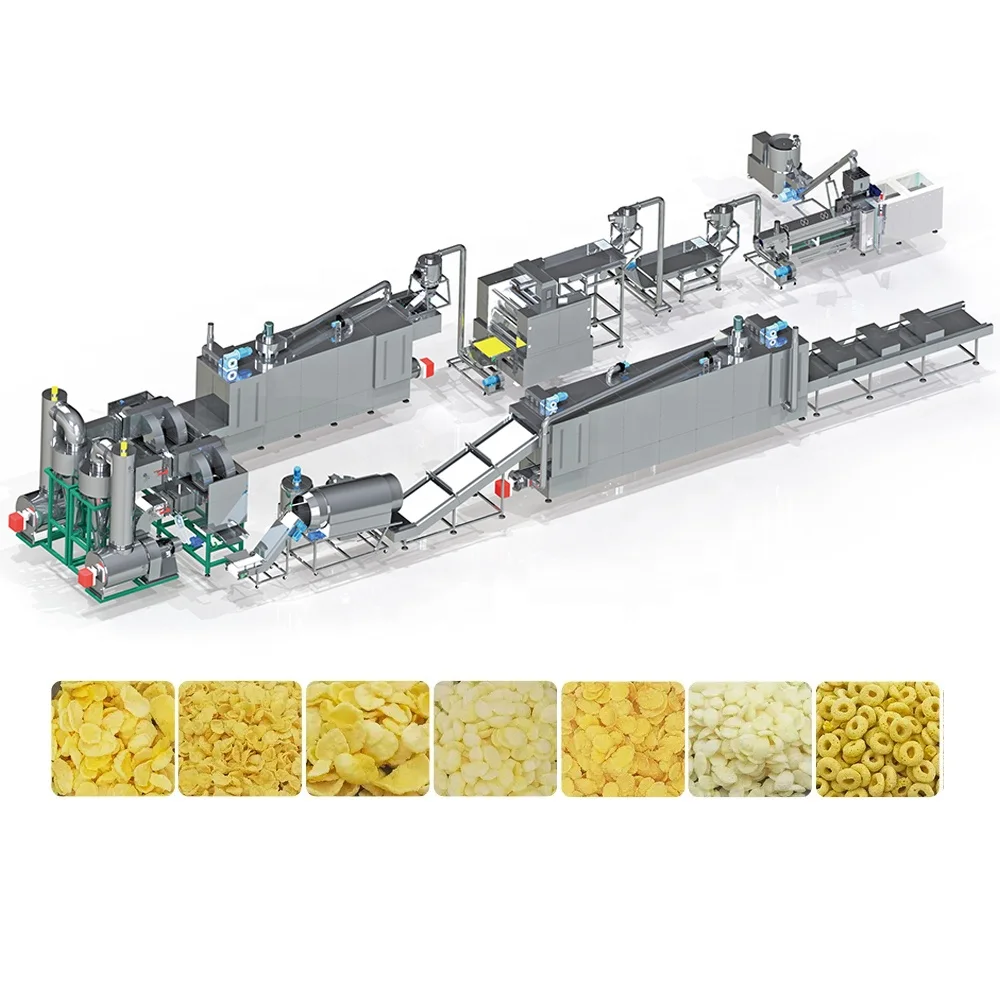
Integrated Line Throughput — Every station from batching through packing is sized to your raw material recipe so no single unit bottlenecks the corn flakes breakfast cereal production line full equipment range.
Technical Specifications
| Parameter | Value |
|---|---|
| Product Type | Corn Flakes Breakfast Cereal Production Line |
| Screw Type | Twin Screw |
| Installed Power | MT70 — 160 kW; MT85 — 190 kW; MT75 — 210 kW |
| Power Consumption | MT70 — 120 kW; MT85 — 140 kW; MT75 — 150 kW |
| Output Capacity | MT70 — 150–200 kg/hr (basis to be confirmed); MT85 — 300–400 kg/hr (basis to be confirmed); MT75 — 300–500 kg/hr (basis to be confirmed) |
| Overall Dimensions | MT70 — 41 × 1.5 × 2.2 m; MT85 — 43 × 1.5 × 3.2 m; MT75 — 45 × 1.5 × 3.5 m |
| Control System | PLC control with MCC available |
| Flaking Station | Hydraulic double-roller system, dual-motor separate drive, infrared sensor temperature control |
| Dryer Heating Source | Gas / Electric |
| Roasting Oven | Hot air roasting with conciliation burner, dual circulating fans, cyclone dust removal |
| Coating System | Double tumble sugar melting, elevator, coating drum, spraying nozzle |
| Line Stations (Natural) | Mixing → Extruding → Flaking → Drying → Hot Air Roasting → Cooling → Packing |
| Line Stations (Sugar Coated) | Mixing → Extruding → Flaking → Drying → Hot Air Roasting → Sugar Spraying → Sugar Coating → Drying → Cooling → Packing |
| Basic Raw Materials | Corn, rice, wheat, oat, barley powder |
| Certifications | CE, ISO |
Application Suitability
| Application | Material or Output |
|---|---|
| Natural corn flakes | Corn, rice, wheat, oat, or barley powder base processed through extrusion, flaking, and roasting |
| Sugar-coated corn flakes | Same grain base with integrated sugar melting and tumble coating stages |
| Shaped breakfast cereals | Ball, tube, stick, ring, fruit loop, star, wheel, flower, heart via extruder die adjustment |
Why Nominal Capacity Figures Mislead Breakfast Cereal Buyers
A corn flakes line rated on generic maize will not hold that output when the local corn flour has different starch content or moisture levels.
When I first ran a trial on standard maize, the flakes came off the roaster looking right. Then we switched to the customer’s local corn flour, which had considerably less starch. The flakes turned soft and dense, and the entire line had to be reworked — screw profile, barrel temperatures, and dryer settings all rebuilt from scratch on site. A corn flakes breakfast cereal production line full equipment range quoted without testing your actual raw material is a line that will underperform the day you start commissioning [NEED_CITE: twin-screw extrusion behaviour on varying starch content in cereal grains].
Extruder Screw and Barrel Configuration for Cereal Grains
The twin-screw extruder is where the grain recipe is transformed into the cooked dough that determines flake texture. Screw configuration and barrel temperature profile are specified to the buyer’s raw material blend — whether that is pure corn grits, a wheat-corn mix, or oat-heavy recipes. The automatic lubricating and cooling function built into the screw assembly maintains stable operation across extended production runs. Each die design is matched to the target product shape, and changing between natural flakes and shaped cereals requires only a die swap at the extruder outlet.
Flaking, Roasting and the Stations That Define Final Texture
The hydraulic double-roller flaking station uses separate motors for each roller and infrared sensor temperature control to hold consistent flake thickness across the full production run. Downstream, the hot air roasting oven relies on a conciliation burner, two separate circulating fans, and a cyclone dust removal device to manage temperature uniformity and keep the roasting environment sanitary. These two stations together determine whether the finished flake has the snap and density the market expects or falls short [NEED_CITE: flake thickness and roasting temperature relationship in breakfast cereal quality control].
Reading the Power and Dimension Data Across Models
The installed power figures — from 160 kW on the MT70 to 210 kW on the MT75 — reflect the combined demand of the extruder drive, heating zones, flaking hydraulics, and roaster fans rather than the extruder alone. Actual power consumption runs lower, between 120 kW and 150 kW, because heating elements cycle and the extruder drive rarely operates at full rated torque during steady-state cereal processing. The overall line dimensions span 41 to 45 metres in length, which means utility routing — steam lines, gas supply for the dryer or roaster, electrical distribution — must be planned before the equipment arrives. The PLC control system manages the flaking station and can be extended to coordinate mixing ratios and dryer temperatures for batch-to-batch consistency.
What Happens When Line Stations Are Sized Separately
Buyers who source extruders, dryers, and roasters from different vendors frequently discover during commissioning that one station cannot keep pace with the others. A flaking unit that cannot process the extruder output forces the extruder to idle or the dough to over-ferment in the buffer. A roaster undersized relative to the dryer creates a backlog of half-dried flakes that cool unevenly and develop inconsistent colour. These mismatches are invisible on a quotation sheet and only surface when the line is running under real production conditions [NEED_CITE: throughput matching across stations in cereal processing lines].
Why Sourcing This Corn Flakes Line From One Supplier Matters
Throughput at every station is calculated together, so the mixing batch size, extruder output, flaking roller speed, dryer belt area, and roaster capacity are matched to one target rather than assembled from independent vendor claims. The screw configuration and die design are specified to your raw material and target flake density before production begins, not copied from a generic build. Every line goes through a trial run in the in-house testing workshop using your actual raw material before it ships — the same process that caught the starch-content mismatch I described earlier. Documentation arrives as a matched set: line layout, machine specifications, screw records, electrical schematics, trial run report, and operation manuals covering every station from mixer to packer. Installation is handled by engineers who have worked across breakfast cereal lines and understand the sequence from utility hookup through operator training.
Documentation & Verification
- Line layout and capacity calculation matched to your factory dimensions and target cereal output
- Screw and die configuration record tied to your grain blend and target flake density
- Trial run report on your actual corn, rice, or wheat material conducted before shipment
- Electrical schematic with voltage, frequency, and control language confirmed before production
- Operation and maintenance manual covering every station from mixing through packing
Installation, Commissioning & Support
- Utility planning for 120–150 kW operating load across extruder, flaker, dryer, and roaster stations
- Line footprint of 41–45 metres requires confirmed floor plan and ceiling clearance before delivery
- PLC and MCC control panels configured to local voltage and frequency before factory test
- First-run parameter setting for screw speed, barrel temperatures, and flaking pressure on your material
- Spare wear parts list for screws, dies, and flaking rollers included with initial shipment
What to Share When Requesting a Line Proposal
Tell us your base raw material and any recipe variations you plan to run, because corn, wheat, oat, and barley each behave differently through the twin-screw extruder and require distinct screw profiles. Provide your factory floor dimensions and ceiling height so the 41–45 metre line layout can be fitted before equipment is built. Confirm your local voltage, frequency, and preferred control language to avoid rework on electrical panels after delivery.
Frequently Asked Questions
Q: What supporting equipment is included and how is throughput matched across every station?
A: The corn flakes breakfast cereal production line full equipment range covers mixing, twin-screw extrusion, flaking, drying, hot air roasting, cooling, and packing as one integrated system. Throughput at each station is calculated against the others so no single unit bottlenecks output. Sugar coating stages are added as a parallel branch when required by the product specification.
Q: What raw material options are available and how does each affect configuration?
A: Corn, rice, wheat, oat, and barley powder can each serve as the base material. Each grain has different starch content and gelatinisation behaviour, which changes the screw profile, barrel temperature settings, and dryer retention time. A trial run on your specific material confirms the correct configuration before the line ships.
Q: How is the line layout customized to my factory size and utility layout?
A: The overall line spans 41 to 45 metres depending on model and whether sugar coating stages are included. A layout drawing is prepared against your factory dimensions and utility connection points before production begins, covering steam, gas, electrical, and compressed air routing for every station.
Q: What product shapes are available and how is the mould changed on the extruder?
A: Beyond natural flakes, the extruder can produce ball, tube, stick, ring, fruit loop, star, wheel, flower, and heart shapes by swapping the die plate at the extruder outlet. Die changes are straightforward and typically take less time than a recipe changeover at the mixing station.
Q: What documentation is provided for each machine and for the line as a whole?
A: Documentation includes line layout and capacity calculation, machine specification sheets for every station, screw and die configuration records, electrical schematics, a trial run report on your raw material, CE and ISO certificates, factory test records, and operation and maintenance manuals.