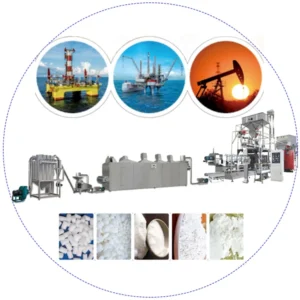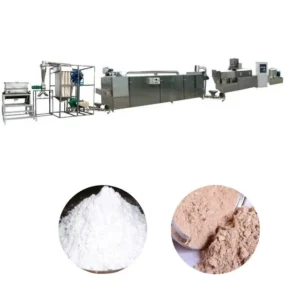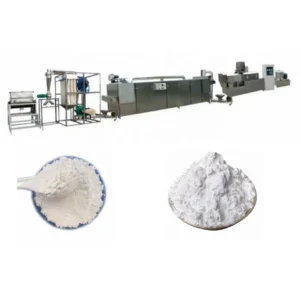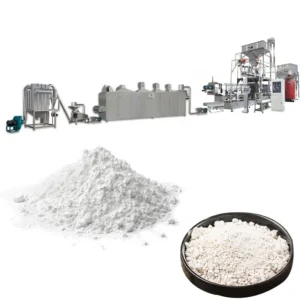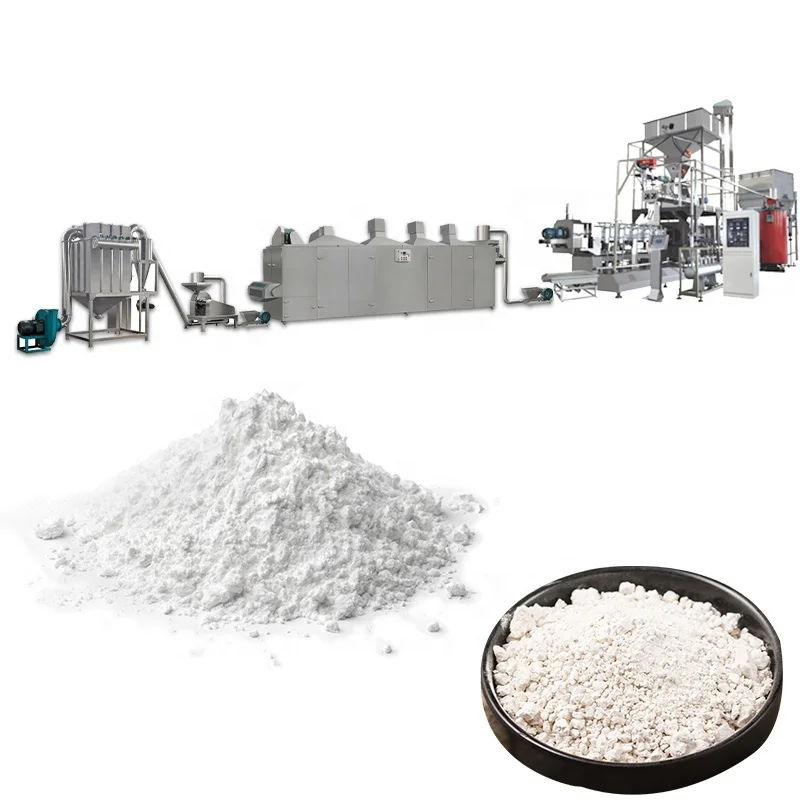
Throughput-matched line stations — every node from mixing through packing is sized against your actual starch type, not a generic catalog number.
Technical Specifications
| Parameter | Value |
|---|---|
| Product Type | Modified Starch Processing Line |
| Available Models | MT65 / MT70 / MT85 |
| Screw Type | Twin-screw |
| Output Capacity | 100–150 kg/h (MT65, basis not stated in source — confirm raw material / moisture) |
| Output Capacity | 200–250 kg/h (MT70, basis not stated in source — confirm raw material / moisture) |
| Output Capacity | 300–500 kg/h (MT85, basis not stated in source — confirm raw material / moisture) |
| Line Stations | Mixing → Extrusion → Drying → Grinding → Blending → Packing |
| Raw Materials | Corn starch, cassava starch, potato starch, tapioca starch, rice flour, soybean flour |
| Extruder Total Power | 22 kW |
| Mixer Power | 3 kW |
| Oven Power | 1.1 kW |
| Overall Dimensions | 24000×1200×2200 mm (MT65) / 26000×1500×2200 mm (MT70) / 29000×3500×4300 mm (MT85) |
| Control System | PLC and MCC |
| Certification | CE |
Application Suitability
| Application | Material or Output |
|---|---|
| Pre-gelatinized starch for food processing | Corn starch, tapioca starch, potato starch |
| Modified starch for oil drilling fluids | Maize starch, cassava starch |
| Functional starch for textile sizing | Corn starch, rice flour |
| Modified starch for paper making | Tapioca starch, potato starch |
| Fortified and nutritional starch ingredients | Soybean flour blended with rice or corn starch |
What "Nominal Capacity" Leaves Out on a Modified Starch Production Line for Sale
A line rated on paper does not automatically hold that rate on your specific starch chemistry.
I once watched a cassava starch processor in the Middle East run a full batch through an extruder that was matched to the line’s nameplate capacity, only to find the gelatinisation degree stuck well below target. The root cause was local cassava with lower amylose content than the generic screw profile assumed. The entire lot was scrapped before anyone touched the die configuration. That kind of loss is exactly why output claims on any Modified Starch Production Line for sale must be verified against the buyer’s actual raw material and moisture level before a single component ships [NEED_CITE: starch gelatinisation behaviour across amylose ratios].
Barrel Temperature Profiling Across Starch Varieties
Different starches gelatinise at different thresholds, and the barrel zones on a Modified Starch Production Line for sale must be mapped accordingly. Corn starch typically demands a steeper ramp in the mid-barrel region compared to tapioca, which softens earlier and requires tighter moisture control at the feed zone. The twin-screw configuration allows operators to adjust shear intensity zone by zone, keeping the melt temperature within the window that produces consistent pre-gelatinised output without scorching.
Screw Configuration Matched to End-Use Functionality
The functional property a buyer needs — whether cold-water swelling viscosity for food applications or controlled fluid-loss characteristics for oil drilling — depends heavily on how the screw elements are sequenced. Kneading blocks positioned too early can over-shear the polymer chains in potato starch, reducing peak viscosity. Elements spaced too far apart may leave cassava starch under-processed, producing a product that fails industrial specification [NEED_CITE: twin-screw element sequencing for starch modification]. Every configuration is documented and can be adjusted after the in-house trial run confirms behaviour on the buyer’s raw material.
Power Draw, Line Length, and What They Mean for Your Workshop
The extruder total power sits at 22 kW across configurations, while mixer draw is 3 kW and the oven runs at 1.1 kW for air circulation. These figures define the electrical infrastructure a plant must prepare before installation. The overall line stretches from roughly 24 metres on the smaller model to 29 metres on the largest, which means workshop ceiling height and floor space must be confirmed early. Buyers sourcing a Modified Starch Production Line for sale often overlook that the oven alone spans 23 metres — a dimension that dictates whether the drying section can fit in an existing building or requires an extension. The PLC and MCC control architecture centralises start-up and shutdown across all stations, so operators manage the entire sequence from a single panel rather than walking between isolated controls.
The Cost of Skipping the Trial Run
Lines shipped without a material-specific trial run frequently arrive at the buyer’s facility with the wrong die diameter or an incompatible screw pitch, forcing weeks of on-site adjustment. In some cases, the dryer capacity proves insufficient for the actual moisture profile the extruder generates, creating a bottleneck that drags real throughput well below expectations [NEED_CITE: extrusion line throughput bottleneck caused by undersized dryer]. Those delays translate into idle installation crews, postponed product launches, and strained relationships with downstream customers who were counting on scheduled deliveries.
Why Procurement Lands Here
Every station from the 3 kW mixer through the 23-metre oven to the packing end is selected and sized under one supplier, so throughput balance is calculated rather than guessed. The testing workshop runs the buyer’s starch before dispatch, generating a documented trial report that confirms screw combination, temperature curve, and achievable rate. Screw and die configuration is specified to the raw material and target functional property, not copied from a generic template. Pre-sales consultation covers line layout and utility planning, while on-site installation includes operator training so the local team can reproduce trial results independently. Long-term wear parts supply for screws and dies is established from day one, preventing the downtime that surfaces when the first replacement cycle arrives.
Documentation & Verification
- Line layout and capacity calculation matched to your starch type and target output
- Screw and die configuration record specifying element sequence for your raw material
- Trial run report generated on your cassava, corn, or potato starch before dispatch
- Electrical schematic and voltage confirmation document for your local grid standard
- Machine specification sheet covering every station from mixer to packing end
- CE declaration of conformity covering the complete integrated line
Installation, Commissioning & Support
- Floor space confirmation based on the 24–29 metre overall line length depending on model selected
- Dedicated power circuit sized for the combined extruder, mixer, and oven load
- Assembly sequence planned around the 23-metre oven footprint and ceiling clearance
- First-run parameter setting using the trial report baseline from the testing workshop
- Operator training on PLC and MCC interface covering start-up, shutdown, and fault response
- Wear parts inventory plan for screws and dies covering the first replacement cycle
Preparing Your Modified Starch Production Line for Sale Inquiry
A detailed enquiry accelerates configuration work considerably. Share the specific starch variety — whether cassava, corn, potato, or a blend — along with amylose content data if available. State the target functional property and the industry it serves, as oil drilling starch demands a very different screw profile than pre-gelatinised food starch. Confirm local voltage, frequency, and preferred control language so the MCC and PLC architecture can be finalised before production begins.
Frequently Asked Questions
Q: How is output capacity verified against my specific starch raw material?
A: Your raw material is run in the in-house testing workshop before shipment. The team adjusts screw combination, barrel temperature profile, and moisture input until the target gelatinisation degree and functional property are met. A trial report documents the confirmed rate and configuration, so the capacity you see on paper is the capacity the line delivers on your starch.
Q: What screw and die configuration is specified for my target modified starch product?
A: Screw element sequencing and die diameter are selected based on your starch variety and end-use application. Kneading block placement, pitch length, and die opening are all documented in the configuration record. Adjustments can be made after the trial run if the product behaviour requires a different shear or pressure profile.
Q: How are voltage, frequency, and control language confirmed for my market?
A: The electrical schematic and voltage confirmation document is prepared during the specification phase before production starts. PLC and MCC interfaces are configured to your preferred language. Frequency and plug standards are matched to your local grid so that commissioning begins without electrical rework on site.
Q: Can I arrange a trial run on my raw material before shipment?
A: Yes. The testing workshop is designed for exactly this purpose. You send a representative sample of your starch, and the line runs it through the extruder and dryer under production-equivalent conditions. The resulting trial report becomes the baseline for your installation and operator training programme.