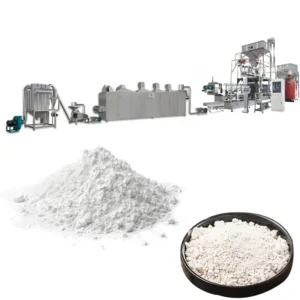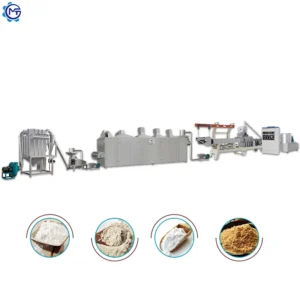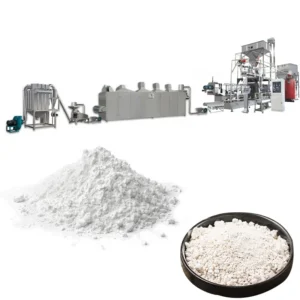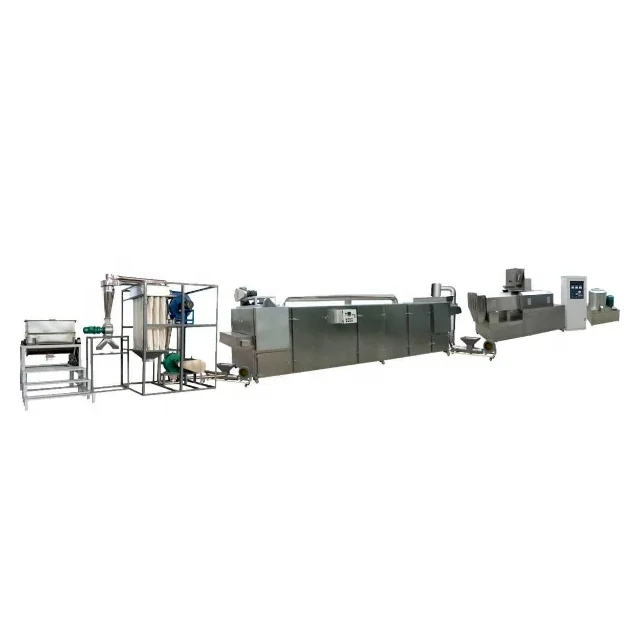
Matched Extrusion Throughput — Every station on this modified starch processing line equipment for sale is sized to the same output target, preventing downstream bottlenecks that commonly stall single-vendor builds.
Technical Specifications
| Parameter | Value |
|---|---|
| Product Type | Modified Starch Extrusion Processing Line |
| Extruder Type | Twin-screw |
| Main Motor Power | 45–200 kW |
| Line Capacity | 100–1500 kg/h (basis not stated in source — confirm raw material moisture, starch type and target gelatinisation degree) |
| Line Weight | 1000–5000 kg (source value — verify against final layout) |
| Voltage & Frequency | 220–440V tri-phase, configurable to local grid (e.g. 380V 50Hz, 415V 60Hz, 220V 60Hz) |
| Contact Material | Food-grade 304 stainless steel, including gearbox housing |
| Control System | PLC control panel |
| Key Line Stations | Twin-screw extruder, air-cooling conveyor, pulse grinder with cyclone and dust collector |
| Dryer / Oven Fuel Options | Gas, diesel, electricity, steam |
| Certification | CE, ISO |
Application Suitability
| Application | Material or Output |
|---|---|
| Food-grade thickening and stabilising agents | Corn starch, potato starch, wheat flour with additive blends |
| Pre-gelatinised starch for instant food and nutrition programmes | Rice flour, corn starch, fortified grain blends |
| Industrial modified starch for oil-drilling fluids | Corn starch, cassava starch with cross-linking additives |
| Paper-making and corrugating adhesive starch | Potato starch, wheat flour, tapioca starch |
| Textile sizing and warp yarn treatment | Corn starch, modified cassava derivatives |
Why the Raw Material Question Must Come Before the Quotation
A line configured on generic starch will underperform the moment your actual feedstock enters the barrel.
Buyers often submit an inquiry listing a target capacity without specifying whether the input is waxy corn, high-amylose corn, potato or cassava starch. Each of these raw materials carries a different gelatinisation temperature, moisture absorption rate and shear sensitivity. When the extruder screw profile and barrel heating zones are set for one starch chemistry but the plant runs another, the result is uneven modification, surface crusting on the pellet, or material that refuses to disperse properly at the grinder stage [NEED_CITE: starch gelatinisation temperature ranges by botanical source]. Sizing a modified starch processing line equipment for sale without locking down the raw material parameter sheet is the most frequent cause of commissioning delays I have seen on-site across Southeast Asian starch plants.
Barrel Zoning and Shear Control for Starch Modification
The twin-screw extruder at the heart of this line uses independently heated barrel zones, allowing the temperature profile to be staged from feed intake through the metering and reaction sections. Starch modification inside the barrel depends on a precise balance between thermal energy and mechanical shear. Configurable screw elements — kneading blocks, reverse-flight segments and conveying screws — let the process engineer dial in the residence time and shear intensity that a specific starch chemistry requires. This is where the difference between a lightly oxidised starch and a fully cross-linked derivative is actually determined. A well-mapped modified starch processing line equipment for sale will ship with a documented screw configuration matched to the buyer’s target degree of substitution.
Pulse Grinding and Cyclone Discharge for Particle Uniformity
After extrusion and cooling, the semi-finished starch pellet must be reduced to a consistent powder. The pulse grinder on this line works with a cyclone discharge and integrated dust collector, producing a narrow particle-size distribution without exposing the starch to excessive friction heat. Heat buildup during grinding can trigger secondary gelatinisation or degrade the modification already achieved in the extruder barrel [NEED_CITE: impact of grinding temperature on pregelatinised starch functionality]. The dust collector serves a dual purpose: it protects operator health in the milling area and recovers fine starch that would otherwise represent a measurable yield loss over a production campaign.
Reading the Spec Sheet Against Your Production Target
The motor power range of 45–200 kW across available extruder sizes directly correlates with the torque available for high-viscosity starch melts; a line running highly cross-linked starch at low moisture needs more torque than one producing lightly treated pregelatinised powder. Voltage and frequency must be confirmed against the buyer’s local grid before the control cabinet is wired — a 415V 60Hz motor running on a 380V 50Hz supply will underperform and overheat within the first shift. The PLC panel allows recipe storage, so once the screw speed, barrel temperatures and feed rate are dialled in during commissioning, subsequent batches can be called up without manual recalibration, reducing operator-induced variation.
The Cost of Skipping the Trial Run
I once watched a line commissioned on standard cassava starch run without incident during the factory acceptance test, only for the buyer to switch to waxy corn at their plant and face immediate pellet clumping in the cooling conveyor. The gelatinisation onset for waxy corn sits several degrees lower, and the barrel profile had not been adjusted. An entire batch was scrapped before the team identified the mismatch. That outcome is entirely avoidable when the buyer’s actual raw material is run through the extruder in the supplier’s testing workshop before the line ships [NEED_CITE: importance of raw material trial runs in extrusion equipment procurement]. Skipping this step transfers all process risk to the buyer’s production floor.
What Sets This Line Apart at the Equipment Level
Throughput matching is addressed at the engineering stage, not left to chance during installation. The extruder, cooling conveyor and pulse grinder are each selected so that the slowest station does not cap the line below its nameplate rate. Screw configuration and die design are specified to the buyer’s raw material and target modification degree, documented in the configuration record that ships with the machine. The air-cooling conveyor uses a wind-knife arrangement to strip surface moisture without thermal shock, preserving starch colour. Electrical schematics are reviewed with the buyer before the cabinet is built, confirming voltage, frequency and the language printed on the HMI. The in-house testing workshop allows a trial run on the buyer’s actual starch before dispatch, generating a test report that becomes the baseline for commissioning.
Documentation & Verification
- Line layout drawing with throughput calculation across extruder, cooler and grinder stations
- Screw element arrangement and die plate drawing matched to your starch type
- Electrical schematic confirming voltage, frequency and PLC language before cabinet wiring
- Factory trial run report on your supplied raw material with output and quality readings
- Operation manual covering start-up sequence, barrel temperature ramp and shutdown procedure
- Wear parts list with recommended first-replacement intervals for screw elements and die plates
Installation, Commissioning & Support
- Foundation plan provided early, accounting for extruder and grinder vibration isolation requirements
- Dedicated circuit sizing confirmed against the 45–200 kW motor draw and auxiliary heater loads
- Line arrives in modular sections for positioning through standard plant doorways and reassembly on-site
- First-run parameter mapping covers screw speed, barrel zones and feed rate on your starch chemistry
- Operator training covers PLC recipe management, emergency stop logic and routine screw inspection
- Initial wear parts package sized to cover the first scheduled screw element and die replacement cycle
What We Need to Move Your Inquiry Forward
Share the exact starch source you intend to run — corn, potato, cassava, waxy maize or a blend — along with the target modification type and any end-use specification your customer has set out. Let us know the daily output you need to sustain and the electrical supply standard at your facility, including voltage, phase and frequency. If you have existing upstream mixing or downstream packing equipment, send the interface dimensions so the line layout can be matched from the start.
Frequently Asked Questions
Q: How is output capacity verified on my specific starch raw material and moisture content?
A: Capacity depends on starch type, incoming moisture and the target modification degree. We run your actual raw material through the extruder in our testing workshop before shipment, documenting throughput, pellet appearance and grinder yield in a trial run report. That report becomes the contractual output baseline rather than a generic nameplate figure.
Q: How are screw configuration and die design selected for my target modification degree?
A: The screw element arrangement — kneading blocks, reverse flights, conveying segments — is built around the shear and residence time your starch chemistry requires. Die geometry controls pellet shape and density entering the cooler. Both are recorded in a configuration document that ships with the line and can be referenced when you introduce a new starch blend.
Q: What voltage, frequency and control language options are confirmed before production?
A: We review the electrical schematic with you before the control cabinet is wired, locking in tri-phase voltage, frequency and the language displayed on the PLC screen. This prevents rewiring delays and operator confusion at commissioning. Common configurations include 380V 50Hz, 415V 60Hz and 220V 60Hz.
Q: Can I run a trial on my raw material in your testing workshop before shipment?
A: Yes. Buyers are encouraged to send a representative batch of their actual starch to our in-house testing workshop. We run the extruder on that material, record process parameters and product quality, and share the trial report before the line is crated for dispatch.
Q: How are wear parts such as screws and dies stocked and when is first replacement due?
A: Screw elements and die plates wear at rates that depend on starch abrasiveness and run hours. A wear parts list ships with every line, noting recommended inspection intervals. We hold standard elements in stock and can supply replacements against your production schedule so that the first changeover does not force unplanned downtime.